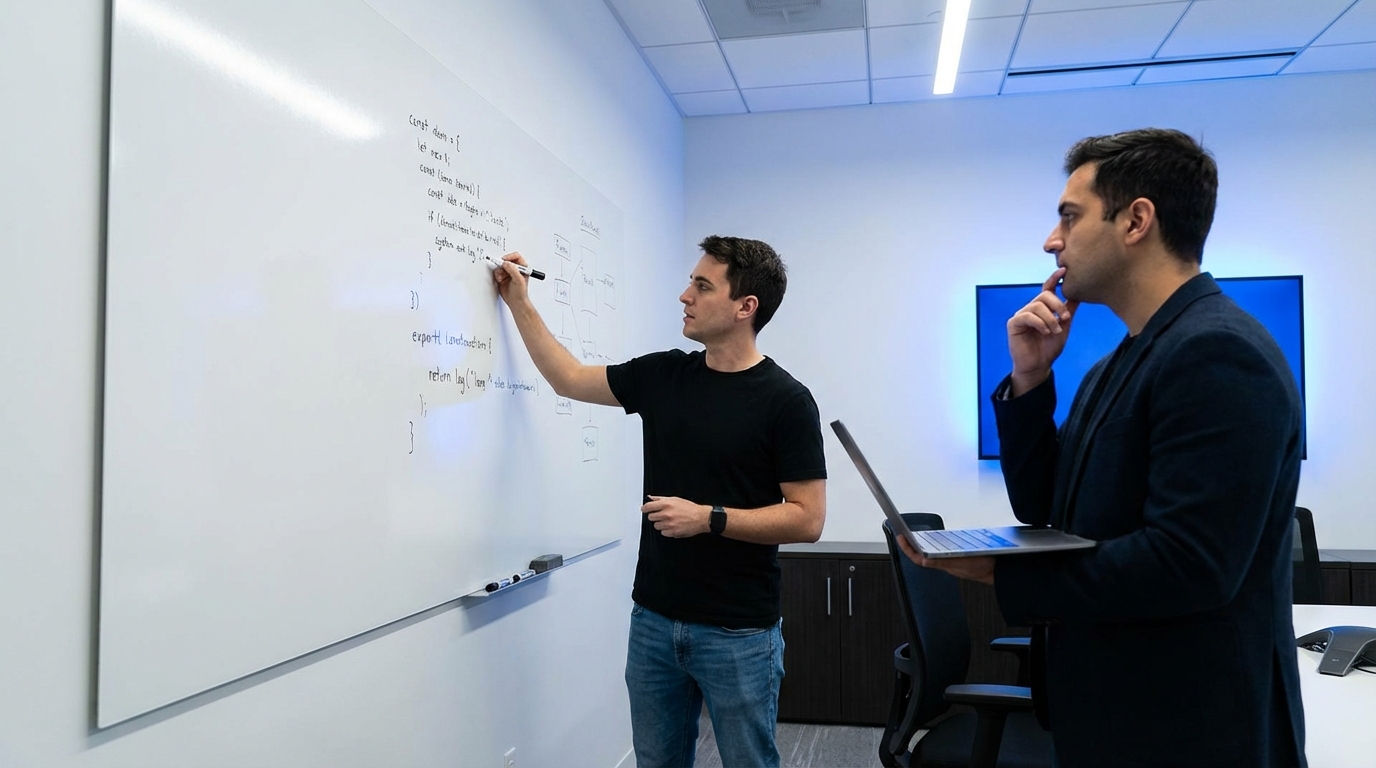
I realized during a late lab session that the whiteboard in front of me felt way more intimidating than my actual code. No syntax highlighting. No autocomplete. Just me, a marker, and my brain on display.
Here is the blunt truth: you ace whiteboard interviews by training *thinking out loud*, not by memorizing 200 LeetCode problems. You need a repeatable process: clarify, plan, write, test, and reflect. If you can do that calmly on a whiteboard, you will impress interviewers even with a partial answer.
What whiteboard interviews are really testing
At some point I realized that the whiteboard round is not a “do you know this trick” test. It is much closer to: “Would I want to debug production code with this person at 3 a.m.?”
You are not being judged only on whether your code is correct. You are being judged on how you think, communicate, and react under pressure.
Here are the real dimensions interviewers usually care about:
- Problem understanding: Do you jump into coding too early, or do you ask sharp questions first?
- Decomposition: Can you break a messy prompt into clean subproblems?
- Technical fundamentals: Do you know basic data structures and their tradeoffs without a cheat sheet?
- Communication: Can you narrate your thought process so that someone else can follow it?
- Iteration: Do you improve your first idea when you see better options?
- Edge cases and testing: Do you think about weird inputs, errors, and constraints?
- Composure: Do you keep going when you get stuck, or do you freeze?
Whiteboard interviews are slightly unfair in that they remove all your usual crutches: laptop, compiler, stack overflow, etc. That is annoying, but also the point. The interviewer wants to see your raw reasoning.
Here is a useful way to think about it:
| What you might think is tested | What is actually tested |
|---|---|
| Memorized algorithms | Can you adapt “known tools” to a new variation? |
| Perfect code | Can you produce code that another engineer can read and fix? |
| Speed only | Speed after you have a clear solution |
| Raw intelligence | Working method, patience, and clarity |
You are not auditioning to be a human compiler. You are auditioning to be a clear-thinking teammate.
The 5-step whiteboard game plan
Over time, I started treating every whiteboard problem as a fixed ritual. Same flow, different problem. It reduced panic a lot.
Step 1: Clarify the problem like a lawyer
If you start writing code in the first 60 seconds, you are probably moving too fast.
Treat the prompt like a contract. Until it is fully clear, you are not allowed to “ship” anything.
Here is a checklist you can literally memorize:
- Restate the problem in your own words.
- Clarify inputs: types, valid ranges, size limits, order guarantees.
- Clarify outputs: type, format, constraints (unique, sorted, etc.).
- Ask about constraints: time, memory, frequency of calls.
- Ask about edge cases: empty input, duplicates, negative values, huge values.
- Ask about mutability: Can you modify the input? Is it read-only?
Concrete example:
Interviewer: “Write a function that returns the first non-repeating character in a string.”
You:
– “Just to restate: I get a string, and I must return the first character that appears exactly once in that string, correct?”
– “Are we dealing with ASCII only, or can there be Unicode?”
– “If there is no such character, what should I return? Null, a special value, throw?”
– “What is the typical length of the string? Millions of characters, or more like thousands?”
Why this helps:
– It buys you time to think.
– It shows structured thinking.
– It often reveals hidden constraints that strongly influence your solution.
An extra 90 seconds of questions can save you from 15 minutes coding the wrong thing.
Step 2: Think out loud and propose approaches
After the prompt is clear, your job is not to suddenly go silent and “solve it in your head.” Your job is to narrate.
You can literally say:
– “I will start with a brute-force idea to anchor my thinking.”
– “Let me think through a couple of approaches and then pick one.”
Then you walk through ideas at a high level.
For example, with the “first non-repeating character” question:
- “Brute force: for each character, scan the rest of the string to see if it appears again. That is O(n²). That probably fails for large n.”
- “Better idea: make a frequency map of characters in one pass, then a second pass to find the first char with count 1. That is O(n) time, O(k) space where k is the alphabet size.”
- “If space was a huge concern and characters were only lowercase letters, we could even use a fixed-size array of 26 integers instead of a map.”
At this stage, the interviewer might nudge you:
– “What if memory is tight?”
– “What about streaming input?”
Your job is to handle those nudges calmly. Change course if needed.
Your first idea does not need to be optimal. It only needs to be explicit.
Step 3: Pick a plan and sketch before coding
Once you have a candidate approach, pause before you start writing line-by-line code.
On the whiteboard, outline:
– Inputs and outputs (names, types).
– Main data structures.
– High-level algorithm in 3 to 7 steps.
For example, for the frequency map solution:
“Plan:
1) Build a map from char to count in one pass.
2) Loop through the string again.
3) Return the first char whose count is 1.
4) If none, return null.”
Why bother with this short plan?
– It gives the interviewer a clear mental picture.
– It makes your coding smoother.
– It makes it easier to correct course before you commit to details.
If the interviewer looks unhappy, this is the best time for them to say:
– “This might break if the string is extremely large.”
– “Assume streaming input, one char at a time.”
Then you adjust before you waste effort.
Step 4: Write clean, readable whiteboard code
People underestimate how different whiteboard code feels from editor code. No red underlines. No instant feedback. Your brain will forget semicolons. That is fine.
What interviewers care about:
- Structure: Clear function signature, logical blocks, consistent indentation.
- Naming: Variables that explain their meaning, not one-letter chaos.
- Control flow: Loops and conditionals that are easy to follow.
- Comments where needed, but not everywhere.
Try this format:
– At the top: function signature and short description.
– Then: variable declarations and structure.
– Then: body of the algorithm, narrating key steps.
For example (language-agnostic pseudocode, which is often acceptable):
function firstNonRepeatingChar(s):
    if s is null or length of s is 0:
        return null

    // step 1: count occurrences
    counts = new map from char to int

    for each char c in s:
        if c not in counts:
            counts[c] = 0
        counts[c] = counts[c] + 1

    // step 2: find first char with count 1
    for each char c in s:
        if counts[c] == 1:
            return c

    return null
While you write, narrate:
– “I will start with an early exit for null or empty input.”
– “I will use a map to count frequencies.”
– “Second pass to return the first character whose count is exactly one.”
Do not panic about tiny syntax mistakes. Just correct them out loud:
– “Actually, I missed an initialization here, let me fix that.”
– “This should be ‘==’, not ‘=’; I will correct that.”
Interviewers care far more about correctness and clarity than about exact punctuation.
Step 5: Test with examples and tighten the solution
Many candidates write code, put the marker down, and quietly wait.
That looks unconfident.
Instead, finish your last line and say:
– “Let me test this with a small example.”
Then write a small example next to the code and trace through it step by step.
Example:
Input: “swiss”
You narrate:
– “First loop: counts = { s:3, w:1, i:1 }.”
– “Second loop: ‘s’ has count 3, skip; ‘w’ count 1, so we return ‘w’. That matches expectation.”
Then test edge cases:
- Empty string: does code return null?
- String with all repeating chars: “aabbcc”. Returns null?
- Single char: “z”. Returns “z”?
You can ask:
– “Do you want me to handle Unicode, or is ASCII enough for this example?”
– “Should I treat uppercase and lowercase as the same or different?”
Testing your own code in front of the interviewer signals maturity and self-awareness.
If you find a bug, that is not fatal. Say:
– “I noticed a bug here in the edge case. Here is the fix.”
Then patch it.
Core technical knowledge to bring to the whiteboard
You cannot rely on memorizing every trick, but you do need a solid base. The good news: the list is finite and not that long.
Key data structures and what you should know
Think of this as your mental toolbox. You should know what each tool is good for and what tradeoffs it has.
| Structure | What you should know | Typical use in interviews |
|---|---|---|
| Array | Index access O(1), insertion in middle O(n), contiguous memory | Two-pointer problems, subarrays, sliding windows |
| Linked list | Sequential access, easy insertion/deletion, no random access | List reversal, cycle detection, merge sorted lists |
| Hash map / dictionary | Average O(1) lookup/insert, potential collisions, uses hashing | Frequency counting, memoization, lookups |
| Set | Similar to map but only keys, no duplicates | Membership tests, “have we seen this before” |
| Stack | LIFO, push/pop O(1) | Balanced parentheses, DFS, undo operations |
| Queue | FIFO, enqueue/dequeue O(1) | BFS, level-order traversals |
| Priority queue / heap | Get min/max in O(1), insert/remove O(log n) | Top K elements, scheduling problems |
| Binary tree / BST | Traversal, recursion, BST ordering property | Range queries, in-order traversal, search |
| Graph | Adjacency list vs matrix, directed vs undirected | Path finding, connectivity, cycles |
| Trie | Prefix tree, stores strings character by character | Autocomplete, prefix matching |
Whiteboard rounds usually care more about your choice of data structure than about fancy syntax.
Algorithms and patterns worth mastering
You do not need PhD level math, but certain patterns appear again and again.
- Two pointers:
- Typical for sorted arrays, linked lists, or substring problems.
- Common tasks: remove duplicates, find pairs that sum to a target, reverse subsections.
- Sliding window:
- Perfect for “longest/shortest substring or subarray with property X”.
- Maintain a window that expands and shrinks while tracking counts or sums.
- Binary search:
- On arrays, or on answer space (searching for minimal feasible value).
- Careful with mid calculation and loop condition.
- Recursion / DFS / BFS:
- Tree traversals, graph search, backtracking (permutations, combinations).
- Need to track visited sets for graphs.
- Sorting:
- Often used as a pre-step to simplify logic.
- Know basic complexity: O(n log n) for comparison-based sorts.
- Dynamic programming (DP):
- Problems that can be broken into overlapping subproblems.
- Recognize knapsack, Fibonacci variants, longest increasing subsequence, edit distance.
You do not have to solve every problem with some clever trick. Many problems that feel complex collapse to a known pattern plus clean coding.
Practicing for whiteboard success (without burning out)
I used to brute-force 50 LeetCode questions in a weekend and remember almost nothing by Monday. Practice only works if it is structured and reflective.
Simulate the whiteboard at home
If you are practicing on a laptop only, you are missing half of the challenge.
Try this routine:
- Pick 1 problem, not 10.
- Stand up at a real whiteboard, mirror, or large sheet of paper taped to a wall.
- Set a 30-minute timer.
- Talk out loud as if an interviewer is there.
- Follow the 5-step plan: clarify, plan, code, test, refine.
- After the timer, open an editor and type your solution from the whiteboard.
- Run it with tests, note what you got wrong, and write down one lesson.
You need “mouth memory” and “marker memory”, not only “keyboard memory”.
Some people feel silly talking to a wall. Do it anyway. You are literally training the skill you will need in the real interview.
Focus on patterns, not problem counts
Instead of proudly tracking “200 questions solved,” track patterns learned.
When you solve a problem, ask yourself:
– What data structure did I choose and why?
– Which pattern is this: two pointers, DP, recursion, greedy, or something else?
– How would I explain this solution in 3 sentences to a friend?
You can keep a small “pattern log” like this:
| Problem | Pattern | Key idea |
|---|---|---|
| Two sum (array) | Hash map + single pass | Store complement in map and check on the fly |
| Longest substring without repeats | Sliding window + set | Move right pointer, shrink from left when duplicate seen |
| Merge k sorted lists | Heap | Min-heap of head nodes, pop smallest, push next from same list |
Once you know the major patterns, new questions feel less like random puzzles and more like variations.
Do mock interviews with real constraints
Practicing alone is good. Practicing with another human is better.
Try this:
- Pair with a friend who is also preparing.
- Alternate: one interviewer, one candidate.
- Use a whiteboard or a shared online board.
- Set 45 minutes. Interviewer gives 1 or 2 questions plus feedback.
- Record the session if possible (audio or video) and watch key parts.
What to pay attention to in the recording:
– Do you mumble or pause for too long?
– Do you start coding too early?
– Do you ignore edge cases until the interviewer forces them?
You might notice annoying habits, like:
– Saying “I am bad at this” out loud.
– Apologizing every time you make a minor mistake.
– Writing tiny, unreadable text.
Those are fixable once you see them.
Handling nerves and mistakes during the interview
The hardest part of whiteboard interviews is not the problem complexity. It is your brain screaming “do not mess up” while you are trying to think.
Before the interview: pre-game routine
Trying to cram new concepts 10 minutes before the interview can backfire. Instead, focus on being calm and clear.
Useful pre-game habits:
- Physical reset: Short walk, stretch, drink water.
- Warm-up: One easy problem or a simple coding exercise just to wake up your brain.
- Script your opening: A standard way to respond when they give you a problem:
- “Ok, let me restate the problem to see if I understand.”
- “I will ask a few clarifying questions first.”
That way, you do not start the interview on “panic autopilot.”
During the interview: manage stuck moments
You will get stuck at some point. Everyone does. The difference is how you respond.
Bad pattern: silent staring, then “I do not know” after 3 minutes.
Better pattern:
– Narrate where you are stuck:
“The part I am unsure about is handling duplicates efficiently once the data does not fit in memory.”
– Ask a targeted question:
“Can I assume the entire data set fits in memory, or should I consider streaming and external storage?”
– Propose a fallback:
“If memory is limited, I can sketch a high-level approach using chunking and sorting, even if I do not code that fully.”
Interviewers are usually fine with you being stuck. They are less fine with you being silent.
Handling mistakes gracefully
You will make mistakes. In fact, catching and fixing them is a strong signal.
Example script:
– “I realize I forgot to check for negative numbers in this range. That could break the algorithm. Let me add a guard clause here.”
– “Initially, I used an O(n²) approach, but with the constraints you gave, that will not scale. Let me refactor to an O(n log n) method by sorting first.”
The key is to:
– Acknowledge the issue briefly.
– Show the reasoning for your fix.
– Move on without drama.
Interviewers have all made mistakes in production. They care more about your recovery than your perfection.
Whiteboard-specific tactics that many students forget
Some small habits can quietly boost how competent you look on a whiteboard.
Write big, structured, and readable
You want your interviewer to follow your board at a glance.
Tips:
- Use clear sections: “Problem restatement”, “Plan”, “Code”, “Tests”. Label them.
- Leave space between segments so you can insert corrections.
- Write function names and key variables larger.
- Erase clutter if the board gets overcrowded.
You can say:
– “Let me rewrite this function signature more clearly on the side.”
That communicates maturity, not insecurity.
Use diagrams for trees, graphs, and complex data
Many candidates try to keep the entire state in their head. That is unnecessary and hard.
Draw:
– Tree structures with left/right pointers.
– Graphs with labeled nodes and edges.
– Arrays with indexes written clearly.
Then walk through your algorithm visually.
For example, for a linked list reversal problem, draw 4 or 5 nodes and track the `prev`, `curr`, and `next` pointers as you explain.
A small, well-labeled diagram can explain in 10 seconds what 20 lines of code would confuse.
Make your time awareness visible
In a 45 minute interview, you might spend:
| Phase | Rough time |
|---|---|
| Clarification + planning | 5 – 10 minutes |
| Coding | 15 – 20 minutes |
| Testing + refinement | 10 minutes |
| Questions / extra improvements | Remaining time |
You do not control the clock, but you can show awareness:
– “I will aim to get a correct solution first, then if we have time I can try to improve the complexity.”
– “Given the time left, I will not fully code the alternative DP version, but I can outline how it would differ.”
This signals that you are used to working with time limits, which is realistic in any engineering role.
Answering follow-up questions and extensions
Often, the interviewer will not stop at “works on basic input.” They might extend the requirements.
When they ask for better complexity
Example:
– “Can you do better than O(n²)?”
– “Can you avoid sorting?”
Strategy:
- State current complexity clearly: “Right now this is O(n²) because of the nested loops.”
- Identify the bottleneck: “The slow part is checking every pair.”
- Propose a new structure or pattern: “If we use a hash map, we can reduce lookups to O(1) on average.”
Even if you do not fully reach the better complexity, showing that you know where the cost lies is useful.
When they add new constraints
Common twists:
– “What if the data does not fit in memory?”
– “What if this is running on a system that needs to handle 10,000 requests per second?”
– “What if the network is unreliable and calls can fail?”
In those moments, think at a higher level:
– “We might need to think about batching requests.”
– “We might need an external storage system and streaming reads.”
– “We might need retries with backoff.”
You do not need a full system design. Just connect your algorithm to realistic constraints.
Follow-up questions are often less about coding and more about your awareness of real-world tradeoffs.
Putting it all together: a mental template for each whiteboard round
During a lecture, I realized I could treat every whiteboard interview like an algorithm itself: fixed steps, repeated under different inputs.
Here is a compact template you can keep in your head:
- Hear & restate
– “Let me restate the problem in my own words.”
– Ask: inputs, outputs, constraints, edge cases. - Explore approaches aloud
– Start from brute force.
– Mention complexity.
– Offer 1 to 3 higher-level ideas. - Pick and plan
– Choose one approach, explain why.
– Outline main steps on the board. - Code clearly
– Write function signature.
– Narrate each logical block.
– Use meaningful names. - Test & refine
– Walk through examples and edge cases.
– Fix bugs aloud.
– If time permits, discuss improvements.
If you practice this template often enough, you will start each whiteboard interview already knowing your process. That reduces anxiety and lets your actual skills show up more reliably.
The goal is not to never feel nervous. The goal is to have a process that still works even when you are nervous.