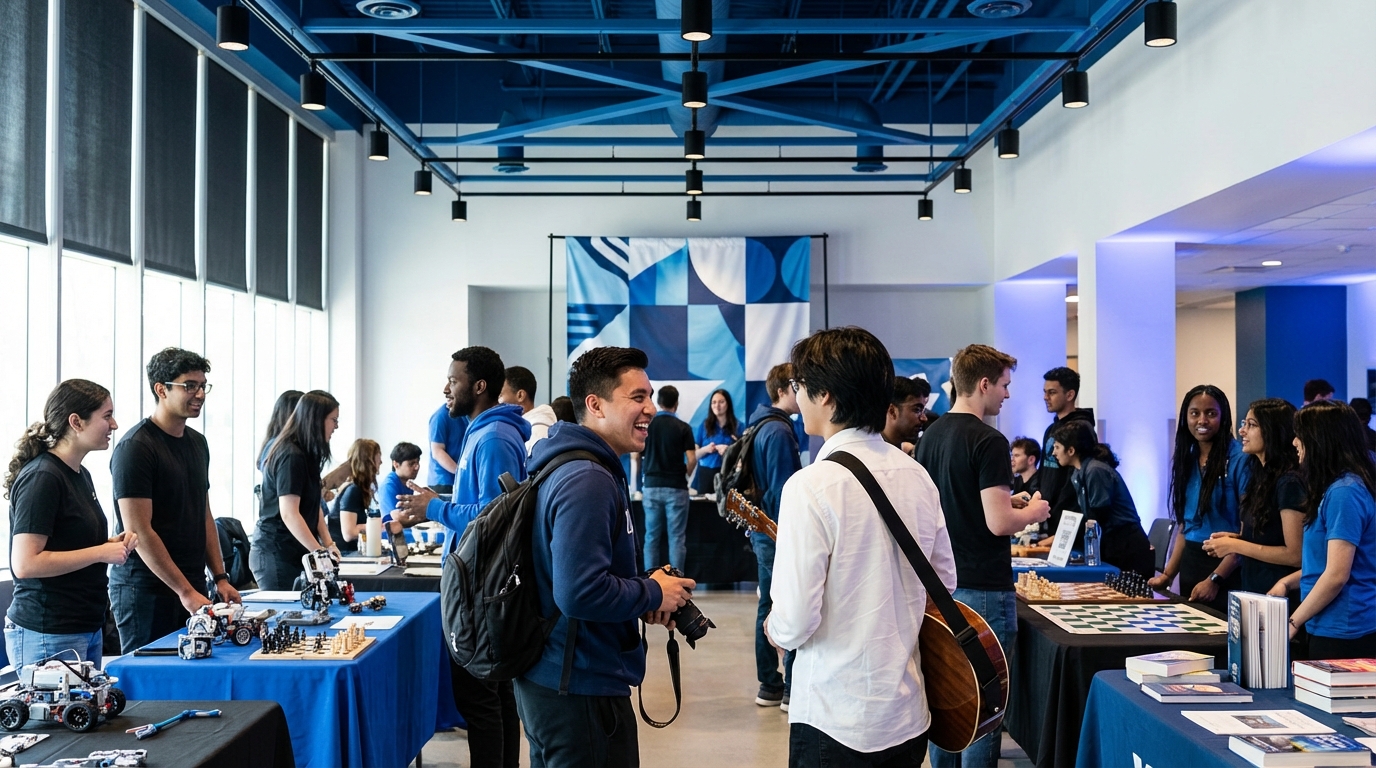
I was sitting in a 9 pm group meeting for a club that had nothing to do with my degree when it hit me: I was learning more about people and projects there than in half my lectures. Have you ever walked into a random society event “just for fun” and walked out thinking, “Why does this feel more useful than my coursework?”
The short answer: joining a society outside your major quietly upgrades your brain, your network, and your future options in ways your timetable never will. You get to practice skills your degree barely touches, meet people who think in completely different ways, and test-drive interests without committing to a minor, a second major, or a huge tuition bill. If you only stay inside your department bubble, you are leaving a lot of growth on the table.
Why Staying Inside Your Major Bubble Limits You
At first, staying close to your major feels safe. Same buildings, same classmates, same course group chats. It is predictable. Lecture, tutorial, lab, go home.
Then the pattern starts to show:
- You keep hearing the same jargon and the same opinions.
- Group projects feel like copy-paste: same roles, same people talking.
- Your “network” is basically 40 versions of you with slightly different hoodies.
If all your learning, all your friends, and all your projects sit inside that one subject box, you are training yourself to think in one direction.
If your whole week only exposes you to your own major, you are not at a university, you are in a slightly fancy vocational school.
That sounds harsh, but it is true. A university is structured around departments. Growth is not. Growth happens where those departments collide in messy, weird, social spaces.
Societies are exactly that.
What Cross-Major Clubs Actually Give You
When you join a society outside your major, you are not just “doing a hobby.” You are running small experiments with your future self.
Here is what is actually happening when you walk into a debating club as a computer science student, or a robotics club as an English major.
1. You Get Access To New Mental Models
Each subject trains people to think in a certain pattern. You probably already feel yours:
- Engineering: “What is the system? Where does it break?”
- Design: “How does this feel? What does the user see first?”
- Economics: “What are the incentives? Where is the trade-off?”
- Philosophy: “What are the assumptions hiding underneath this?”
- Biology: “How does this adapt and interact with its environment?”
Now imagine dropping yourself into a club where most people share a mental model that is not yours.
In a finance society meeting about student startups, the questions might be:
- “How does this project make money?”
- “What is the unit economics?”
- “How do we pitch this in 2 minutes?”
If you come from physics, your brain is not wired like that yet. Sitting in that room slowly rewires it. You start predicting what other people will ask. You start internalising their filters.
Cross-major clubs are like free brain upgrades. You borrow other disciplines ways of thinking without paying for an extra degree.
Over one semester, that reshapes how you approach assignments, side projects, and even your own career choices.
2. You Practise “Translate Mode”
One underrated skill in any ambitious career: the ability to explain one world to another.
You see this in student teams all the time:
- The coder who can talk to designers without making them feel stupid.
- The artist who can explain brand vibe to the engineering team.
- The biology major who can pitch a research-heavy idea to a business club.
Clubs outside your major force you into this “translate mode” over and over.
Example: You are a statistics student presenting in a social entrepreneurship society. You cannot throw p-values at people and expect them to care. You have to say, “Look, when we tested this with 50 students, this happened,” and then turn it into a story. That translation work is communication training in disguise.
Your career ceiling is not set by how smart you are, but by how clearly you can make other people feel that your ideas matter.
Societies outside your subject are where you get the reps for that.
3. You Build Real Diversity Into Your Network
Diversity is not just about demographics. It is also about:
- Different majors.
- Different year levels.
- Different ambitions.
- Different ways of measuring “success.”
If your entire social graph is “people who take the same courses as me,” your future options shrink without you noticing.
Consider this small table of what different majors often bring into a shared club:
| Member type | What they usually bring | Why it matters to you |
|---|---|---|
| Engineering / CS student | Tools, automation, building prototypes | Turns vague ideas into actual products or systems |
| Business / Economics student | Pricing, markets, basic finance, pitching | Makes your ideas fundable, sustainable, or at least legible |
| Design / Arts student | Branding, visuals, user experience | Makes your work feel real and attractive to humans |
| Social sciences / Humanities | Context, ethics, policy, narratives | Stops your ideas from being naive or tone-deaf |
| Science / Medicine | Rigor, evidence, domain knowledge | Grounds your project in reality and research |
When you join a cross-major society, you are basically connecting nodes across that whole table. You might not need that law student from the debating club this semester. But three years later, when you are trying to formalise a startup or a student-led initiative, you will be glad your network is not only people who can help you debug code at 2 am.
4. You Get “Safe” Reps Doing Real Work
I realised during a committee meeting that I was doing free training for my future career without thinking about it.
In one campus group, my tasks ranged from:
- Planning a 60-person event with a budget.
- Talking to sponsors and not sounding clueless.
- Managing a team chat so people actually read it.
- Posting on social media and reading the engagement numbers.
None of that was part of my degree. All of it shows up later in internships, jobs, and any project that tries to reach real people.
The nice part: campus societies are “low stakes.” If a poster looks bad, nobody fires you. If your workshop only gets 10 people, nobody sues you. You can test things, reflect, and try again.
Clubs give you the reps that make you dangerous in the real world, but with training wheels on.
Majors train depth. Societies outside your major train range.
How Joining Outside Your Major Helps Your Future Self
When you zoom out a bit, you can see how this plays into the student-startup-campus-trends world. A lot of student-led ventures and campus projects are born in weird crossovers: coding plus design, policy plus tech, biology plus business, art plus mental health advocacy.
If you only ever talk to clones of yourself, those overlaps never show up.
5. You Spot Opportunities Your Classmates Miss
Every field has blind spots. For example:
- Many engineering students underestimate distribution and marketing.
- Many business students underestimate technical risk.
- Many arts students underestimate legal and funding constraints.
When you are in a society that sits outside your major, you get to stand in those blind spots and look back at your original field.
Concrete example:
- You are a biology student in a student consulting club.
- You notice that local labs and research groups have terrible public-facing websites and zero community outreach.
- Your consulting group offers them a project: redesign their communication strategy, maybe help attract volunteers or grant partners.
Now you see two things your classmates might not:
- Your own subject is full of small problems worth solving.
- You have rare context, because you can speak “biology” and “consulting club” at the same time.
This pattern is powerful. That is exactly where a lot of student startups and side projects come from: someone who lives at the intersection of two worlds notices something broken and feels equipped to fix it.
6. You Become More Interesting To Recruiters (And Co-founders)
If everyone in your program has the same list on their CV, nothing stands out:
- Same core courses.
- Same mandatory group projects.
- Maybe one standard internship everyone in your year wants.
A society outside your major sends a different signal:
- “I am curious beyond what I am forced to learn.”
- “I can move in rooms where I am not the default person.”
- “I can handle uncertainty, because I joined something where I was a beginner again.”
Think about two physics students:
- Student A: top grades, research assistantship.
- Student B: slightly lower grades, but also treasurer of a cross-major film society who managed a real budget and dealt with sponsors.
If I am a recruiter for a small, fast-moving company or a campus founder building a team, Student B looks more “real world ready.” They have exposure to non-technical tasks, non-physics people, and messy social dynamics.
You are not just building a CV. You are building a story. Clubs outside your major give your story unexpected chapters.
7. You Reduce Career FOMO By Testing Interests Early
There is that quiet panic that hits around second or third year: “What if I picked the wrong major?” Almost everyone feels it. Most people just do not say it out loud.
Joining a society outside your field is a low-cost way to answer that question.
Three scenarios that happen a lot:
- You join an entrepreneurship society as a psychology major and realise you love talking to users, shaping products, and doing strategy. You do not need a business degree to work in product or operations one day.
- You join a campus coding club as a law student and notice that you enjoy logic puzzles but hate debugging. You realise you prefer policy around tech, not pure engineering.
- You join a university radio station as a math student and discover that you love audio storytelling, but only as a side hobby, not a career path. That still helps: you stop fantasising about “dropping everything” for podcasting.
These experiments are much cheaper than changing majors or starting a masters in a field you have never tested.
8. You Train Yourself To Learn Fast From Scratch
Walking into a new club outside your comfort zone feels like the first week of first year all over again.
You do not know:
- The acronyms.
- The unspoken rules.
- The tools they use.
Instead of avoiding that discomfort, you can treat it like a training regime: “Can I become useful in this new environment within one semester?”
That is the same skill you will use:
- When you get thrown into a new internship domain.
- When a startup you join suddenly pivots.
- When your job asks you to handle a task that has nothing to do with your degree.
Your future self will not be paid for what you already know, but for how fast you can learn what you do not know yet.
Societies outside your major are controlled environments where you can practice that.
How To Choose a Society Outside Your Major (Without Wasting Time)
Now the practical part: choosing well. Not every random student group will give you the growth you want. Some are active and intense. Some are mostly group chats that nobody reads.
Here is a simple way to filter, without turning this into another homework assignment.
9. Use the “Two Axes” Method
Imagine two questions:
- Axis 1: “Does this sound genuinely interesting to me?”
- Axis 2: “Does this sit outside my current path?”
Map a few societies you see at the fair or on your campus app into four categories:
| Category | Description | Example | What to do |
|---|---|---|---|
| High interest, outside path | You feel curious and it is far from your major | Design club for an engineering student | Top priority to try |
| High interest, close to path | You feel curious and it relates strongly to your major | AI club for CS student | Join, but remember this will not stretch you that much |
| Low interest, outside path | Good for growth on paper, but you feel no pull | Finance society for a poetry lover who hates money talk | Probably skip, you will not show up consistently |
| Low interest, close to path | Feels boring and similar to classes | Another theory-heavy reading group in your department | Skip unless you need it for a specific reason |
Your best bet: one or two “high interest, outside path” clubs. That is where growth and consistency meet.
10. Run a 4-Week Experiment
Treat your first month like a test, not a lifetime contract.
Here is a simple 4-week structure:
- Week 1: Attend one intro event or meeting. Ignore the vibe of the first 10 minutes. Many clubs start awkwardly. Look at: What are people actually working on? How do committee members talk to each other?
- Week 2: Join one smaller activity. A workshop, a project team, a subcommittee. The real culture shows up in small groups.
- Week 3: Volunteer for a tiny responsibility. Helping with check-in, taking photos, writing a recap. See how the team reacts. Are they organised? Do they give you real tasks?
- Week 4: Ask yourself: “Have I learned something I could talk about in an internship interview?” If yes, stay. If no, reduce commitment or leave politely.
You are not “quitting” a society if you leave after an honest 4-week experiment. You are redirecting your energy to a better learning lab.
The key is to be intentional. Many students collect memberships like Pokémon cards, then end up doing nothing deeply.
11. Watch For These Green Flags And Red Flags
When you are exploring clubs outside your major, look beyond the poster design.
Green flags:
- They can explain what they actually do in one or two sentences.
- New people speak during meetings, not just the same three committee members.
- There are visible projects with names, dates, and outcomes, not just vague talk.
- Members from different majors are present, not only one department.
Red flags:
- Everything feels like vague networking with no real activity.
- You hear a lot of “We should…” and almost no “We did…” with examples.
- Newcomers sit quietly on the side while committee members talk to each other.
- They cannot answer, “What are you working on this semester?”
If you want a place to grow, you need more than a logo and an Instagram account.
How To Balance Clubs Outside Your Major With Your Actual Degree
At this point, you might be thinking: “This sounds good, but I am already drowning in coursework.” That is fair. There is a real risk: joining too much and doing all of it badly.
Here is how to avoid that.
12. Set a “Club Budget” For Your Week
Time is your main currency. Instead of saying, “I will join 5 societies and see how it goes,” reverse the logic.
Decide a weekly time budget first. For example:
- Light: 2 hours per week.
- Medium: 4 hours per week.
- Heavy: 6 to 8 hours per week.
Then allocate that budget across your choices.
Example for a medium load:
- 2 hours per week: committee work in one main society outside your major.
- 1 hour per week: attending events in a second, lighter club.
- 1 hour “buffer”: certain weeks will require extra time. Protect that.
If you do not cap your club hours, they will quietly eat into sleep, revision, and time with actual friends.
Clubs become unsustainable when they turn into a way to avoid your real responsibilities.
13. Match Club Intensity To Your Semester Curve
Your semester is not flat. It has spikes: midterms, project deadlines, exam season.
Plan your club involvement around that curve.
- Early semester: good time to test, show up more, take on a small project.
- Midterm season: scale down. Attend key meetings, skip non-critical events.
- Exam season: you are allowed to go into “maintenance mode” or fully pause.
Before you accept a big role outside your major, ask these questions:
- “When will the peak effort be?”
- “Does that overlap with my hardest courses?”
- “Can I survive that overlap without losing sleep long-term?”
If the answer is “not really,” do not take the largest role offered. Being a reliable small contributor is better than being an overcommitted vice-president who burns out.
14. Avoid Turning Clubs Into Performative CV Decor
There is a subtle trap here. Once you notice that cross-major societies look good on applications, you might be tempted to stack them for appearance only.
You end up with a list like:
- Member, Consulting Society.
- Member, Finance Club.
- Member, Entrepreneurship Network.
- Member, Data Science Group.
On paper, that looks “busy.” In a conversation, it falls apart. Any decent interviewer will ask, “What did you actually do?” If the honest answer is, “Mostly attended speaker events and ate free pizza,” that does not help you.
One intense, outside-major club where you did real work beats five passive memberships in groups you barely attended.
When you write bullet points about your club experience later, aim for verbs like:
- “Organised,”
- “Built,”
- “Led,”
- “Designed,”
- “Coordinated,”
- “Interviewed,”
- “Launched.”
That kind of work usually lives in societies that actually run projects.
Where Student Startups And Campus Trends Fit Into All This
If your niche interest is student startups and campus trends, cross-major club culture is your lab.
A lot of emerging campus themes show up first inside societies where different majors collide.
15. Clubs As Early Stage Startup Sandboxes
Look at your campus:
- The team building a campus delivery app often started in a casual coding club or entrepreneurship society.
- The student running a popular newsletter about campus housing maybe learned basic writing consistency from a creative writing group.
- The people hosting hackathons for mental health tech might have met in a psychology society plus a tech group crossover event.
These are not random accidents. They happen because:
- Clubs let people from different majors meet regularly.
- Some of those people are slightly restless and want to build things.
- Repeated casual conversations about problems eventually turn into “We could try this.”
When you join a society outside your major, you are placing yourself in those early-stage conversations.
16. How Cross-Major Clubs Predict Campus Trends
If you pay attention, you can see campus trends forming inside club culture before they become mainstream.
For example, notice:
- A surge in non-tech majors joining coding workshops.
- More arts students attending talks on climate tech.
- Law or policy students showing up in AI ethics groups.
These patterns hint at where students feel the world is heading and where they feel their degrees alone are not enough.
If you are interested in building something new, this is useful. A few questions you can ask yourself in those cross-major clubs:
- “Why are people from totally different subjects showing up here?”
- “What do they say they cannot get from their degree that this club gives them?”
- “Is there a problem that 3 or 4 different majors all complain about?”
Those are early signals for student-led ventures, side projects, or even research topics.
17. Roles You Can Play Inside These Crossovers
You do not have to be the “founder” personality to benefit from this.
In a society outside your major, you might end up as:
- The connector: You notice that someone in your club needs a designer, and you know one from another society. You introduce them, and a new project forms.
- The translator: You sit between technical people and non-technical people, helping both sides understand each other during planning.
- The organiser: You are the one who can actually schedule, follow up, and keep the Trello board or Notion workspace alive.
- The storyteller: You write the recap posts, craft the narrative around what the club is building, and make it look coherent.
All of these roles are valuable in startup teams and student-led projects later. None of them require you to switch your major or be the loudest person in the room.
What To Do If You Are Introverted Or Feel Out Of Place
A lot of advice about club culture secretly assumes that you love crowded rooms and mingling. Many students do not. That does not mean you should avoid societies outside your field.
18. Play To Your Interaction Style
If large social events drain you, focus on clubs and roles that have:
- Smaller working groups or project teams.
- Clear tasks that you can prepare for.
- Asynchronous work: writing, design, engineering, research.
For example, in a debating society, you might:
- Help with research briefs for topics.
- Manage recording and editing of debate videos.
- Run the website or newsletter.
You still get all the cross-major benefits without forcing yourself into constant high-intensity social situations.
Joining a society outside your major does not mean becoming a different personality. It means bringing your own personality into a new room.
19. Use Your “Beginner Status” As An Advantage
Feeling like the least knowledgeable person in a room can be uncomfortable. In a weird way, that is your advantage.
When you are not from that field:
- You can ask naive questions that insiders are too embarrassed to ask.
- You can connect dots that specialists do not see because they are too deep in their niche.
- You are free from some of the unspoken “rules” or ego fights that long-time members have.
If something feels confusing in a club outside your subject, assume at least three other people are confused too. Being the one to ask out loud improves the experience for everyone and makes you memorable in a good way.
When You Should Not Join Another Society
So far this sounds positive, but there are times when joining another club, even outside your major, is a bad move.
20. When You Are Using Clubs To Avoid Hard Work
Ask yourself honestly: “Am I joining this because I am curious, or because I am running away from a course that scares me?”
If your grades are collapsing in core classes you actually want to pass, and your instinct is to bury yourself in 5 new societies, that is not growth. That is avoidance.
The smarter move:
- Stabilise your core workload.
- Fix your study habits.
- Then gradually add one cross-major club, not five.
Growth from clubs is only helpful if it does not burn down your degree in the background.
21. When The Club Culture Fights Your Values
Not every society is healthy, just like not every friend group is healthy.
Some warning signs:
- Pressure to drink or party in ways that cross your boundaries.
- Casual disrespect toward certain majors or groups of people.
- Leadership drama that never ends and soaks up everyone’s time.
- People bragging about overworking and treating burnout as a badge of honor.
No amount of cross-major exposure is worth spending your limited time in a place that makes you feel smaller or constantly anxious.
The right club outside your major should stretch you, not drain your sense of self.
If something feels off, you do not owe that society your loyalty. The campus is bigger than one group.
Bringing It All Together In Your Own Way
When you look back a few years from now, there is a good chance your most vivid memories will not be specific lectures. They will be:
- The night your cross-major team finally fixed a bug at 2 am.
- The debate where you argued a position you completely disagreed with, just to test your brain.
- The community project where you combined your major knowledge with perspectives you picked up from a club far outside your field.
You do not need to become the poster child for club culture. You do not need to join everything. You just need one or two “outside your major” spaces where you can:
- Think differently.
- Work with unlike minds.
- Run experiments with your future self.
Lecture halls give you content. Societies outside your major give you context and practice. Both matter. But only one of them will introduce you to the people who might build the next big student project with you.