I remember scrolling past yet another Dead Sea selfie at 1:30 a.m., half-awake, thinking: “Is it really that magical, or is it just very salty bathwater with better PR?” Then a friend came back from a semester in Jerusalem and said: “It kind of feels like cheating at physics.”
Short answer: yes, the Dead Sea can be worth the hype, but only if you go in with the right expectations. It is not a tropical beach, it is a harsh, fragile, extremely weird place where the science is cooler than the Instagram. If you are into geography, skincare, climate anxiety, or just places that feel like another planet, it is very worth it. If you just want soft sand, cocktails, and waves, you will be disappointed in about 7 minutes.
The Dead Sea is less of a beach trip and more of a science experiment you climb into.
What the Dead Sea Actually Is (And Why Everyone Floats)
At some point in a geology lecture I realised: a lot of tourist spots are just really old homework assignments from the planet. The Dead Sea is one of those assignments that got extra credit.
Fast facts that matter more than the brochures
- Location: Between Israel/Palestine on the west and Jordan on the east.
- Lowest land point on Earth: Around 430 meters below sea level and dropping.
- Salinity: Roughly 10 times saltier than normal ocean water.
- Name: “Dead” because almost nothing lives in it except some bacteria and hardy microbes.
Here is the basic physics experiment behind the “effortless floating”:
| Water type | Salt concentration (approx.) | Floating experience |
|---|---|---|
| Freshwater (lakes, rivers) | 0.05% | You sink unless you actively swim. |
| Ocean | 3.5% | You float a bit easier, still need to tread. |
| Dead Sea | 30%+ | You bob like a cork with almost zero effort. |
Because the Dead Sea is so salty, the water is much denser. Your body is less dense than the water, so the water pushes up on you more strongly. That is buoyancy. The same principle that helps ships float applies to your half-asleep, exam-burnt brain and body.
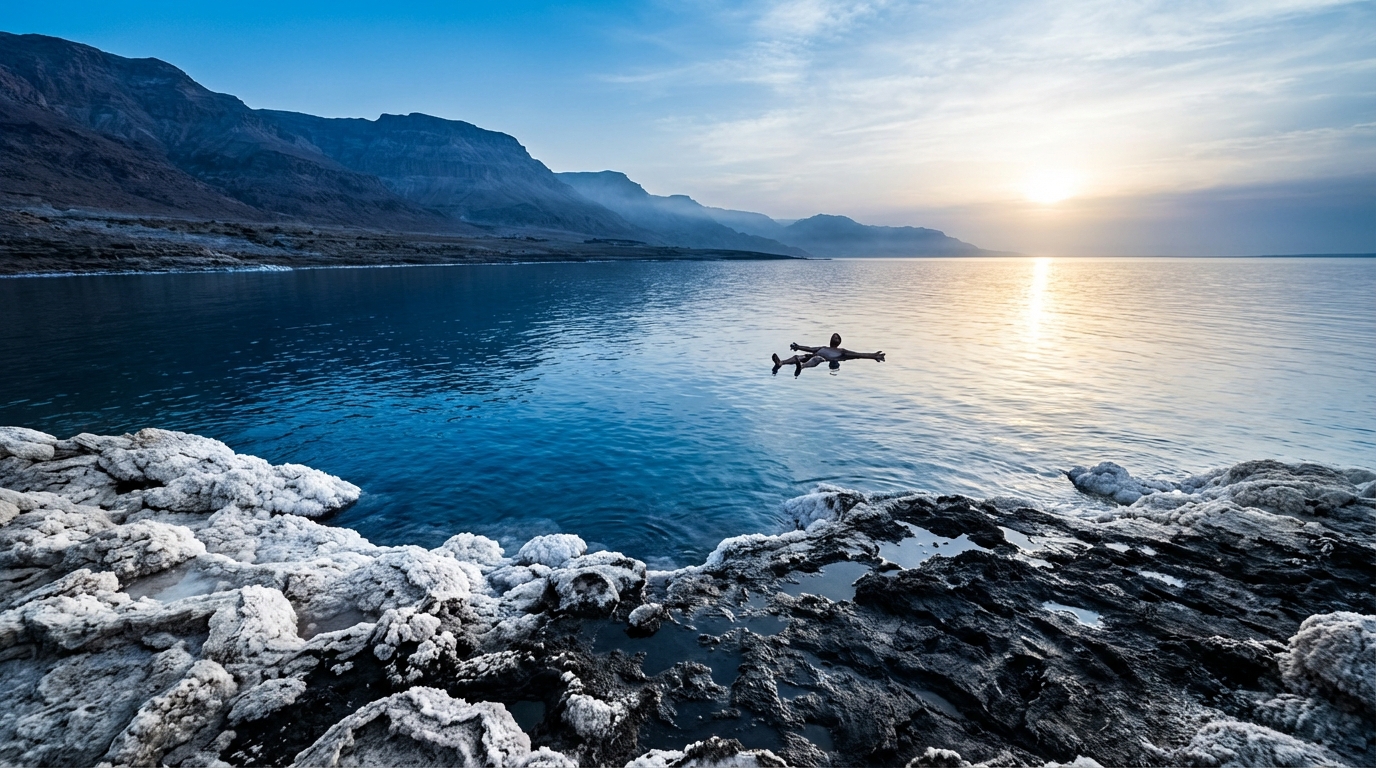
Floating in the Dead Sea feels less like swimming and more like sitting in invisible furniture.
Why it is so salty and weird
If you look at a map, the Dead Sea sits in a long trench called the Jordan Rift Valley. The Jordan River flows in, carrying minerals. Almost no water flows out. The only real exit is evaporation.
Picture a shallow bowl where water keeps arriving but mostly leaves as vapor:
- Water evaporates in the dry, hot climate.
- Salts and minerals stay behind.
- Over thousands of years, those minerals build up.
That is why you see salt crystals, weird formations, and shorelines that look like something from a sci-fi film.
This also means the Dead Sea is shrinking. Fast.
The “dying” part of the Dead Sea
The name “Dead Sea” feels more accurate now than ever.
Human water use upstream has cut the flow of the Jordan River. Less fresh water arrives, but evaporation still works overtime. The water level has been dropping by more than a meter per year in recent decades. That exposes more shoreline and triggers sinkholes when underground salt dissolves.
If you visit the Dead Sea, part of what you are seeing is a slow environmental emergency in real time.
For a student, that gives the place a strange double feeling: awe on one side, guilt on the other.
What It Actually Feels Like To Visit (No Filter)
In my head, the Dead Sea was this mystical glossy blue mirror. In reality, it is harsher, more industrial in some sections, and way more uncomfortable if you are not prepared. Still fascinating, just not as glamorous.
The first 10 minutes in the water
Here is the typical sequence:
- You walk in, notice the bottom can be rocky or muddy.
- The water feels thick and slightly oily because of the minerals.
- You lower yourself and suddenly your legs pop up on their own.
- You laugh, because your body will not stay vertical even if you want it to.
It really is that floaty. You can sit as if you are on a chair, read a book, or just lean back and stare at the cliffs.
But there are catches:
- Any micro-cut on your skin feels like you dipped it in lemon juice and fire.
- Water in your eyes is instant pain and panic.
- Staying in too long dries your skin out aggressively.
Most people do not spend an hour floating. Many come out after 10 to 20 minutes, rinse, and then maybe go again for a shorter round.
The mud situation
You have seen the photos: people completely covered in dark mud, posing like budget superheroes.
That mud comes from mineral-rich sediment around the shore and from curated pools at resorts. People smear it on their skin, let it dry for a bit, and then wash it off.
Why do people care so much about this mud?
- It contains high levels of magnesium, calcium, and other minerals.
- Some visitors report softer skin, less dryness, and calmer eczema or psoriasis.
- There are actual dermatology studies that look at Dead Sea treatments.
The mud is not magic, but it is a rare combination of high mineral content, dry air, and UV conditions that some clinics use seriously, not just for tourist selfies.
If you have skin conditions, the Dead Sea is not a guaranteed cure, and you should absolutely talk to a doctor first. But it is not pure marketing. There is real research behind some of the medical tourism you see in the region.
The climate and air: lab for your lungs and stress levels
Another underappreciated part: the air itself.
Because the Dead Sea is so far below sea level:
- The air is thicker and contains slightly more oxygen.
- UV rays get filtered differently through extra layers of atmosphere.
- The area is dry, which some people with respiratory issues find helpful.
This is why you find clinics and wellness centers there focusing on psoriasis, arthritis, and breathing-related issues. Again, it is not a miracle zone, but it is a clearly unusual environment that doctors have studied and used.
Pros, Cons, And Honest Expectations For Students
During a semester abroad, the Dead Sea often lands on the “must-see” list. Before you jump on a bus at 6 a.m., it helps to know what you are actually signing up for.
Who will probably think it is worth the hype
- Science and geography nerds: The geology, salinity, and rapid shrinkage make it a real-life case study.
- People into skincare or medical tourism: The unique water and mud are worth trying once, especially if you already use dermatology treatments.
- Photographers and content creators: The salt formations, desert cliffs, and sunset colors are hard to fake.
- History fans: The area links to ancient trade routes, biblical stories, and archaeological sites nearby.
Who might find it overhyped
- Beach vacation people who want waves, sand, and swimming.
- Budget travelers who are choosing between multiple long day trips.
- Anyone who hates heat, dust, and very dry air.
Here is a simple comparison if you are planning a semester abroad schedule:
| Experience | Primary vibe | What most students say |
|---|---|---|
| Dead Sea | Strange, scientific, extreme environment | “So weird and cool, but I would not spend more than a day.” |
| Red Sea beaches (Eilat, Aqaba, Sinai) | Actual beach holiday, snorkeling, coral reefs | “Way more fun if you want to stay longer.” |
| Jerusalem old city | History, religion, politics, culture overload | “Mentally intense, but unforgettable.” |
If your time and budget are tight, the honest answer is: go to the Dead Sea as a half-day science field trip, not as your main “beach” plan.
Science, Hype, And What The Research Actually Says
One thing that irritated me when I started reading about the Dead Sea was the gap between tourist marketing and clinical papers. The truth sits somewhere in the middle.
Health claims that have some evidence
Studies on Dead Sea therapy often combine several elements:
- Bathing in the water
- Applying mud
- Sunlight exposure, carefully timed
- Dry, clean air
Conditions where researchers have found benefits in at least some patients:
- Psoriasis: Many see improvement in symptoms after multi-week programs.
- Atopic dermatitis (eczema): Some get better hydration and reduced itch.
- Arthritis: Warm mineral baths can reduce joint pain in the short term.
- Asthma or chronic bronchitis: Certain patients report easier breathing.
These are controlled treatments, not a random quick dip while chewing Pringles at a public beach. Clinics supervise exposure time, salt levels, and sun.
So if you just float for ten minutes on a day trip, you should expect:
- A fun physics lesson your body can feel
- Temporarily softer skin, if you rinse properly afterward
- Some nice photos and stories
Not a full body reset or permanent cure.
Common myths that need a reality check
- “Nothing lives in the Dead Sea.”
Actually, some bacteria and microbes do. They are just small and very tough. - “You cannot sink at all.”
True for normal conditions, but if you flip face-down and do not move, you can still drown. The high salinity does not cancel basic physics of breathing. - “The mud is pure magic.”
It is helpful for some skin issues, but it can also irritate sensitive skin. Patch testing is smart. - “The Dead Sea will be gone in a few years.”
The situation is severe, but there are complex political and engineering debates about how to slow or change the process. It is not a countdown timer that suddenly hits zero and vanishes overnight.
Environmental Reality: You Are Visiting A Shrinking Wonder
One thing I wish more travel blogs said clearly: the Dead Sea is not just “unique,” it is under stress.
Why it is shrinking so fast
There are several main factors:
- Reduced flow from the Jordan River: Water is diverted upstream for agriculture and cities.
- Industrial mineral extraction: Companies on both sides pump out water for potash and other minerals.
- High evaporation: Hot, dry air pulls water into the atmosphere constantly.
Imagine a bathtub with the tap barely on, the drain sealed, and giant fans blowing across the surface. That is roughly what is happening.
The result:
- Shorelines have moved many meters away from old hotels and facilities.
- Spars have formed inland where the ground collapses as underground salt layers dissolve.
- Some beaches have closed for safety.
The Dead Sea is not just a tourist destination; it is also a visible side effect of political decisions and unsustainable water use.
Should students feel guilty visiting?
This is where I will push back if you think “tourists are the main problem.” They are not. The big drivers are policy choices and industry.
That said, you still have agency:
- Support operations that respect environmental rules.
- Avoid littering or walking into closed sinkhole zones.
- Use your visit as fuel for projects and awareness, not just posts.
If you are studying environmental science, international relations, or engineering, the Dead Sea can be an uncomfortable, vivid case study for the “water crisis” chapter in your notes.
Student Logistics: Cost, Timing, And How Not To Regret The Trip
On a student budget, every long bus ride has an opportunity cost. So let us treat this like a mini planning session.
Public beaches vs resort access
You basically have three options:
| Type | What you get | Trade-offs |
|---|---|---|
| Public / low-cost beach | Basic access, minimal facilities, usually cheaper | Less comfortable, rocks or mud, fewer showers, can be crowded. |
| Mid-range resort day pass | Showers, changing rooms, proper paths, pools, maybe mud buckets | Costs more, feeling of a controlled tourist bubble. |
| High-end spa hotel | Private beach, full spa, treatments, comfortable loungers | Expensive, overkill for many students unless splitting or on scholarship money. |
If you are an exchange student or backpacker, the mid-range day pass is often the sweet spot. Pay once, get decent facilities, and you do not have to dry off in a bus seat covered in salt.
Timing the trip
To keep it practical:
- Season: Spring and autumn are gentler. Summer can be brutally hot.
- Time of day: Mornings or later afternoons are better than standing in peak sun at noon.
- Combine with: Masada, Ein Gedi, or Wadi Mujib hikes to make the whole day feel fuller.
A classic student day trip template on the Israeli side is:
- Leave early, hike Masada at sunrise.
- Stop at Ein Gedi for a short hike and waterfalls.
- Finish with a float in the Dead Sea and then head back.
That way, even if you find the Dead Sea itself underwhelming after the first 20 minutes, your day still feels full.
What you absolutely need to bring
This is one area where a bit of planning saves a painful afternoon.
- Swimwear you do not mind damaging: Salt can be rough on fabric and colors.
- Cheap flip flops or water shoes: The ground can be sharp with salt crystals.
- Plenty of drinking water: You will dehydrate faster than you expect.
- Sunscreen, hat, light cover-up: The reflection off the water catches students off guard.
- Towel and change of clothes: You will want to rinse and change immediately after.
- Small bag for trash: Public beaches do not always have enough bins.
Do not wear your favorite metal jewelry into the water. The salt can stain or corrode it.
How “Worth It” Is It, Really? A Student-Level Scorecard
Since this whole article is orbiting one question, it helps to quantify things a bit, even if it is subjective.
The hype checklist
Here is a rough rating, from a student perspective, on a 1 to 10 scale:
| Category | Dead Sea score | Why |
|---|---|---|
| Uniqueness | 9/10 | The combination of salinity, altitude, and rapid change is very rare. |
| Pure fun | 6/10 | Floating is fun but short-lived; it is not a “stay all day in the water” place. |
| Photo potential | 8/10 | You get distinctive shots, especially around salt formations and sunsets. |
| Comfort | 5/10 | Heat, salt stings, and dry air make it rougher than normal beach trips. |
| Educational value | 9/10 | Great live example of geography, climate stress, and health research. |
| Budget-friendliness | 6/10 | Transport and day passes add up, especially from farther cities. |
If your goal is to collect experiences that feel singular and intellectually interesting, the scorecard leans heavily towards “yes, go.”
If your goal is maximum fun per dollar, then a beach or city trip might win.
Questions to ask yourself before you decide
Instead of automatically slotting the Dead Sea into your itinerary because everyone else did, actually interrogate your own reasons:
- Am I genuinely curious about the science, geography, or health angle?
- Would I enjoy the experience if I could not post any photos?
- Is my schedule packed enough that a full-day trip means cutting something else I care about more?
- Do I handle heat and intense sun reasonably well?
If you answer “no” to most of these, then it is okay to skip it. There is a strange social pressure to “tick the box” on famous places. You do not get extra credits in life for suffering through an experience you knew did not fit you.
The Dead Sea is worth the hype for curious people with realistic expectations. It is not worth the hype if you want a classic relaxing beach day.
Ways Students Are Turning The Dead Sea Into Projects, Not Just Photos
One of the coolest shifts among students I know is treating trips not just as vacations but as raw material for projects: research, startups, campaigns.
Research angles for student projects
If you are thinking of a paper, thesis, or group assignment, the Dead Sea offers angles across disciplines:
- Environmental science: Study salinity changes, sinkholes, or evaporation patterns.
- Political science: Look at water-sharing agreements between neighboring territories and countries.
- Economics: Compare tourism revenue, mineral extraction, and the cost of environmental damage.
- Health sciences: Evaluate how Dead Sea treatments are marketed vs what trials actually show.
- Cultural studies: Trace how different communities relate to and narrate the Dead Sea.
You could literally design a small field study: survey visitors, interview local guides, observe environmental signage, and connect it all to what you study back on campus.
Startup and campus initiative angles
Since the niche of this site is student ventures and campus trends, here are some hooks:
- Sustainable tourism apps: Tools that give visitors real-time info on fragile zones, water use, and eco-friendly choices.
- Education content: Short-form video or interactive modules for schools, built from actual field footage.
- Skin-care product audits: Student-led reviews comparing “Dead Sea” cosmetic claims with real ingredient lists and research.
- Policy hackathons: Campus events where teams design water management proposals or information campaigns using the Dead Sea as a case study.
Visiting a shrinking natural wonder and walking away with nothing but a selfie misses an opportunity. The place is a live demo of climate stress intersecting with health tourism and politics. That is basically the intersection of half the debates happening on campuses right now.
Practical Safety And Comfort Tips That Travel Blogs Soft-Pedal
This is the part that most glossy guides hide behind filters. Here is the unromantic checklist.
What not to do in the Dead Sea
- Do not jump or dive. The water is shallow in many spots, and impact with salt crystals is no joke.
- Do not shave the same day. Anywhere. Just do not. The sting is legendary.
- Do not stay in too long. Start with 10 to 15 minutes. Your skin reaches a point where more salt is not better.
- Do not rub your eyes if water splashes. Move to the shower or fresh water, and rinse gently.
- Do not drink the water. It sounds obvious, but accidental sips during laughter happen. It can make you very sick.
What to do immediately after your dip
- Rinse with fresh water as soon as you can, head to toe.
- Use a neutral moisturizer; the salt dries your skin out quickly.
- Change into clean clothes so your skin can breathe.
- Drink water or something with electrolytes to compensate for sweat and dryness.
If you have serious health conditions, ask a medical professional before going in. No FOMO is worth a bad health episode.
So, Is The Dead Sea Worth The Hype For You?
The Dead Sea is not overrated in the way some tourist traps are. The physics, the geology, and the environmental reality really are that striking. What is overhyped is the fantasy that it is a soft, glamorous beach escape.
If you go expecting:
- A harsh but fascinating physical experience
- Some minor short-term skin benefits, not miracles
- An uncomfortable but powerful glimpse at climate and water politics
then it will probably exceed the right kind of expectations.
If you go expecting:
- Soft sand, playful waves, and relaxing swims
- Effortless comfort
- Endless entertainment in the water
then you will likely step out, rinse off, and think: “That was impressive, but not what the brochures promised.”
Treat the Dead Sea like a field lab, not a spa brochure, and it suddenly becomes very worth the hype.