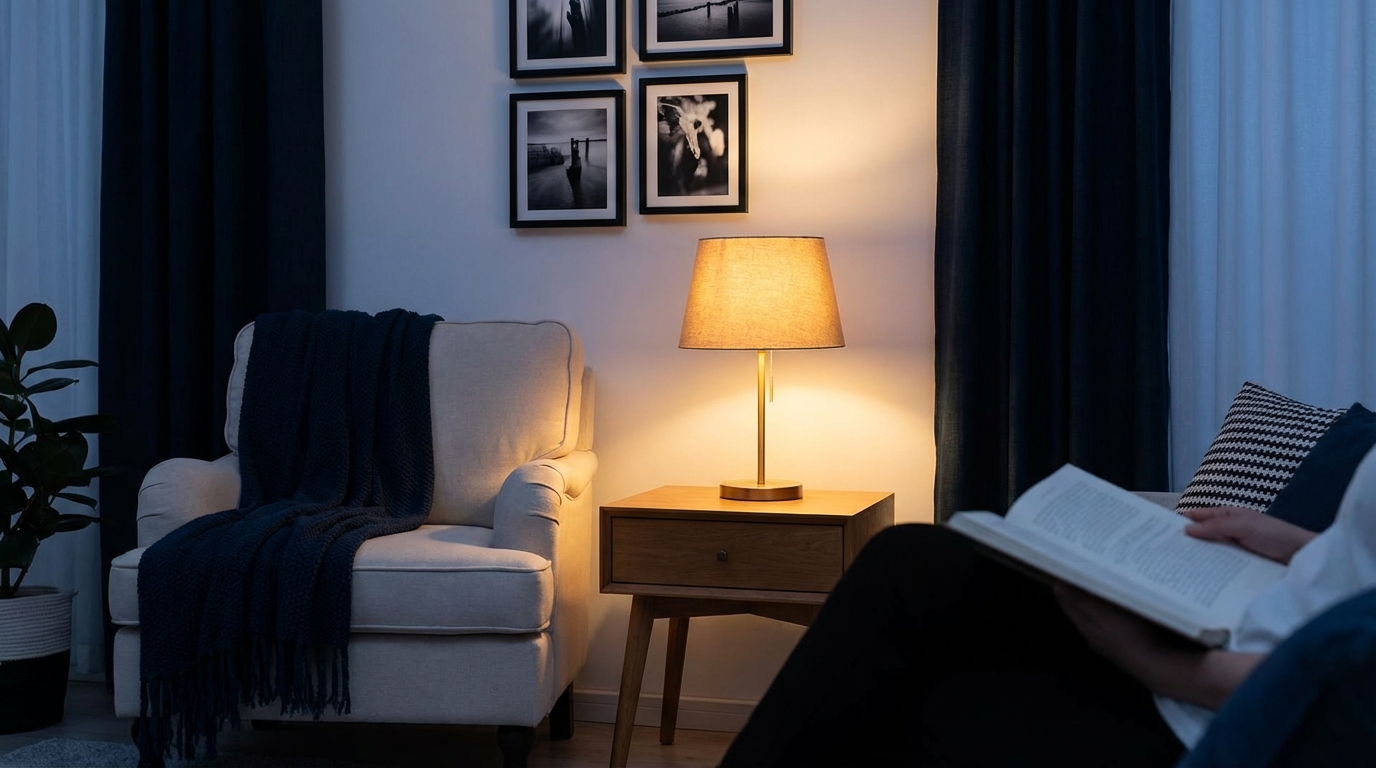
I was staring at my laptop at 1:43 a.m., feeling weirdly wired but also exhausted, when I realized the only things awake in my room were me and my cold, white ceiling light. The room felt like a library at exam time, not a place where a human is supposed to fall asleep.
Warm light is better for relaxation because it matches how our brains have evolved to read light: bright, bluish light tells the body “stay alert,” while softer, warmer light tells the body “you are safe, the day is ending, you can switch off.” If you want your brain to stop acting like it is in a 24/7 startup accelerator, you need to give it signals that the workday has ended, and the fastest signal is: change the lighting.
Warm light is not just an aesthetic choice. It is a biological signal that it is time to relax.
Why Your Brain Cares About Light Color More Than Your Room Decor
I used to think lighting was just a design choice, like choosing a poster or a plant. Then I learned in a neuroscience lecture that our eyes have special cells that do not care what you are looking at; they care what kind of light hits them.
These cells feed directly into your internal clock. They do not ask if you have a deadline. They just respond to light.
- Blue-rich light (cool, white light) = “Wake up, it is daytime.”
- Warm light (yellow/orange) = “The sun is going down, start winding down.”
Your ceiling light might be telling your brain that it is midday on a beach, while your timetable says it is 11 p.m. in a dorm. That clash is why you feel tired but wired.
The Science in Simple Terms
Here is the short version of the biology, without 50 journal citations.
| Thing | What it is | Why it matters for relaxation |
|---|---|---|
| Melanopsin cells | Light-sensitive cells in your eyes | Respond strongly to blue light and tell your brain to stay awake |
| Circadian rhythm | Your 24-hour internal clock | Uses light to decide when to release sleep hormones |
| Melatonin | Hormone that helps you feel sleepy | Blue light blocks it, warm low light lets it rise |
| Color temperature (K) | How “warm” or “cool” the light appears | Lower numbers feel cozy, higher numbers feel like daylight |
Think of your brain as running old “sun logic.”
Daylight with a lot of blue = “hunt, study, build.”
Sunset-type light with more orange/red = “talk, relax, sleep soon.”
Artificial lighting hacks that logic. The ceiling light in a lot of dorms and apartments sits around 4000K to 6000K, which mimics cloudy daylight. That is useful for focus. It is terrible if you want your brain to enter chill mode.
Warm Light vs Cool Light: What Actually Changes?
At first, “warm” and “cool” light just sounded like marketing labels to me. So I went looking for what actually changes in the body.
Impact on Your Body Clock
When you sit under cool, bluish light at night:
- Your brain delays melatonin release.
- Your heart rate and alertness stay higher for longer.
- Your sleep tends to start later and be lighter at the beginning.
When you spend the last 1 to 2 hours of your day with warm, dimmer light:
- Your brain reads the signal: “sun is setting.”
- Melatonin can ramp up earlier.
- Falling asleep feels less like a fight and more like a slide.
It is not about being “sensitive.” Almost every human walks around with this same light-sensitive system.
How Color Temperature Works (Without Jargon)
Color temperature gets measured in Kelvin (K). You can think of it like this:
| Color Temp | Looks like | Feels like | Better for |
|---|---|---|---|
| 2000K – 2700K | Very warm, orange | Candlelight, campfire | Deep relaxation, late evening |
| 2700K – 3000K | Warm white | Cozy lamp, living room | Evening reading, unwinding |
| 3500K – 4100K | Neutral white | Office, classroom | Studying, work |
| 5000K – 6500K | Cool white / daylight | Overcast outdoor light | High-focus tasks, labs, studios |
So when you grab a random bulb from the supermarket that says “cool daylight,” you are literally installing a tiny cloudy afternoon in your room at night.
If your room feels like a lab at midnight, your brain will act like you are in a lab at midnight.
Why Warm Light Feels Psychologically Calming
Even if you ignore hormones and neuroscience, there is a strong psychological effect. Warm light feels safe. There is a reason horror movies rarely use it in the scary scenes.
We Associate Warm Light With Safe Spaces
Think about where you have felt the most naturally relaxed:
- A campfire with friends.
- Soft lamps in a living room.
- Cafes that make you want to stay longer than you planned.
Now think about where you usually feel tense or “on”:
- Hospitals with bright white lighting.
- Lecture halls with fluorescent panels.
- Supermarkets and exam venues.
Those places are often lit with cool, bright light that erases shadows and flattens everything. Your brain reads that as “task mode.” Warm lighting, with more gentle contrast and softer shadows, feels like “story mode” or “connection mode.”
Lighting sets the emotional “temperature” of a room faster than furniture does.
Attention vs Relaxation Modes
Your brain has limited attention resources. Lighting nudges those resources in a direction.
Here is how it tends to split:
| Lighting type | Mental mode triggered | Typical feeling |
|---|---|---|
| Cool, bright, overhead | Task mode | Slight urgency, readiness, alertness |
| Warm, soft, from side lamps | Rest mode | Openness, calm, lower tension |
If you keep your room in permanent “task mode,” your brain never fully gets permission to power down. That is when scrolling in bed becomes your default, because your environment is encouraging “awake habits.”
Why Students Feel This More Than They Think
Campus life usually mixes everything into one tiny space. My bed is one meter away from my desk. My desk doubles as a dinner table. That overlap makes light choice even more critical.
Your Room Has Too Many Jobs
One physical space is doing all of these:
- Lecture replay zone.
- Startup brainstorm zone.
- Gaming zone.
- Sleep and recovery zone.
If the lighting never changes while the job changes, your brain loses contextual clues. It fails to switch modes.
If your “sleep corner” looks exactly like your “assignment panic corner,” your brain will treat them the same.
That is why a warm light ritual matters. It is a simple, low-effort way to mark the transition from “doing” to “resting” inside the same four walls.
Chronic Stress and Light
Between classes, projects, part-time work, and side hustles, many students live in a mild state of constant pressure. Cool, harsh lighting at night keeps your body slightly on guard.
You might notice:
- You feel restless at night even when sleepy.
- You wake up feeling like you did not “fully” sleep.
- Your room never really feels like a sanctuary.
Switching to warm light will not fix exams or deadlines, but it removes one constant “stay awake” signal that you do not need.
How Warm Light Physically Helps You Relax
Let us get specific. What exactly does warm light change in your body that relates to relaxation?
Melatonin and Sleep Pressure
Your body builds up “sleep pressure” during the day. Melatonin helps convert that pressure into actual sleep. Blue-rich light interrupts this.
Research on light exposure shows something very simple:
- Bright, blue-heavy light at night can suppress melatonin for 1 to 2 hours.
- Warmer, dimmer light barely touches melatonin levels.
So if you are under a cold white ceiling light while working at 11 p.m., you might feel tired, but your hormones are saying “stay available.”
Swap to a warm lamp, keep things dimmer, and you let the hormone patterns run closer to their natural timing.
Heart Rate and Muscle Tension
Relaxation is not just “feeling calm” in your head. Your body does things too.
In lower, warmer lighting in the evening:
- Heart rate tends to drop slightly.
- Blood pressure can reduce a little.
- Muscle tension can lower, especially in the shoulders and neck.
Part of this is indirect. Warm light invites calmer activities: reading, journaling, talking softly with roommates, meditating, stretching. Harsh, bright light encourages more mentally sharp tasks.
Eyestrain and Screen Use
If you work on screens a lot, harsh overhead light gives an extra level of discomfort. There is glare on the screen, and your pupils are trying to balance two different light sources: the ceiling and the display.
With a warm, indirect lamp in the evening:
- Your pupils do not need to constrict as much.
- The contrast between screen and room drops to a more comfortable level.
- Your eyes fatigue more slowly.
You still need to manage screen time, but at least you are not adding lighting conflict into the mix.
Designing a “Relax Mode” Lighting Setup in a Student Room
Here is where it turns into something you can actually set up in your own space without needing an interior design budget.
Step 1: Split Your Lighting Into Two Modes
Treat your lighting the way you treat your apps:
- Work Mode: Brighter, possibly cooler, for focused tasks.
- Relax Mode: Dimmer, definitely warmer, for late evening.
You do not need expensive smart bulbs to do this, although they help. You can do it with two very simple tools:
- A bright main light for study sessions.
- A warm bedside or desk lamp for evenings.
The rule of thumb: after a certain time at night, you stop using the main light completely.
Step 2: Choose the Right Warm Bulb
When you look at bulbs, ignore the brand claims and read the fine print on the box. Look for:
- Color temperature: 2200K to 3000K for relaxation.
- Lumen level: 200 to 600 lumens is enough for a chill lamp.
- Label: Words like “warm white,” “soft white,” or “amber.”
Avoid:
- “Daylight” bulbs for your relaxation corner.
- Overly bright bulbs above 800 lumens near your bed.
If you like numbers, this is a simple pairing that works well in small student spaces:
| Use case | Color temp | Brightness | Light type |
|---|---|---|---|
| Study / work | 4000K – 5000K | 800 – 1200 lumens | Desk or overhead light |
| Relax / pre-sleep | 2200K – 2700K | 200 – 600 lumens | Bedside or corner lamp |
Step 3: Focus on Light Placement, Not Just Color
Where the light comes from changes how it feels.
For relaxation:
- Avoid strong, direct overhead beams.
- Use lamps that shine light sideways or upwards onto a wall.
- Keep the light source out of your direct line of vision when lying down.
Some cheap, effective options students actually use:
- A simple desk lamp pointed at the wall, not at your face.
- String lights with a warm label (not the harsh blue ones) along a wall.
- A small clip-on lamp attached to your bed frame with a warm bulb.
Relaxation lighting should feel like a glow, not a spotlight.
Step 4: Set a Cutoff Time for Warm Light Only
There is a psychological trick here. Instead of just “I should sleep earlier,” set a “light curfew.”
For example:
- After 10 p.m.: Main light off, only warm lamp or string lights.
- After 11 p.m.: Screens on low brightness, room as dim as safely possible.
You do not impress anyone by working under harsh lighting until 2 a.m. The work you do at that time is usually low quality anyway.
Warm Light vs Night Mode on Devices
A lot of people ask: “If I use Night Shift or a blue light filter, do I still need warm lamps?”
The short answer is: those features help a little, but they are not the full story.
What Night Modes Do
Night modes on laptops and phones:
- Reduce blue wavelengths from the screen.
- Shift the screen tint toward orange or yellow.
- Lower some of the melatonin suppression from screens.
This is good. You should probably keep them on. But they are not magic.
What They Do Not Change
They do not:
- Change your room lighting.
- Change how bright the screen is in a dark room.
- Change your mental state from “scrolling” to “sleeping.”
If your phone is on Night Mode but your ceiling light is blasting 5000K light at 11:30 p.m., you are sending mixed messages to your body.
Think of warm room light as the stage, and screen filters as one small prop. The stage matters more.
Common Myths About Warm Light and Relaxation
Let us run through a few assumptions that I hear in dorm conversations that do not really hold up.
“I Sleep Fine With Bright White Lights On, So It Does Not Matter”
You might fall asleep, yes. Students are tired. But the question is: how is the quality of that sleep?
Indicators that your lighting is hurting you, even if you crash:
- Regularly needing an alarm plus multiple snoozes.
- Feeling foggy for the first hour of the day.
- Craving caffeine by mid-morning almost every day.
Sleep quality is just as important as sleep quantity. Lighting influences quality.
“Warm Light Is Just Aesthetic, Not Functional”
Aesthetic choices can still have physiological impact. Gym lighting, for example, is often very bright for a reason: it keeps energy up.
Warm light affects:
- Your circadian rhythm.
- Your hormone timing.
- Your emotional association with a space.
That is functional. Artists, architects, and hospitality designers treat lighting as a core variable because it changes human behavior, not just photos.
“Smart Bulbs Are Too Expensive, So I Cannot Do This”
Smart bulbs are nice, but they are not required.
Low-budget alternatives:
- One cheap warm LED bulb (often a few dollars) in a small lamp.
- Battery-powered warm fairy lights hung near the bed.
- A secondhand lamp from a thrift shop plus a 2700K bulb.
If the choice is between a warm lamp and a fancy RGB smart bulb that you use at full brightness in white mode, choose the basic warm lamp every time.
Examples of Lighting Setups That Actually Work on Campus
Here are a few real-world style setups for different living situations. No product names, just simple patterns.
Small Dorm Room (Bed & Desk in One Space)
Goal: Make one corner feel like “work” and the other feel like “rest.”
Possible setup:
- Ceiling light: keep as is, used only for cleaning, dressing, quick tasks.
- Desk lamp: 4000K bright bulb for study sessions, angled at books, not eyes.
- Bedside lamp: 2200K to 2700K, low brightness, only used after your work cut-off time.
Routine idea:
- Before 9 p.m.: You can use desk lamp plus ceiling light for strong focus.
- 9 p.m. onward: Ceiling light off. Only desk lamp for light work.
- One hour before intended sleep: Only warm bedside lamp.
Shared Apartment Living Room / Bedroom Combo
Goal: Your brain should know when “social time” is ending and “winding down” is starting.
Setup:
- Living room: floor lamp with warm bulb for evenings, overhead off after dinner.
- Bedroom: one main light for getting ready, one small warm lamp for pre-sleep reading.
Routine idea:
- Group study on the table: overheads on, cooler bulbs if available.
- Post-dinner hangout: only floor lamps with warm bulbs.
- Bedtime: no overhead lights in the bedroom for the last hour, only small warm sources.
Student Founders / Creators Who Work Late
If you are working on a venture, creative project, or research late, you might feel you “need” bright light. You do not always.
You can try:
- Using a focused desk lamp for your work surface but keeping the rest of the room dim.
- Shifting to a warmer bulb in the desk lamp after a certain time, even if it slightly reduces sharpness. Your long-term health is more valuable than a slightly faster email.
Ask yourself: “Is this task really so critical that it justifies hitting my sleep quality?” Often the honest answer is no.
Micro-Habits To Make Warm Light Your Default Relax Signal
Habits stick better if they have clear triggers and require little effort.
Link Lighting To Daily Events
Rather than using the clock, attach your warm light shift to existing anchors:
- After your last meal: main light off, warm light on.
- Once your laptop is closed for the night: only warm light from that point.
- When you start your “pre-sleep” routine (face wash, brushing teeth): lights go to warm mode only.
If you turn a warm lamp on at the same time every day, your brain will start to associate that light with “we are winding down.”
Use Physical Cues, Not Just Apps
Apps that remind you to relax are nice, but physical actions are stronger.
You can:
- Place the warm lamp switch somewhere you almost always pass at night.
- Put the main light switch slightly out of reach from your bed so you leave it off after lying down.
- Use a cheap timer plug to automatically cut your brightest lamp at a set time, if your housing allows it.
Removing one friction point is often the difference between following the habit or ignoring it.
When Warm Light Alone Is Not Enough
Lighting is powerful, but it is not magic. If you have serious sleep issues or anxiety, warm light will help, but it will not replace real support.
You might want more than lighting tweaks if:
- You regularly lie awake for more than 30 to 40 minutes, even when you are exhausted.
- You wake up many times a night, not just once or twice.
- You feel intense anxiety at night no matter what the lighting is.
In that case, warm light can still be one of your tools, but combine it with:
- Talking to a campus counselor or health service.
- Looking at your caffeine timing and intake.
- Checking whether you are doing heavy work right before trying to sleep.
Do not let “I changed my light bulbs” delay you from getting help if you feel something deeper is off.
Why This Matters For Student Builders And Creators
If you are building something, studying hard, or trying to push yourself, it is easy to treat sleep as optional and lighting as cosmetic. That approach is short-sighted.
Light affects:
- Your cognitive performance the next day.
- Your mood stability over the week.
- Your capacity to handle stress during high-pressure moments.
Chronic overexposure to harsh light at night is like constantly running your brain in “debug mode” and never letting it reboot properly.
Warm light is a small, practical adjustment with outsized benefits:
- It costs very little money compared to gadgets or supplements.
- It works quietly in the background once set up.
- It makes your space feel more like a place you want to rest in, not just work in.
If you are already experimenting with habit trackers, productivity systems, or biohacks, treating your lighting seriously is not overkill. It is just responding to one of the strongest environmental signals your brain understands.
Switching one bulb will not flip your life upside down. But try this: for one week, give yourself a strict rule that after a certain hour, your room lives in warm light only. Notice whether falling asleep feels different. Notice whether your room suddenly feels more like yours.
Lighting matters more than we like to admit. And for relaxation, warm light is not optional decoration. It is part of how you tell your own brain: “You can stand down now.”