I was staring at my laptop at 1:37 a.m., surrounded by laundry, snack wrappers, and three half-dead plants, and my brain just refused to work. It felt like my room was actively lowering my GPA. That was the night I realized my dorm was not a room, it was a user interface for my mind, and the UI was broken.
If you want your dorm to support focus, start with three things: where your desk faces, how you separate “study” from “chill,” and how much visual noise lives in your line of sight. Put your desk where your eyes see light and depth (window or open space, not a wall two inches from your face), keep your bed visually and mentally separate from your work zone, and remove anything distracting from the view directly in front of you when you sit down to study. The details are personal, but those three moves change how your brain shows up in the room.
What Feng Shui Even Means When You Are Living In A 10×12 Box
I used to think feng shui was about bamboo fountains and rich people moving couches to boost “energy”. In a dorm, it turns out to be a lot more basic and a lot more practical.
At its core, feng shui is just a way of asking: “How does the arrangement of stuff affect how you feel and think?”
Your room is not neutral. Every object placement is a silent instruction to your brain: focus, relax, snack, scroll, or panic.
In a dorm, you have extra constraints:
– Tiny floor space
– Weird built-in furniture
– Random roommate choices
– Zero control over architecture
So the question becomes: How do you arrange the *things you can control* so your mind does not feel like 37 tabs open all at once?
Why Focus Feels So Fragile In A Dorm
Think about the average student room: bed, desk, wardrobe, maybe a sink, a pile of clothes, LED strips, and a permanently open laptop. Everything is touching everything.
Your brain is trying to do three conflicting jobs in the same four square meters:
1. Sleep
2. Study
3. Escape from both of those
That confusion shows up as “I cannot seem to get into deep work” or “I scroll for an hour before I can start.”
From a feng shui angle, the problem is not mystical. It is physical:
– Lines of sight
– Proximity of objects
– Clutter density
– Lighting balance
– Movement paths
If you tweak those, even slightly, focus becomes less of a fight.
The Core Layout Moves That Matter For Focus
Here is where everything starts to click from “vibe” to “practical setup.”
- Desk placement and what you face when you study
- Where your bed sits relative to the desk
- Traffic paths: how you move through the room
- Light: natural, artificial, and screen glow
- Clutter zones vs clear zones
Think of these as your layout variables. You probably cannot change the walls, but you can change how you contact them.
The Command Position For Your Desk
One concept that actually holds up in a dorm is the “command position.” In classic feng shui terms, it means you can see the door, you are not directly in line with it, and you have a solid wall behind you.
Translated to student life:
Your desk should let you see people entering the room without forcing you to sit *in* the path of the door.
Why your brain likes this:
– You are not startled by someone walking in behind you.
– You reduce the urge to keep checking the door.
– You feel less exposed, which calms background alertness.
Practical versions in a small room:
| Desk Setup | Pros for Focus | Cons / Risks |
|---|---|---|
| Desk facing window, door visible in side vision | Natural light, sense of space, less eye fatigue | Can trigger daydreaming if view is very busy |
| Desk sideways, wall on one side, door opposite | Stable feeling, door in peripheral vision, fewer distractions straight ahead | Wall can feel cramped if too close to your face |
| Desk with back to door | Sometimes the only option in strange rooms | Higher background tension, more interruptions |
If you are stuck with your back to the door, use a small mirror or a reflective PC screen angle so you can see movement behind you without turning around. Not because of superstition, but because your nervous system prefers to know what is happening.
Do Not Face A Dead Wall If You Can Avoid It
I did an experiment one semester: one week with my nose 30 cm from a wall, next week with the desk rotated to face the window.
Ranking of focus states:
1. Facing a window with a view of sky or trees: best for long study blocks.
2. Facing an open part of the room with depth: good, feels spacious.
3. Facing a completely blank wall: drains motivation after 20 minutes.
Why? Depth gives your eyes micro-breaks. Your focus system is not meant to stare at a flat plane for hours. Even a poster with depth or a pinboard arranged with some vertical structure can help if the wall is non-negotiable.
Separating Work Zone From Sleep Zone
If your bed is two steps from your desk, your brain keeps cross-wiring associations: bed = reading, desk = scrolling, chair = napping at 3 p.m.
For focus, the goal is not a perfect room; the goal is clear mental boundaries held up by physical cues.
You want:
– A *work zone* where your brain expects to think hard
– A *rest zone* where your brain expects to wind down
Concrete ways to separate them, even in a tiny space:
- Use orientation: Point your desk away from your bed so you do not see the whole mattress while you work.
- Create a visual “border”: Use a short shelf, a clothes rack, or even a curtain to subtly divide bed from desk.
- Use lighting: Bright white light over desk, warmer light near bed. Your brain reads the difference fast.
- Use surfaces: Bed is for sleep and intentional rest only, desk is for anything academic or planning.
If you study on your bed “because it is more comfortable,” you are trading short-term comfort for long-term confusion. Your brain stops knowing whether the bed means “knock out” or “struggle to understand differential equations.”
Managing Visual Noise: What Your Eyes See While You Work
Take the seat you use to study. Look straight ahead. Whatever you see is what your brain has to filter out when you try to concentrate.
So ask:
– Do you see a pile of clothes?
– Do you see your gaming console?
– Do you see your bed?
– Do you see your roommate’s half of the room?
If yes, you are forcing your attention system to multitask just by existing.
Designing A Focus Frame
“Focus frame” is how I refer to the rectangle your eyes see when you look up from your laptop.
Your focus frame should contain cues for clarity, not chaos.
You want three categories in that frame:
1. Order
2. Meaning
3. Calm
Examples:
- Order: straight lines, stacked books, simple shelves, cables managed enough that they do not scream for attention.
- Meaning: one or two items that remind you why you are working (goal list, a printed project idea, a photo of a research lab, something that signals future plans).
- Calm: neutral colors, a plant, an empty section of wall so your eyes can rest.
Stuff to keep out of the focus frame if possible:
– Dirty dishes
– Laundry baskets
– Snack stashes
– Phone or console controllers
– Bed pillows and blankets
If hiding everything is not realistic, use boxes or closed containers. Your brain reads a closed lid as “dealt with,” even if the inside is chaos.
The Roommate Variable
Campus life means your focus frame might include someone else’s existence. That can be tricky.
Some tactics that have actually worked for students:
- Back-to-back desks: Put your desks against opposite walls so each person sees their own wall or window, not the other’s screen.
- Study schedule zones: Agree on “deep work” slots where both keep volume low and movement minimal, balanced with more flexible time.
- Soft dividers: Use a foldable screen, a tall shelf, or even a hanging curtain between halves of the room to reduce visual cross-traffic.
If your roommate insists on their gaming setup glowing like an RGB volcano, angle your desk so that it lands in peripheral vision at worst, not directly in front.
Light, Air, And Sound: The Invisible Layout
You cannot see air patterns or decibel levels, but your body reacts to both long before your mind decides how it feels about your room.
Light: Directing Your Attention With Brightness
I realized during a late lab report that my brain wakes up in response to light changes more than caffeine changes.
Key ideas:
- Natural light in front or to the side of you: keeps you alert, reduces eye strain.
- Avoid bright window directly behind you: makes your screen harder to see, tires your eyes.
- Layered lighting: overhead light, desk lamp, and a softer side light near the bed.
For focus:
– Turn on bright, cool light at the desk.
– Turn off colored LED strips during study sessions. They look fun but confuse your brain about whether it is party time or midterm time.
You can use light as a ritual:
Same desk, different light = different mental mode.
Bright white task lamp on = “study mode.” Warm, dim side light on = “wind-down mode.”
Air And Smell: The Subtle Productivity Killers
Stale air and random smells (food, sweat, perfume clouds) create low-level discomfort that you try to ignore. That costs focus.
Basic fixes that work even in strict dorms:
- Open the window at least 5 minutes every few hours when allowed.
- Use a small fan to keep air moving, aimed past you rather than straight at your face.
- Keep any strong food smells away from your desk area; store snacks in sealed containers.
- Pick one simple, light scent (like a mild diffuser or plain soap), not five clashing ones.
Your goal is neutral air, not “spa day.” Neutral is easier for focus because your brain stops paying attention.
Sound Zones And Noise Objects
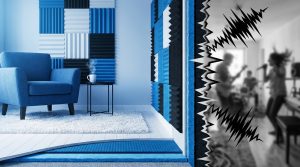
Some sounds are built in: hallway chatter, doors, traffic, construction. Others you introduce: speakers, alarms, clacking keyboard, fan.
If you cannot change the building, you change the layer around your own ears:
– Noise cancelling headphones or at least comfortable over-ear ones
– White noise apps or simple fan noise
– Agreed quiet hours with roommate
Object placement matters for noise too:
– Keep your speaker farther from your head while you study, so you are not overwhelmed by sound even at low volume.
– Put noisy things (mini-fridge, loud fan) as far from the desk as the room allows.
Clutter Physics: How Stuff Arrangement Affects Thinking
There is the motivational poster version of “declutter” and then there is the realistic dorm version: surfaces that are clear enough that your brain does not flinch every time you look at them.
Three Types Of Clutter That Hit Focus Hard
I have noticed three especially harmful kinds:
- Horizontal clutter: flat surfaces buried in objects.
- Vertical clutter: walls full of random, unstructured items.
- Floating clutter: items with no clear “home,” constantly moving.
How they affect you:
| Clutter Type | Effect On Focus | Quick Fix Pattern |
|---|---|---|
| Horizontal (desk, floor) | Signals “unfinished tasks,” spikes mild stress | Give everything a container: trays, boxes, small bins |
| Vertical (posters, notes) | Creates visual noise in your focus frame | Group by theme, leave blank space around key items |
| Floating (random items) | Keeps your attention scanning for “where does this go” | Define a “catch-all” box and a weekly reset time |
Clutter is not about moral failure. It is about unsolved logistics.
Fix the logistics, and your attention frees up.
“Study-Ready” Desk By Default
Imagine sitting down and your desk already looks like it is mid-focus, not mid-chaos. That is worth more than yet another study hack video.
Aim for this default state:
– Laptop or monitor centered
– One notebook and one pen in a fixed spot
– Desk lamp ready and reachable
– Nothing stacked higher than a small book near your keyboard
– Cables tamed enough that you do not knock things over each time you plug in
Trick that helped me: end each night with a 3-minute “future me favor” reset.
- Put all loose papers in one vertical file or shelf.
- Return pens, chargers, and headphones to fixed spots.
- Clear food and cups entirely from the desk.
The key is not perfection. It is changing the default from “messy until I fix it” to “clear until I use it.”
Micro Zones: Turning One Room Into Multiple Spaces
Your dorm is one rectangle, but your brain needs multiple “scenes.” You can fake it with micro zones.
Think: tiny, defined regions, each with a single main purpose.
Typical Micro Zones In A Focus-Friendly Dorm
- Focus zone: desk + chair, best light, minimal decorations, tools in reach.
- Rest zone: bed area, soft textures, warm light, no textbooks or laptop on the pillow.
- Buffer zone: a small slice where items transition in or out: bag hook, shoe mat, laundry basket spot.
- Refresh zone: small area with water bottle, caffeine gear, maybe snacks, but not directly next to the laptop.
In a perfect world, these would be separate rooms. In a dorm, they might be:
– Different sides of the same wall
– Different height levels of a loft bed and under-bed desk
– Different corners created with a shelf or curtain
Physical zoning teaches your brain: “When I sit here, I do *this*.”
If your sleep zone and work zone overlap physically, try to at least separate them in time and light. For example: after a study session, clear objects off the bed and switch lighting to warm and dim.
Case Study: Ultra Small Single Room
Let us imagine a very tight single room: bed along one wall, desk along the window, wardrobe near the door.
How you might zone it:
| Area | Location | Primary Role |
|---|---|---|
| Focus Zone | Desk by window, facing out with door in peripheral vision | Studying, planning, laptop work |
| Rest Zone | Bed opposite or perpendicular, with head away from door | Sleep, offline reading, reflection |
| Buffer Zone | Space near door with hooks, small rug, laundry basket | Transition from outside to room, drop bag, shoes |
| Refresh Zone | Small tray or shelf near desk but not on main work surface | Water, coffee gear, a snack box |
You have not changed the square footage. You have changed the story each part of the room tells your brain.
The Psychology Behind The Arrangement
If the word “energy” feels too vague, you can translate a lot of feng shui ideas into simple cognitive science:
– Visibility influences salience (what your brain notices first).
– Boundaries encode habits.
– Predictable patterns reduce mental load.
Lines Of Sight And Threat Detection
Humans have a built-in “watch the entrance” bias. That background system scans for movement and risk. In a dorm, the “threat” is more like “roommate walking in at the worst moment,” but your body reacts anyway.
Arranging your desk so that:
– You see the door from where you work.
– People do not appear suddenly at your back.
reduces micro-startle events and low-grade vigilance.
That is why the classic feng shui advice “do not sit with your back to the door” makes sense, even without any spiritual frame.
Environmental Cues And Habit Formation
Your brain loves shortcuts. If every time you sit at a particular chair you open your laptop and start a problem set, your brain starts linking that spot with that habit. This is called context-dependent behavior.
You can hack that by making environmental cues as consistent as possible:
– Same desk setup for focused work.
– Same type of light and posture.
– Same minimum level of tidiness.
The more consistent the cue, the less willpower you need to start.
If your desk sometimes means “study,” sometimes means “gaming,” and sometimes means “eating noodles while watching random videos,” your brain cannot predict what the cue calls for. Starting focus work will feel heavier.
Step-By-Step: Rebuilding Your Dorm For Focus In One Afternoon
If you want to apply all this without getting lost in theory, here is a practical flow that fits into a weekend afternoon.
Step 1: Clear The Center, See The Room Fresh
1. Move portable stuff off the floor and into piles on the bed.
2. Stand in the middle and turn slowly, paying attention to what feels cramped or chaotic.
3. Note three things that clearly block movement or line of sight.
You are not judging, you are just collecting data about how your body reacts.
Step 2: Decide The Command Spot For Your Desk
Ask:
– From which angle can I see the door without sitting in the door’s direct path?
– Where can I get the best natural light without glare on my screen?
– What angle helps me avoid facing the whole bed directly?
Try moving the desk temporarily, even if it feels annoying. Sometimes a 90-degree rotation changes your whole experience of the room.
Step 3: Define Your Zones
Grab a notebook and sketch a crude floor plan. Mark:
– Focus zone
– Rest zone
– Buffer zone near the door
– Refresh zone (very small is fine)
Then in the actual space:
- Put your desk and chair in the focus zone, with lamp and study items.
- Strip the bed area of textbooks and electronics; keep it visually softer.
- Place a hook or small rack near the door for bag and coat.
- Assign one shelf or tray as your refresh corner.
Step 4: Build A Clean Focus Frame
Sit at your desk in the position you will study.
Look straight ahead and ask:
– What do I see that pulls me away from work?
– What do I see that supports work?
Remove, cover, or move any distraction from direct sight line:
– Shift laundry baskets to a side that is not directly in front of you.
– Put distractions in drawers, boxes, or under-bed areas.
– Add one or two meaningful study-related visuals where your eyes land first.
Step 5: Fix The Worst Clutter Patterns
Target the high-impact spots:
– Desk surface
– Floor around bed and door
– Any shelf right in your line of sight
Simple container rule:
If it appears loose three days in a row, it deserves a fixed home.
Use:
– One box for stationary
– One box for tech (chargers, cables, headphones)
– One vertical file or magazine holder for active papers
Put boxes where you will actually return things, not where you think they “should” live ideally.
Step 6: Set Your Light Routines
Create two default modes:
- Study mode: overhead + bright desk lamp, minimal colored lights.
- Rest mode: desk lamp off, warm bed-side or wall light on.
Train yourself: do not study in rest mode, do not relax aimlessly in full study mode lighting.
Step 7: Add One Tiny Ritual To Lock It In
Habits stick better when they start and end with small rituals.
Ideas:
– Light a single desk lamp and open your notebook to the same page style before every study session.
– Close the laptop, put pen on top, and switch to warm light at the end of each session.
– Do a 3-minute “reset loop” before sleep: clear the desk, set up for next day’s first task.
You are telling your nervous system, “This is the switch.”
When The Room Fights Back: Common Tricky Situations
Real dorms are not blank canvases. They come with oddities.
Situation: No Choice But To Put Desk With Back To Door
If the architecture locks you in:
– Place a small mirror or shiny object on your desk angled to show the door behind you.
– Keep your back as close to a solid wall as possible, not floating in the middle.
– Ask your roommate or friends to knock or announce themselves before entering during known study blocks.
You are trying to reduce surprise, which reduces background stress.
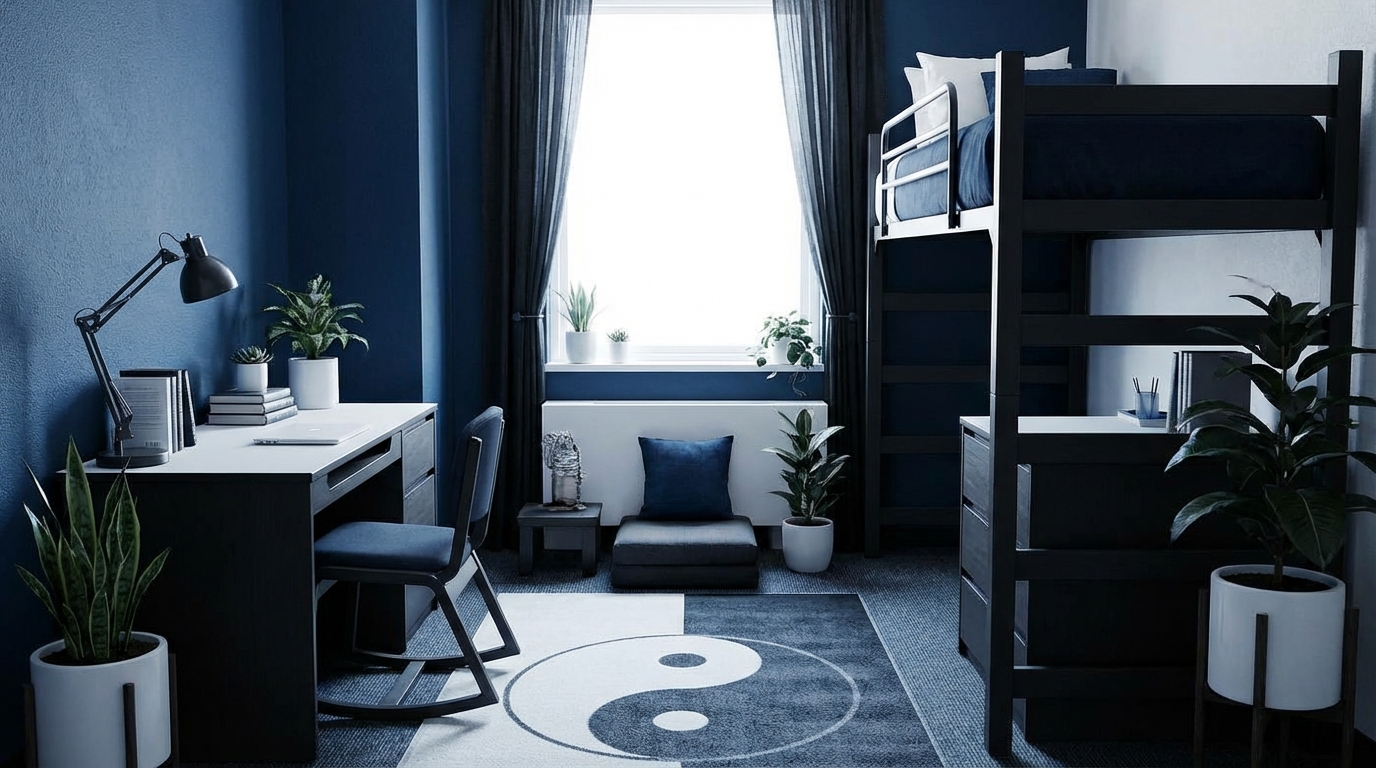
Situation: Bunk Bed With Desk Underneath Feels Like A Cave
This is common in shared rooms.
To make the under-bed desk workable:
- Use strong task lighting from both the side and above, not just a single dim lamp.
- Keep visual decoration above the desk minimal, so you do not feel trapped.
- If the bed slats are visible, cover them with a plain fabric panel to create a smoother “ceiling.”
You want the under-bed space to feel intentional, not like a storage container you happen to study in.
Situation: Roommate Is Messy And You Are Not
You cannot control their half, but you can:
– Angle your desk to reduce how much of their area you see.
– Define a clear visual boundary: a shelf, rug, or curtain line between halves.
– Agree on shared zones (like the middle floor) that must stay clear enough to walk and not trigger constant low-key stress.
You do not have to fix their side. You need to protect your visual and physical space.
Constant Tuning: Your Room As A Live Experiment
The best part of approaching your dorm like this is that it turns you into an experimenter rather than a victim of furniture.
Treat your room like a prototype, not a finished product.
Questions to keep asking every few weeks:
– Where do I accidentally end up when I procrastinate?
– Where do I forget how much time has passed while working?
– Which objects always migrate into the wrong zone?
Then adjust one variable:
– Rotate the desk 30 degrees.
– Move a clutter magnet to a different shelf.
– Shift a light source.
Live with each change for a few days, watch how your focus responds, keep what works, discard what does not.
Over time, your dorm stops being a random container and starts acting like an ally in getting things done, thinking clearly, and then actually resting when you are done.