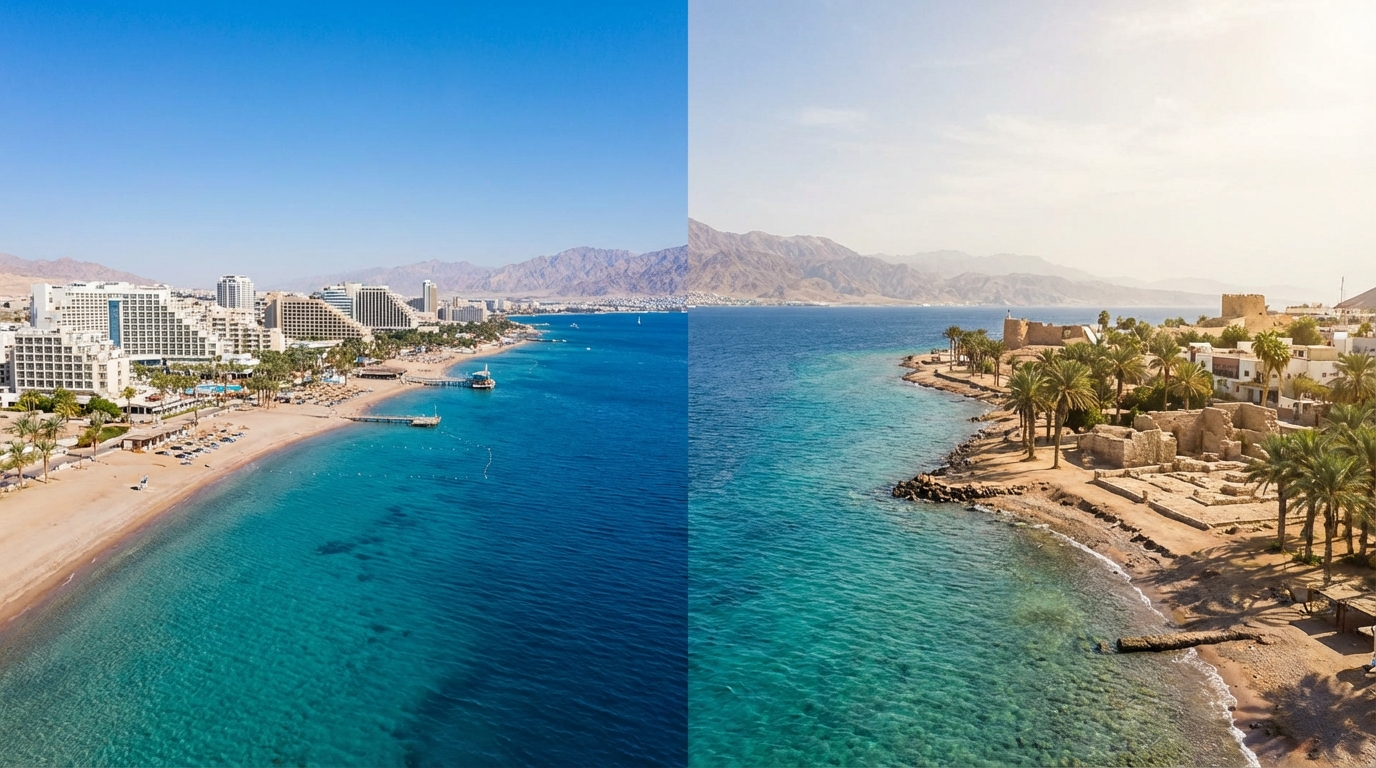
I was scrolling through travel deals at 1:30 a.m. instead of studying, and I noticed something weird: Eilat and Aqaba kept popping up in the same search results like they were siblings fighting over the same Red Sea spotlight. Same water, same coral, different countries… so which one actually makes more sense for a student trip?
TL;DR: If you want nightlife, Western-style vibes, and you are fine spending more money, go to Eilat. If you care more about value for money, chilled local atmosphere, and easier access to Petra and Wadi Rum, Aqaba is the better base. The sea is equally stunning in both.
Big Picture: What Are Eilat and Aqaba, Really?
I realized during a geography lecture that Eilat and Aqaba are basically two sides of the same bay. Same Red Sea gulf, same fish, same sun, but very different contexts: one is in Israel, one is in Jordan. You can literally see one from the beach of the other.
So if they share the same water, what actually separates them?
Eilat is the louder, more expensive beach city with a “mini Tel Aviv by the sea” feel.
Aqaba is the calmer, cheaper gateway to Petra and Wadi Rum with more local character.
Here is the high-level contrast:
- Country: Eilat = Israel, Aqaba = Jordan
- Vibe: Eilat = resort-town-meets-shopping-mall, Aqaba = port city plus resorts and local life
- Price level: Eilat is generally more expensive; Aqaba is usually cheaper for food, taxis, and hotels
- Side trips: Eilat is better for the Negev desert and Timna Park; Aqaba is better for Petra and Wadi Rum
- Nightlife: Eilat wins clearly; Aqaba is calmer and more family oriented
Quick Comparison Table
| Category | Eilat (Israel) | Aqaba (Jordan) |
|---|---|---|
| Average daily budget (student, low-mid) | 80-130 USD | 40-90 USD |
| Overall vibe | Touristy, loud, “resort city + mall” | Relaxed, mixed local and tourist feel |
| Nightlife & alcohol | Lots of bars, clubs, alcohol widely available | Some bars & beach lounges, but mostly quiet |
| Best for | Parties, shopping, short Israel getaway | Budget trips, Petra & Wadi Rum combos |
| Beach quality | Good public & hotel beaches, some rocky | Good beaches, several private resort strips |
| Snorkeling & diving | Very strong, famous coral sites | Very strong, fewer crowds at some spots |
| Visa complexity | Depends on your passport & Israel policies | Often easier for many nationalities |
| Side trips | Timna Park, Negev hikes, desert tours | Petra, Wadi Rum, desert camps |
Cost: Where Does a Student Budget Survive Longer?
The first thing I always check is: how fast is my savings going to evaporate?
In my notes from comparing prices, Eilat felt like a place where my debit card would keep crying, while Aqaba looked more like a reasonable “I can eat and still have money for a boat trip” situation.
Accommodation
- Eilat: Hostels and cheap hotels exist, but they are not super cheap. Budget dorm beds often sit around 25-40 USD per night. Mid-range hotel rooms can jump to 120-200 USD very quickly, especially in peak season and during holidays.
- Aqaba: You can find hostel dorms around 10-20 USD and private rooms from 25-50 USD. Beachfront resorts cost more, but still tend to be cheaper than equivalent big-name resorts in Eilat.
If your trip is more “student with a backpack” than “family resort vacation,” Aqaba gives you more nights for the same money.
Food and Drinks
Food tells you a lot about a place. It also tells you if you are going to need instant noodles later in the trip.
- Eilat: Cafes and restaurants feel like city prices. A basic sit-down meal can easily be 15-25 USD. Street food is more affordable but still not cheap. Alcohol is available almost everywhere but is not cheap either.
- Aqaba: Local eateries, shawarma spots, and small restaurants are much more budget friendly. A filling meal can be 5-10 USD. Tourist restaurants on the water cost more, but you can still eat decently without blowing your budget. Alcohol is available but less visible and more limited.
Transport and Activities
- Eilat: Getting around by bus is cheap, but taxis can be pricey. Activities like boat excursions, diving, and water sports are well organized but can be costly, especially with resort markups.
- Aqaba: Local taxis generally cost less, especially if you agree on a price in advance. Activity prices, especially outside the fancy resorts, can be lower than in Eilat. Trips to Petra and Wadi Rum add cost, but they feel like big-ticket experiences rather than everyday spending.
If you are very cost sensitive, Aqaba clearly wins. Eilat can work on a student budget, but you need to plan more carefully, look for hostel deals, and probably cook more or choose cheaper eats.
Vibe & Atmosphere: What Does Each City Feel Like?
It is like that feeling when you step off a bus and instantly know whether a place is “you” or not. Eilat and Aqaba have very different energies even though they share the same bay.
Eilat: Resort City, Shopping, and Energy
Eilat feels like an Israeli vacation bubble. Hebrew everywhere, lots of domestic tourists, loud music near the main beach, and large hotels stacked near the shore.
Think: malls, big hotel chains, beach bars, families, student groups, and a general sense that nobody is thinking about exams here.
Key vibe points for Eilat:
- Tourist-focused: The city is designed for holidaymakers. There are promenades, shopping centers, and attractions like ice skating and an underwater observatory.
- Nightlife: Bars, clubs, and late-night spots are easy to find. If you want to go out, drink, and stay up, Eilat is very suitable.
- Music & noise: In popular areas, there is music, traffic, and typical resort-city noise. Quiet spots exist but are not the default near the center.
- Language: English is widely spoken; tourist infrastructure is very developed.
Aqaba: Port City with a Slower Rhythm
Aqaba is a real city that happens to have resorts, not just a resort constructed from scratch. You feel more local life: shops, markets, people doing everyday errands, and then pockets of tourist activity.
Key vibe points for Aqaba:
- Mixed atmosphere: There are both international hotels and simple local cafes. You can move between “resort bubble” and “local streets” easily.
- More chilled evenings: The city does not shut down early, but it is not a big party hub. People stroll, drink tea, eat dessert, and sit on the corniche.
- Cultural context: Jordan is more conservative than Israel, and you notice that in dress codes, public drinking, and PDA. You will likely adjust your behavior a bit, especially away from resort areas.
- Language: Arabic dominates, but tourism workers usually speak English. You might need more patience ordering in smaller places, but it is manageable.
If your dream Red Sea trip involves clubs and loud parties, Eilat wins. If you want a slower pace and more local feeling without constant noise, Aqaba is more comfortable.
Beaches, Water, and Weather
During an oceanography lecture, I realized something funny: coral and fish do not care which flag is near the shore. The marine life is spectacular on both sides of the gulf.
Water Quality & Marine Life
The Red Sea here is clear, warm, and rich in coral.
For snorkeling and diving, both Eilat and Aqaba are extremely strong; the main difference is how crowded and commercial the access points feel.
- Visibility: Usually very good in both cities, often 20 meters or more.
- Temperature: Warm enough to swim most of the year, cooler in winter but still bearable for many people.
- Coral health: Some areas have damage from human activity, but many sites still have beautiful coral and a wide variety of fish.
Beach Experience
Eilat:
- Plenty of public beaches, some sandy, some with pebbles.
- Hotel beaches can feel crowded in peak seasons.
- Facilities like showers, chairs, and shade are common but sometimes tied to paid services.
- The Coral Beach Nature Reserve area has some of the best accessible snorkeling but also entry fees and rules.
Aqaba:
- Mix of public city beaches and private resort beaches.
- South Beach area has coral and is a good zone for snorkeling and diving.
- Public beaches around the city center can feel more local and less tourist-polished; dress codes are more conservative there.
- Some of the best beach and reef experiences are connected to resorts or dive centers a bit away from the very center.
Weather Considerations
Red Sea weather is generally dry and sunny, but there are still practical differences.
- Summer (June-September): Very hot in both Eilat and Aqaba, often 35-40°C or more. Good for the sea, but you need to be careful with sun exposure.
- Winter (December-February): Mild days, cooler evenings. Water can be a bit cold for long swims but many people still go in. Nice time for hiking and side trips.
- Shoulder seasons: Spring and autumn often bring the best balance of warm water, comfortable air temperature, and slightly fewer crowds.
The climate is similar enough that weather alone should not decide your choice. It comes down more to price, vibe, and what you want beyond the beach.
Snorkeling & Diving: Which Side Wins Underwater?
From a student perspective, diving is where the real Red Sea bragging rights live. Posting a photo next to coral or a sea turtle is worth about ten generic beach selfies.
Both Eilat and Aqaba offer world-class diving for beginners and advanced divers. The difference is in price, crowding, and the broader trip context.
Dive Sites & Quality
Eilat highlights:
- Coral Beach Nature Reserve
- The Caves
- The Satil wreck
Aqaba highlights:
- Cedar Pride wreck
- Japanese Garden
- Power Station Reef
- Various artificial reef structures and some new wrecks
Both sides have colorful coral, reef fish, and accessible sites for beginners. Some divers argue Aqaba’s sites are slightly less crowded and feel more spacious. Eilat’s dive centers are very experienced, but you often share sites with many other divers, especially during holidays.
Dive Schools, Courses, and Prices
Eilat:
- Large number of dive centers, often with long histories and a lot of certification experience.
- PADI and other course options widely available.
- Prices tend to be higher, especially for full certification courses.
Aqaba:
- Strong growth in dive tourism, with many centers offering international certifications.
- Often cheaper for fun dives and courses compared to Eilat.
- More package deals that combine accommodation plus diving.
If you want to do a full open water course on a students budget, Aqaba frequently comes out cheaper. If you are already in Israel and want a couple of day dives with very established operators, Eilat is convenient.
Access, Visas, and Practical Stuff
This is the part everyone ignores until they are sitting in front of a border officer trying to explain their travel route.
Your passport, previous travel history, and regional politics can quietly decide whether Eilat or Aqaba makes more sense.
Getting There
Eilat:
- Access via Ramon Airport (south of the city) for domestic flights from Tel Aviv and some international routes in certain seasons.
- Intercity buses from Tel Aviv, Jerusalem, and other cities.
- Overland routes from the rest of Israel are straightforward.
Aqaba:
- King Hussein International Airport near Aqaba, with some international flights and domestic flights from Amman.
- Four to five hour drive or bus from Amman.
- Ferry and border crossings from Egypt in some cases, depending on routes.
There is also a land border between Eilat and Aqaba (the Wadi Araba / Yitzhak Rabin crossing), which allows travelers to visit both cities in one trip if their passports and visas make that possible.
Visas and Restrictions
Here is where your situation matters and also where many students make mistakes.
- Israel (Eilat): Entry rules depend heavily on nationality and political context. Some passports have visa-free entry, some need visas in advance, and some travelers might face extra questioning.
- Jordan (Aqaba): Jordan often has smoother visa policies for a wider range of nationalities, including visa on arrival for many. There is also the “Aqaba Special Economic Zone” context, where certain arrivals into Aqaba get simplified visa rules, but you should check the latest official information.
If your passport makes entering Israel complex or risky for future travel, Aqaba may be the more practical choice. If you already plan an Israel trip and you can enter without issues, Eilat is natural to include.
Safety, Culture, and Comfort Level
Everyone asks: “Is it safe?” But the better question is: “Safe for what type of behavior and expectations?”
Safety
In general, both cities are used to tourists and have strong security presence.
- Eilat: Israel has tight security infrastructure. You might feel very watched but also quite safe from common crime in the main areas. The downside is that regional tensions can affect travel plans suddenly.
- Aqaba: Jordan has a strong focus on tourism and keeps main tourist areas stable. Normal precautions apply: watch for petty theft, be aware at night, avoid drunk behavior in non-tourist areas.
From a basic “walking around as a visitor” point of view, both cities can be comfortable if you follow normal city smarts.
Cultural Expectations
Dress and behavior:
- Eilat: Dress is very casual and liberal. Beachwear, shorts, tank tops are normal. Public drinking is common in tourist areas.
- Aqaba: Resorts are more relaxed, but in local streets people dress more conservatively. Tourists are not expected to fully match local dress, but modest clothing away from beach zones shows respect. Public drunkenness will stand out a lot more here.
Alcohol and nightlife:
- Eilat: Bars and clubs are a core part of the city vibe. If your plan includes bar-hopping, this city fits that easily.
- Aqaba: You can find bars, hotel lounges, and places to drink, but the overall social life leans more toward cafes and relaxed gatherings.
If your travel style is respectful and curious, both places are fine. If your group tends to be loud, heavily drunk, and not very self-aware, you will probably create less friction in Eilat.
Side Trips: What Can You Add To Your Red Sea Base?
For a student trip, the best travel trick is stacking multiple experiences from one base. Both Eilat and Aqaba give you that, but in different directions.
From Eilat
Timna Park:
- Striking desert scenery, ancient copper mining context, and dramatic rock formations.
- Good for hiking, cycling, and photography.
Negev Desert:
- Access to longer hikes and desert reserves.
- Overnight desert experiences, stargazing, and nature trips.
If you are doing a larger Israel route, Eilat is also a stepping stone toward places like the Dead Sea, Masada, and further north to Jerusalem and Tel Aviv. That said, those are several hours away.
From Aqaba
This is where Aqaba clearly wins the combination game.
Petra:
- One of the most famous archaeological sites on earth.
- About 2 hours to 2.5 hours by road from Aqaba.
- Day trips are possible, but an overnight stay near Petra lets you see more.
Wadi Rum:
- Red sand desert with massive rock formations and long horizons.
- Jeep tours, hiking, climbing, and camping under the stars in Bedouin camps.
- Roughly 1 hour from Aqaba.
If your dream itinerary is “Red Sea + Petra + sleeping in a desert camp,” Aqaba is the logical base.
The combination value here is hard to ignore. On a one-week trip, you can realistically do Aqaba + Wadi Rum + Petra without feeling rushed, and your budget will survive better than an equivalent Eilat + multi-city Israel tour.
Student Experience: What Actually Matters For Us?
Putting aside brochure talk, what does this look like for a real student trip with limited time and money?
If You Choose Eilat
You probably:
- Are already in Israel or planning a bigger Israel route.
- Want to balance daytime water activities with nightlife.
- Feel comfortable spending more each day.
- Prefer a setting where Western norms for dress and behavior match very closely with your default habits.
- Care more about the Negev and desert scenery than Petra itself.
Eilat is suitable for:
- Short 2-4 day sea breaks during a longer academic exchange or internship in Israel.
- Group trips where people want clubs and late nights.
- Diving courses if you are already based in Israel and travel cost is low.
If You Choose Aqaba
You likely:
- Want the strongest value-for-money ratio.
- Are excited by Petra and Wadi Rum, not just the sea.
- Are comfortable with, or curious about, a more conservative cultural setting.
- Do not need intense nightlife; you prefer chilled evenings.
- Are traveling overland around Jordan or the region.
Aqaba is suitable for:
- One-week trips mixing sea, desert, and archaeology.
- Low to mid-budget backpacking or student group travel.
- Dive trips that aim for lower costs per dive and less crowded sites.
Common Misconceptions and Bad Approaches
Some trip-planning habits really do not match how these cities work on the ground.
1. Trying to “Do Both” in 2 Days
On a map, Eilat and Aqaba look extremely close. People get tempted to book one night in each and treat the border as just a casual bridge.
Border crossings involve time, paperwork, and sometimes interviews. They are not like a quick bus transfer.
If you only have 2 or 3 days, trying to split between both will eat time and increase stress without adding much value. Pick one side and commit.
2. Ignoring Visa and Stamp Issues
Some travelers do not think about how entry into Israel can affect future travel to other countries, or how previous stamps from certain countries might affect entry now.
You should:
- Read current entry rules for your passport for both Israel and Jordan.
- Consider long-term effects on future travel routes.
- Avoid planning complicated border hopping if you have a sensitive passport situation.
If your long-term plan involves visiting multiple countries with tense diplomatic relations, going for the simpler visa path (often Aqaba / Jordan) can be the more rational choice.
3. Expecting the Same Beach Norms in Aqaba as in Eilat
Some people treat Aqaba like a copy-paste of Eilat and then feel uncomfortable when locals stare at very revealing beach outfits away from the resort zones.
You should adjust:
- Swimwear for hotel and resort beaches is fine.
- In city public beaches and streets, modest clothing is more appropriate.
- Public affection and loud drunk behavior are better avoided in local areas.
This is not about “being scared”; it is just about basic cultural respect.
Which Is Better For You? Scenario-Based Picks
Sometimes the only way to make a decision is to test it against real student scenarios.
Scenario 1: Erasmus Student in Tel Aviv With a Long Weekend
You have 4 days, exams are far enough away to ignore for a bit, and you want a sunny break.
- Travel time to Eilat: easy bus or flight.
- Travel time to Aqaba: requires border crossing, planning, and maybe visas.
Pick: Eilat. The convenience outweighs the higher cost. You can always visit Petra some other year.
Scenario 2: Budget Backpacker Doing a 10-Day Trip
Your plan: some sea time, some hiking, some culture, and your budget is limited.
- Aqaba gives you Petra and Wadi Rum within short driving distance.
- Accommodation and food are cheaper there.
Pick: Aqaba. You get more experiences per dollar and a strong combo route.
Scenario 3: Dive Nerd Who Wants an Open Water Course
You want to get certified and do it in warm water, but you also care about instruction quality.
- Eilat: many long-established dive centers, but higher course prices.
- Aqaba: growing dive scene, lower prices, good visibility.
If you are already in Israel, Eilat makes sense for logistics. If you are choosing from scratch on a student budget, Aqaba is a strong pick, as long as you research a reputable dive school.
Scenario 4: Group That Cares About Nightlife More Than Museums
Your group chat is full of “Where are we going out?” not “What are we learning?”
Pick: Eilat. The bar and club scene is more intense and closer to typical European student party culture.
Scenario 5: Student Interested in Middle Eastern Culture and History
You care about conversations with locals, regional context, and major heritage sites.
Pick: Aqaba. Combined with Petra, Wadi Rum, and Amman, you get a deep look at Jordan and a lot of cultural variety around one Red Sea stop.
Final Verdict: Eilat vs. Aqaba
If I strip away marketing and focus on the student lens, the comparison ends up like this:
Eilat is better if you value nightlife, convenience within an Israel trip, and do not mind higher prices.
Aqaba is better if you care about budget, Petra and Wadi Rum, and a calmer, more local-feeling experience.
The Red Sea itself is not the deciding factor. The water is beautiful on both sides. Your context, your passport, your budget, and your travel style are what really choose between Eilat and Aqaba.