I once paid 18 euros for microwave pasta at a “famous” restaurant in Rome. The waiter called me “my friend” five times and I still walked out hungry and annoyed.
So here is the TL;DR: To avoid tourist traps and find real food, ignore big signs and TikTok lines, watch where locals actually eat, read menus like a detective, and test a place with small orders before you commit your whole meal or budget.
Why Tourist Traps Exist (And Why Students Fall For Them)
I realized during a trip on a tight student budget that tourist traps are not accidents. They are a business model.
They are built around one idea: they will probably never see you again, so they do not have to impress you. They just need you to sit down once.
Typical pattern:
– Prime location near a big attraction
– English-only or many-language menu with photos
– High prices, average food
– Staff outside trying to pull you in
We fall for them because:
– We are tired and hungry after walking
– We feel pressure to not “waste time” searching
– We trust “Top 10” lists without context
– We panic when we do not understand the local language
The fastest way into a tourist trap is to eat near where you are sightseeing. The fastest way out is to walk 5 to 10 minutes away from the attraction before you start hunting for food.
Signs You Are About To Enter A Tourist Trap
Visual Red Flags Outside The Restaurant
Look at the outside before you even touch the menu.
- Location glued to a major sight: Right in front of the cathedral, next to the famous fountain, on the main square. High rent often means they rely on foot traffic, not repeat customers.
- Aggressive hosts out front: If someone is physically blocking your path, waving menus, or repeating “Very good, my friend!”, treat it like a warning siren.
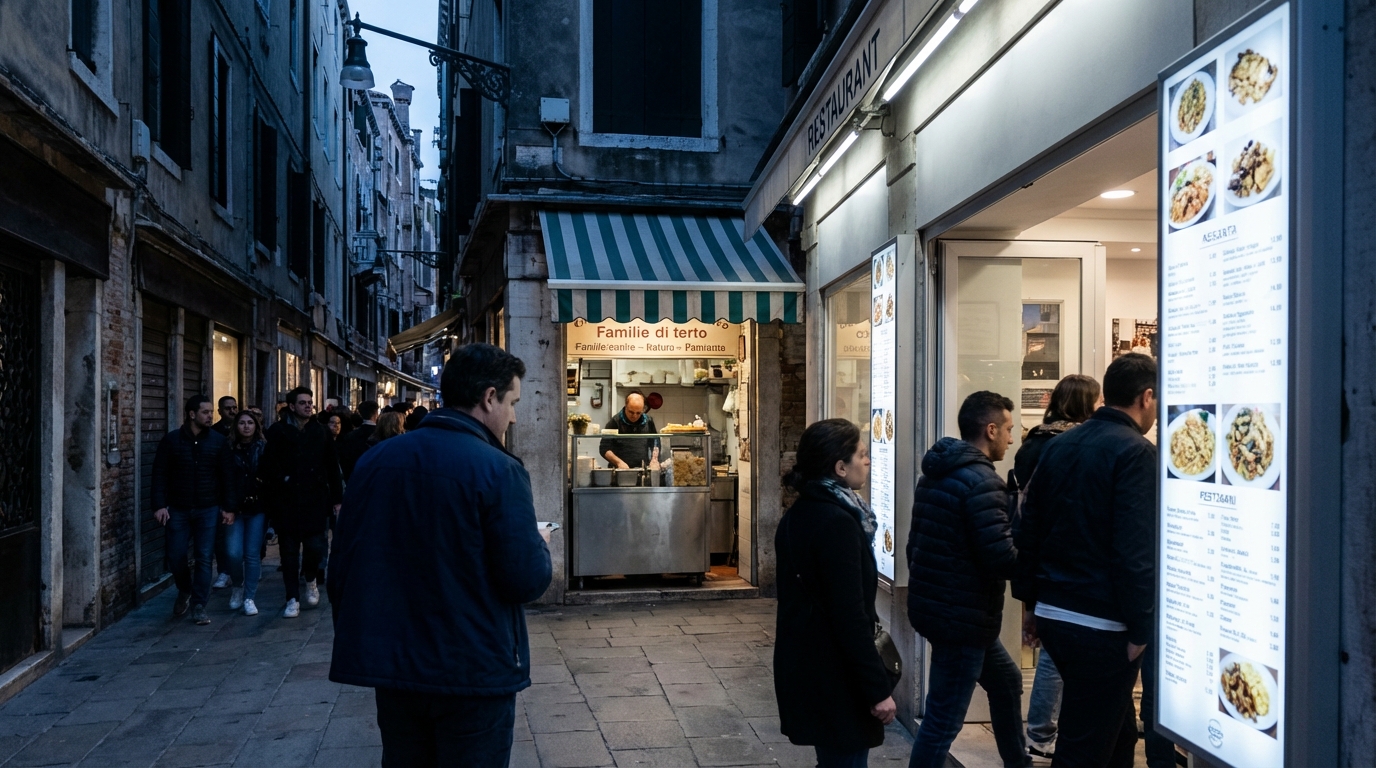
- Huge, laminated photo menus: Especially when every dish has a stock-photo look and descriptions are in six languages.
- Menu translated into many languages: English, French, German, Chinese, Russian, all on one board. Some languages are normal in touristy cities, but a giant international spread often means they target anyone with a camera, not local regulars.
- “Traditional” written everywhere: “Authentic,” “original,” “typical,” “homemade” plastered all over signs with zero context. Real places rarely need to shout that hard.
- TV screens looping promotions: Especially showing dishes that no one inside is actually eating.
If the restaurant looks like a billboard more than a place where people relax and talk, that is your cue to keep walking.
Menu Red Flags Before You Sit
Ask to see the menu and step aside. Do not let a waiter rush you into a seat.
Watch for:
- Huge menu with 60-100 items: Real kitchens cannot cook that many fresh dishes well every day. This often means frozen or pre-made food.
- Everything looks “international”: Pizza, sushi, burgers, curry, tacos, pasta, steaks, all at the same place. This is not a restaurant, it is a compromise.
- No seasonal dishes: Same menu year-round with zero reference to local produce, daily specials, or seasonal items.
- Weird “local” dishes that locals do not eat: “Traditional Irish nachos,” “authentic Italian carbonara with cream,” “Japanese sushi burger.” These exist for photos, not for people who live there.
- Expensive soft drinks, cheap alcohol: High markups on water and soda, but “2 for 1 cocktails” at all hours. That often funds the rent, not the food quality.
Atmosphere Red Flags Once You Step Inside
Sometimes you only notice the trap when you are already sitting. You can still leave politely before you order.
Check for:
- No one speaks the local language at the tables: Every table in English or other visitor languages, zero local chatter.
- No regulars: No staff greeting anyone by name, no one paying at the bar and chatting, no sense of familiarity.
- Very fast “assembly line” service: Starters arriving 2 minutes after you order, mains 5 minutes later. Real cooking takes longer.
- Instant bill pressure: Staff hovering, pushing for more orders or dessert, or dropping the bill before you ask.
If every table feels like it will fully change within 45 minutes, the place probably runs on volume, not loyalty.
Signs You Have Found A Place Locals Actually Trust
Clues From The Street
When I started treating restaurant hunting like a low-stakes investigation, everything changed.
Look for:
- Plain exterior, busy inside: Simple sign, maybe no glowing photos outside, but the interior has a good buzz.
- Short menu posted at the door: A few starters, mains, and desserts. Sometimes handwritten or on a chalkboard.
- People waiting outside calmly: Not a TikTok queue with selfie sticks, but local-looking people checking their watches and chatting.
- No one trying to pull you in: Staff are busy serving people who have already chosen to come.
Who Is Actually Eating There?
Watch the crowd before you commit.
| Signal | Tourist Trap Vibe | Real Place Vibe |
|---|---|---|
| Languages at tables | Mostly English / visitor languages | Mostly local language with a mix of others |
| Age mix | Groups of visitors, same age | Families, older couples, people eating solo |
| Time of visit | Full at odd “tourist hours” | Matches local meal times |
| Repeat customers | No one greeted by name | Staff recognizing regulars |
If you see one person reading a book while eating alone and looking unbothered, it is usually a good sign.
Menu Clues At Good Spots
This is where you switch from “hungry traveler” to “menu inspector.”
Positive signs:
- Short menu: A dozen items done well beats 50 dishes done carelessly.
- Daily specials: A “menu of the day,” lunch formula, or a board that changes often.
- Seasonal references: Asparagus in spring, game in autumn, things that match the local calendar.
- Local dishes present but not exaggerated: They offer regional specialties but do not scream “authentic!” every two lines.
- Reasonable, not extreme pricing: Not the cheapest on the street, not absurdly high compared to neighboring spots.
How To Use Apps Without Getting Trapped
I used to search “Best restaurants near me” and pick from the top 5. That is how I ended up eating reheated paella next to people taking photos of each grain.
The twist: tourist traps game platforms too. High foot traffic, lots of one-time visitors, and friendly staff can produce hundreds of enthusiastic reviews from people who do not know what good local food should taste like.
Smarter Review Reading
When you use apps or maps, read like a skeptic.
- Sort by “Most recent”: Ratings drift over time. A 4.7 average with bad recent reviews tells you more than a shiny overall score.
- Look for reviews from locals: On some platforms you can see where reviewers are from. Reviews written in the local language carry strong signals.
- Ignore generic praise: “So good!” “Amazing!” “Best ever!” is noise. Focus on detailed comments about specific dishes and service.
- Watch for complaints: Consistent notes about “cold food,” “microwaved,” “tourist prices,” or “service rushed” should block the place instantly.
- Compare food photos to menu photos: If actual customer photos look much worse than the official ones, treat it like a red flag.
The “Three Tab” Method
Here is a quick method that has saved me from a lot of nonsense:
1. Open maps.
2. Search for restaurants around your current area, not near the giant attraction.
3. Pick three places with:
– Rating above 4.2
– At least 200 reviews (or fewer in small towns)
– A balanced mix of local-language and foreign-language reviews
Then:
- Check photos: Does the place look like somewhere people relax, or a backdrop for selfies?
- Check hours and typical busy times: Popular local places have consistent busy hours, not full at only 4 pm.
- Walk by in person before deciding: Online information gets you 70% there. Your instincts close the gap.
Off The Beaten Path: Walking Patterns That Lead To Real Food
Distance From Main Attractions
It sounds trivial, but the “10-minute rule” is one of the strongest filters.
Walk 10 minutes away from a major sight before you start taking restaurants seriously.
Patterns that help:
- Turn off the main shopping street: Side streets with less foot traffic often host places for actual locals.
- Head toward residential areas: Look for supermarkets, dry cleaners, kids playing, not souvenir shops every 5 meters.
- Follow office workers at lunchtime: They know the affordable, reliable spots. If you see people with ID lanyards forming a line, you are close.
Time Of Day Matters
Knowing when locals eat gives you extra clues.
| Region | Typical Lunch Time | Typical Dinner Time |
|---|---|---|
| Southern Europe (Spain, Italy, Greece) | 1:00 pm – 3:00 pm | 8:00 pm – 10:30 pm |
| Central / Northern Europe | 12:00 pm – 2:00 pm | 6:30 pm – 9:00 pm |
| East Asia (Japan, Korea) | 11:30 am – 1:30 pm | 6:00 pm – 9:00 pm |
If a place is packed at times when locals usually eat, that is a good sign. If it is full at strange in-between hours with only visitors, be cautious.
Asking Humans: How To Get Reliable Local Recommendations
At some point I realized: I was asking algorithms for answers that actual humans around me already knew.
Who You Ask Matters
People who interact with visitors all day can be helpful, but they also often send you to the “safe” popular spots.
Better sources:
- Students: Especially at campuses nearby. They know where to eat well without going broke.
- Office workers: Ask at a coffee shop during a weekday morning: “Where do you go for lunch around here?”
- Taxi / rideshare drivers: If they are not being paid by a restaurant, they usually know solid affordable places.
- Local shopkeepers: Small, non-touristy shops often have staff who live in the area.
Good questions to ask:
- “Where do you eat with your friends?”
- “If you had 15 euros for lunch, where would you go around here?”
- “Where would you take someone visiting from another city?”
Avoid asking:
- “What is the best restaurant in the city?” (Too broad, invites tourist answers.)
- “Where do tourists usually eat?” (You already know that direction.)
Ask: “If your favorite place was fully booked, where would you go next?” The second choice is often more accessible and still very good.
Reading Menus Like A Local
Learn A Few Key Words
You do not need full language mastery. A cheat sheet goes a long way.
Examples:
- Home-style words: “house special,” “grandma style,” “home cooking” in the local language often points to more traditional dishes.
- Preparation terms: grilled, stewed, baked, braised, marinated. Knowing these helps you understand what you are ordering.
- Common sides: rice, potatoes, salad, bread. You avoid surprises and can judge portions better.
Before a trip, make a tiny note on your phone with 15-20 food words. That alone raises your hit rate.
Balance of Dishes
Look for structure. A thoughtful menu often has:
- Starters or small plates
- Core mains that fit the region
- At least one vegetarian option that is not just “salad”
- Desserts that match local traditions, not only “chocolate lava cake” and “cheesecake”
If the menu feels like someone copied internet trends without any regional logic, the kitchen might be chasing visitors, not flavor.
Pricing Signals
Overpriced is not always a trap; sometimes the area is just expensive. What matters more is how items relate to each other.
Patterns to notice:
- Main dishes all at the same price: Burger, pasta, stir-fry, steak, all at 16.90. That often means cost and effort are not matched to pricing.
- Cheap mains, expensive extras: Small base price, but bread, water, sauces, and sides cost a lot.
- Local dish slightly cheaper than “safe” dishes: If the regional option is better priced than the burgers and pizzas, they probably expect repeat local customers ordering that.
Testing A Place Before You Commit
I started doing small experiments instead of trusting my first impression. It saved both money and stomach space.
Order Something Small First
If you are not sure yet:
- Start with a drink and one small plate or starter.
- Judge the bread, olives, or small free bites if they come.
- Watch plates going to other tables: Are people finishing their food? Does it look fresh?
If the starter is obviously microwaved, bread is stale, and service is tense, it is totally fine to stop there and move on. You are not obligated to stay for three courses.
The “Kitchen Glance” Check
When possible, look briefly toward the kitchen or pass by it on the way to the bathroom.
Notice:
- Is there actual cooking activity or mostly reheating?
- Are there real ingredients visible, or only pre-packaged tubs?
- Can you smell cooking smells that match the dishes, or only oil and cleaning chemicals?
This is not a perfect test, but your senses are often more reliable than online ratings.
Street Food, Markets, And Home-Style Options
Sometimes the most “authentic” food in a place is not a restaurant.
Street Food Stalls
Stalls can be fantastic and also can be tourist traps, so the same logic applies.
Good signs:
- Short focused menu: One or two specialties.
- Constant flow of people, especially locals.
- Food cooked to order, not sitting under a heat lamp for ages.
Bad signs:
- Massive colorful signs in English only, on a street saturated with visitors.
- Pre-made items piled up in the window from early morning.
- Prices higher than nearby cafes with seating.
Markets And Food Courts
Public markets often have both genuine vendors and stalls aimed at visitors with inflated prices.
Strategy:
- Walk the full circuit once before buying anything.
- Watch where older locals shop or sit down to eat.
- Choose vendors with simple setups and repeat customers.
Home Cooking Experiences And Student Canteens
Two underrated options:
- Home dining platforms: Some cities have legal, organized “eat at a local home” programs. Food is usually simple but very real.
- University cafeterias: If you are a student, some universities let visitors eat in their canteens. Food is often basic but reflects local daily eating habits.
If you want to understand how people eat, watch what they eat when no one is trying to impress anyone.
Balancing Authenticity With Your Own Comfort
It is easy to get obsessive and treat every choice like a moral test. That is not helpful.
Food Anxiety vs. Food Curiosity
Signs you are taking the hunt too far:
- You refuse to eat anywhere unless you have triple-checked every review.
- You feel guilty if a meal is “only okay.”
- You skip meals rather than risk a slightly touristy place.
It is fine to say:
– “I just want something quick and decent near here.”
– “I am tired; I do not mind if this is a bit touristy as long as the food is decent.”
The whole point is not to become a snob, but to gain enough skill that you do not feel trapped or exploited.
Respecting Local Context
Some “touristy” places are still meaningful in their own way.
For example:
- Historic cafes that locals rarely visit now but still have real heritage.
- Famous pastry shops where visitors line up, but quality is genuinely high.
- Iconic bars where cocktails are expensive but worth trying once.
In those cases, you are not being scammed; you are paying for a mix of story, setting, and flavor. That can be a valid choice as long as you know what you are doing.
Student Budget Tactics For Better Food
Travel budgets are usually tight for students. That actually gives you an advantage: you cannot afford to overpay for bad meals, so you learn faster.
Timing Your “Big” Meals
A useful pattern:
- One main meal per day at a place you have researched or scouted.
- Lighter meals from bakeries, snack bars, or supermarkets for breakfast and one other time.
- Use lunch for fancier spots: Many restaurants have cheaper lunch menus with the same kitchen quality.
Self-Catering Without Being Boring
Hostels or apartments with kitchens open up options:
- Go to local supermarkets or street markets and buy regional ingredients.
- Cook simple dishes and taste local cheeses, breads, fruit, and sauces.
- Spend saved money on one or two carefully chosen restaurant meals.
You do not have to eat out three times a day to understand how people actually eat. Grocery aisles tell stories too.
Trusting Your Senses Instead Of FOMO
The more I travel, the more I realize my nose, eyes, and ears beat app reviews half the time.
Ask yourself as you stand outside a place:
- Do the smells coming from inside make me hungry?
- Do the people inside look relaxed, or rushed and annoyed?
- Would I come back here next week if I lived in this neighborhood?
If the honest answer feels positive, that is usually enough. If it feels like you are about to sit inside a live advertisement, walk away.
You do not have to eat “the best” thing in a city. You just have to avoid paying too much for something forgettable.
And once you start noticing these patterns, tourist traps stop feeling like an inevitable part of travel and start feeling like a puzzle you know how to solve.