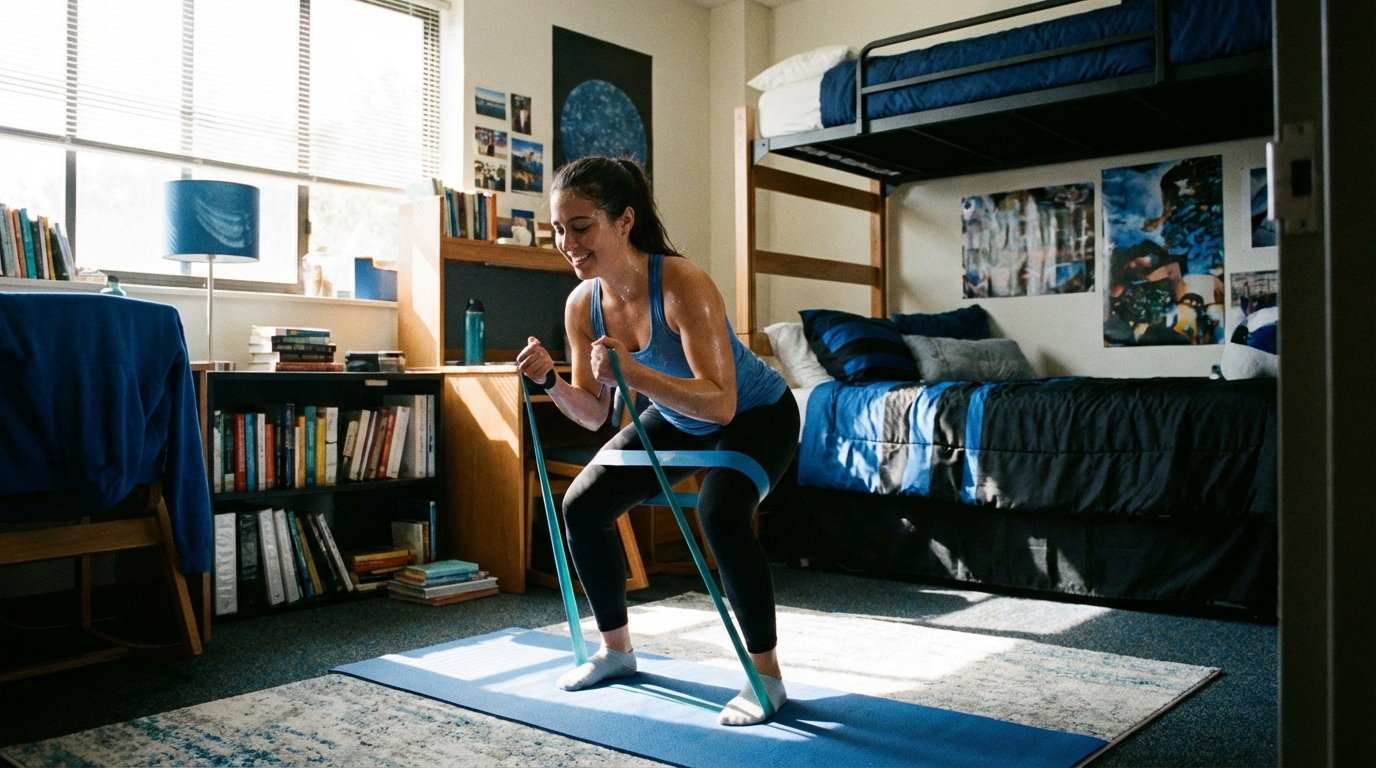
I was sitting at my desk, watching yet another “perfect” gym routine video, when I looked at the clock and realized I had exactly 23 minutes before my next class. Gym? Not happening. Nap? Tempting. So I did a 20-minute workout next to my bed and felt more awake than after any coffee.
If you are a busy student, you do not need a gym membership, fancy gear, or a 90-minute routine. You can get stronger, fitter, and more focused with short 20-minute workouts in your dorm room, as long as you are consistent, you push yourself honestly, and you pick the right exercises. The problem is not time. The problem is doing nothing because you think you need “the perfect setup.”
Short, intense, consistent 20-minute workouts can make a measurable difference in your strength, energy, and mood, even if your “gym” is a 3-meter strip of carpet between your bed and your desk.
Why 20-Minute Dorm Workouts Actually Work
I realized during a lecture on habit formation that most of us are not failing at fitness because we are lazy. We are failing because our plans are unrealistic. A 90-minute gym session five days a week sounds impressive, but try sticking to that in exam season.
Here is why 20-minute dorm workouts work so well for students:
- Low friction: No travel time. No locker room. No equipment. You can start in under 60 seconds.
- High frequency: It is easier to do 20 minutes 4 to 6 times a week than 60 minutes once.
- Good enough stimulus: If you go hard, bodyweight exercises are more than enough for strength and cardio.
- Better focus: Short bursts of movement can clear mental fog before study blocks.
- Habit-friendly: 20 minutes fits between classes, before showers, or during a study break.
If your workout is so long that you skip it often, it is a bad plan, even if it looks “perfect” on paper.
What Can You Actually Expect From 20 Minutes?
Not magic. Not a movie montage. But you can realistically get:
| Area | What 20-minute dorm workouts can do |
|---|---|
| Strength | Noticeable gains in push strength, core stability, leg power with progressive overload |
| Endurance | Better stamina walking campus, climbing stairs, carrying backpacks |
| Energy | Less afternoon crash, more alertness during lectures and study sessions |
| Mental health | Lower stress, better sleep, mood boost from regular movement |
| Body composition | Gradual changes if combined with sane eating and decent sleep |
If you expect a full physique “rebuild” in two weeks, that is fantasy. If you expect to feel better, stronger, and more awake within 2 to 4 weeks, that is realistic.
Ground Rules For Dorm-Friendly Workouts
Before getting into the actual 20-minute routines, you need a few dorm survival rules so nobody hates you and you do not wreck your body.
1. Space, Noise, and Roommate Rules
Your dorm room is not exactly a private gym. So think about:
- Floor space: You need about the length of your body for push-ups and planks. Move your chair, slide your backpack, clear the area.
- Noise: Avoid high-impact jumps if you have people under you or thin walls. There are silent swaps for almost everything.
- Roommates: Ask them when they are okay with you working out. A 7:00 a.m. burpee party is a fast way to damage friendships.
If your workout annoys everyone around you, you will feel awkward and stop doing it. Quiet intensity wins in a dorm.
2. Warm-Up That Does Not Waste Time
You do not need a long warm-up, but you do need something. Think 3 minutes, not 15.
Here is a simple 3-minute warm-up:
- 30 seconds: March in place or light jog in place
- 30 seconds: Arm circles (15 seconds forward, 15 seconds backward)
- 30 seconds: Hip circles or gentle torso twists
- 30 seconds: Bodyweight squats, slow and controlled
- 30 seconds: High knees in place (low impact if needed)
- 30 seconds: Plank walkouts or standing toe taps
That is it. Warm. Awake. Not exhausted.
3. Bodyweight Is Enough If You Progress
I used to think no gym meant no progress. That is false. The trick is progression. If your workout never gets harder, your body has no reason to change.
You can progress bodyweight training by:
- More reps: 8 push-ups becomes 12, 12 becomes 20.
- Harder variations: Knee push-ups to regular to decline push-ups.
- Less rest: 45 seconds rest becomes 30 seconds.
- More sets: 2 rounds becomes 3 or 4 rounds.
If week 4 feels exactly like week 1, your body has no stimulus to adapt.
The Core 20-Minute Dorm Workout Formats
Think of formats like templates. You can plug in different exercises depending on your mood, space, or energy level.
Format 1: Classic Circuit (Full Body)
Perfect when you want to hit everything in one go.
Basic structure:
- 6 exercises
- 40 seconds work, 20 seconds rest
- 3 rounds
Time math:
- 6 exercises x 1 minute each = 6 minutes per round
- 3 rounds = 18 minutes
- Plus 2 minutes for warm-up = 20 minutes total
Format 2: EMOM (Every Minute On The Minute)
This feels like a game. Good when you want structure without thinking too much.
Basic structure:
- Pick 4 exercises
- Minute 1: exercise A, minute 2: B, minute 3: C, minute 4: D
- Repeat the 4-minute block 4 times (total 16 minutes) + warm-up and short cool down
You start a set at the top of each minute, finish your reps, then rest for the remainder of the minute.
Format 3: AMRAP (As Many Rounds As Possible)
This one tests grit. You set a timer and cycle through a list.
Basic structure:
- 5 or 6 exercises
- Reps per exercise are fixed
- 15 minutes continuous, move at your own pace
- Plus 5 minutes warm-up and simple cool down
You keep track of how many rounds you complete, then try to beat it next time.
Three Ready-To-Use 20-Minute Dorm Workouts
These are full plug-and-play workouts you can do tonight with zero gear.
Workout A: Quiet Strength Circuit (No Jumping)
This one is roommate-friendly. No stomping, no jumping, still tough.
| Exercise | Focus | Notes |
|---|---|---|
| Incline push-ups (hands on desk/bed) | Chest, shoulders, triceps | Body straight, lower chest to edge, control tempo |
| Bodyweight squats | Quads, glutes | Feet shoulder-width, sit back like a chair, keep chest up |
| Glute bridge (on floor) | Glutes, hamstrings | Heels close to hips, squeeze at top for 1 second |
| Wall push press (palm push) | Shoulders, chest | Stand slightly away, lean into wall, press away like a push-up |
| Plank (forearms) | Core | Elbows under shoulders, no sagging hips |
| Dead bug (on back) | Core | Lower opposite arm/leg slowly, keep lower back on floor |
Format: Classic Circuit
- 40 seconds work, 20 seconds rest
- Do all 6 exercises, that is 1 round
- Complete 3 rounds (18 minutes) + 2-minute warm-up
Progression ideas:
- Make push-ups flatter over time (from incline to regular on floor).
- Add a 2-second pause at the bottom of squats.
- Turn plank into shoulder tap plank when ready.
Workout B: Study Break Sweat (Cardio-Focused, Small Space)
This one is for when your brain feels like a browser with 87 tabs open.
Exercises (no equipment):
| Exercise | Impact level | Modification for silence |
|---|---|---|
| Fast step-backs (alternating reverse lunges) | Low | Short step, keep weight in front heel |
| High knees in place | Medium | March with speed instead of running |
| Standing knee-to-elbow cross crunch | Low | Slow and controlled, squeeze abs |
| Slow mountain climbers (hands on desk or bed) | Low | One leg at a time, no hopping |
| Side step squats | Low | Step right, squat, step left, squat |
| Shadow punches (in the air) | Low | Soft knees, tight core, fast punches forward |
Format: Circuit with intervals
- 30 seconds work, 15 seconds rest
- 6 exercises = about 4.5 minutes per round
- Do 3 rounds = about 13.5 minutes
- Add 3-minute warm-up + 3-minute walk/stretch cool down = about 20 minutes
Progression ideas:
- Shorten rest to 10 seconds after 2 weeks.
- Make some movements more explosive if noise is not a problem (for example, add small jumps to side step squats).
Workout C: Strength EMOM (Every Minute On The Minute)
This one feels calm but hits hard. Great when you want structure.
Pick a level honestly. Start easier than your ego likes. You can build up.
| Minute | Exercise | Beginner reps | Intermediate reps |
|---|---|---|---|
| 1 | Push-ups (incline or floor) | 6 | 10 |
| 2 | Squats | 12 | 18 |
| 3 | Reverse lunges (total) | 10 | 16 |
| 4 | Plank | 25 seconds hold | 35 seconds hold |
How to run it:
- Set a 16-minute timer.
- Minute 0 to 1: do your push-ups, then rest for the remaining time.
- Minute 1 to 2: do your squats, then rest.
- Minute 2 to 3: do your lunges, then rest.
- Minute 3 to 4: hold plank, rest at the end.
- Repeat this 4-minute block 4 times.
- Add 4 minutes of warm-up and quick stretching to hit 20 minutes.
Progression ideas:
- Add 1 to 2 reps per exercise every week.
- Turn incline push-ups into regular push-ups when you can complete all EMOM blocks with ease.
- Change plank to side planks every second round.
If EMOM feels too easy, you picked too few reps. If you are dying halfway, take a step back, master that, then move up.
20-Minute Workout Plans For Different Schedules
Random workouts are better than nothing, but a simple structure will get you farther. Think like a student planning the week: not perfect, but intentional.
Plan 1: The “I Have 3 Free Days” Plan
For students with 3 clear workout days.
- Day 1: Workout A (Quiet Strength Circuit)
- Day 2: Workout B (Study Break Sweat)
- Day 3: Workout C (Strength EMOM)
How to progress week by week:
- Week 1 and 2: Follow as written.
- Week 3: Add 1 extra round to either Workout A or C (if you have 5 extra minutes).
- Week 4: Shorten your rest where possible by 5 seconds.
Plan 2: The Exam Season “Bare Minimum” Plan
You are drowning in assignments, but you still want to move.
- Pick 2 days per week.
- Do 1 strength-focused day and 1 cardio-focused day.
Example:
- Day 1 (Monday): 20-minute version of Workout C.
- Day 2 (Thursday): 20-minute version of Workout B.
On other days, walk more between buildings, take stairs, stretch for 5 minutes before sleep. Do not pretend that two workouts will cover for zero movement the rest of the week. Move in small ways daily.
Plan 3: The Daily 20-Minute Habit
This is for people who want fitness to feel like brushing teeth.
Structure:
- Day 1: Strength (Workout A)
- Day 2: Cardio (Workout B)
- Day 3: Core + mobility (lighter variation of A with more core holds and stretching)
- Repeat the cycle, keeping 1 day per week very light.
On your light day:
- Do simple core holds: plank, side plank, dead bug.
- Add hip stretches and shoulder mobility between holds.
Exercise Library: Dorm-Friendly Moves You Can Swap In
Sometimes you will hate a specific exercise. That is fine. You are not stuck with it. You can swap exercises that train a similar movement.
Upper Body Options
| Muscle group | Primary move | Quiet dorm alternative |
|---|---|---|
| Chest / triceps | Push-ups (floor) | Incline push-ups on desk, wall push-ups |
| Shoulders | Pike push-ups (hips high) | Wall push press (push body away from wall) |
| Back | Inverted rows (if you have a sturdy low bar) | Doorframe isometric pulls (gently pulling against doorframe, no jerking) |
| Triceps | Bench dips on bed or chair | Close-grip push-ups (hands close together) |
Note: For back work, dorms are tricky. If you can, add:
- A cheap resistance band for rows.
- Occasional pull-ups on a safe bar elsewhere on campus.
Lower Body Options
| Movement | Basic move | Harder move |
|---|---|---|
| Squat pattern | Bodyweight squats | Bulgarian split squats (back foot on bed) |
| Hip hinge | Glute bridge | Single-leg glute bridge |
| Lunge pattern | Reverse lunges | Walking lunges (if you have hallway space) |
| Calves | Standing calf raises | Single-leg calf raises on a step |
Core Options
Core is not just sit-ups. In fact, sit-ups are often the least useful.
- Front plank: Hold on forearms, keep body straight.
- Side plank: On one forearm, stack feet or stagger them.
- Dead bug: On your back, opposite arm and leg down slow.
- Bicycle crunch (slow): Opposite elbow to knee, focus on twist, not speed.
- Bird dog: On all fours, extend opposite arm and leg, hold briefly.
If you feel your lower back more than your abs, re-check your form or pick a simpler variation.
How To Progress Week By Week Without Burning Out
Here is where a lot of students go wrong: they treat week 1 like a punishment and week 2 like recovery from that punishment. Then they quit.
A calmer approach works better.
Step 1: Pick Your Baseline
During your first week, treat every workout as an assessment.
Questions to ask after each workout:
- On a scale of 1 to 10, how hard was this? Aim for 6 to 7, not 9 or 10.
- Was my form collapsing at the end of sets?
- How long did I need for rest to feel stable again?
Write a few notes in your phone, nothing fancy. Something like:
- “Workout A, 3 rounds, 8 regular push-ups each set, 40 sec feel okay, last round hard.”
Step 2: Change Only One Variable At A Time
If you increase everything at once, fatigue wins.
Pick only one of these each week:
- Add 1 round to one workout.
- Add 2 to 3 reps to one or two key exercises.
- Shorten rest by 5 to 10 seconds in one workout.
You will probably want to do more. That desire is good, but overdoing it at the start is what leads to 3-week bursts followed by 2 months off.
Step 3: Keep One “Easy” Week Every 4 to 5 Weeks
This sounds strange, but a deliberate lighter week is smarter than burnout.
What an easier week can look like:
- Same workouts, but 1 less round.
- Skip one workout and go for a long walk instead.
- Keep the habit, reduce the intensity slightly.
Your body will recover, your motivation resets, and you come back more ready.
Common Student Mistakes With Short Workouts
This is where I will push back a bit if you are thinking “I will just wing it.”
Mistake 1: Treating 20 Minutes Like a Sprint Every Single Time
If every workout feels like you are attacking your lungs just to hit some imaginary standard, you will dread it.
Fix:
- Have “hard” days and “medium” days.
- On medium days, keep good form, but stop 2 reps before failure.
Mistake 2: Zero Planning, All Vibes
“I will just do some push-ups when I remember” usually means doing 20 push-ups once, getting sore, and stopping.
Fix:
- Pick 2 or 3 specific times during the week and treat them like mini-classes with yourself.
- Write your chosen workout on a sticky note or in your calendar.
Mistake 3: No Attention To Sleep Or Food
I have seen people blame the workout when the actual problem is four hours of sleep and nothing but coffee and vending machines.
You do not need a perfect diet or perfect sleep, but you do need:
- Something with protein in your day (eggs, yogurt, beans, chicken, tofu).
- Enough carbs to fuel you (rice, oats, pasta, potatoes, fruit).
- Roughly 6 to 8 hours of sleep most nights.
Short workouts can only do so much if your body never recovers.
Sample 4-Week Progression Plan
Here is a simple example so you can see how this might play out.
Week 1: Learning & Baseline
- Mon: Workout A, 3 rounds, 40/20 intervals.
- Wed: Workout B, 3 rounds, 30/15 intervals.
- Fri: Workout C, EMOM with beginner reps.
Goal: Learn form, do not chase max effort. Take notes.
Week 2: Small Push
- Mon: Workout A, same structure, try 1 to 2 more push-ups per set.
- Wed: Workout B, same structure.
- Sat: Workout C, increase squats and lunges by 2 reps per minute.
Goal: Slight increases, see how your body responds.
Week 3: Increase Volume
- Mon: Workout A, add a 4th round if you are not destroyed after 3.
- Thu: Workout B, keep rounds same, but shorten rest from 15 to 10 seconds.
- Sat: Workout C, keep same reps, focus on cleaner form.
Goal: One workout where you clearly notice you are doing more total work than week 1.
Week 4: Consolidation / Easier Week
- Mon: Workout A, 3 rounds only.
- Wed: 20-minute light core + stretching session.
- Fri: Workout C, 3 EMOM cycles instead of 4.
Goal: Give joints and mind a little break, maintain habit, set yourself up for the next block.
Consistency beats intensity. A “pretty good” 20-minute workout you repeat all semester beats a “brutal” workout you quit after two weeks.
Making It Actually Happen In A Real Dorm Schedule
The last piece is not about squats or planks. It is about logistics.
1. Anchor Your Workout To Something You Already Do
Your day is full of anchors already: brushing teeth, making coffee, starting a lecture, finishing dinner.
Pick one and attach your workout to it:
- “Right after my first class, before I open my laptop.”
- “Right after my evening shower, while my hair dries.”
- “As soon as I get back to my room, before I lie on the bed.”
That might sound small, but habits tied to existing routines stick better than vague goals.
2. Pre-Commit With Gear And Space
Before the time comes:
- Lay out a T-shirt and shorts at the end of your bed.
- Clear your floor space when you wake up.
- Queue a 20-minute playlist or timer on your phone.
When the time arrives, reduce all small decisions. You should be one button away from starting.
3. Track Just One Metric
Do not make this a statistics project. Track one simple thing:
- Number of workouts completed per week, or
- Best round count on one AMRAP workout, or
- Max push-ups in one set with good form.
Check it once a week. See if the line goes up over time.
If you are honest with the numbers and your effort, you will not need motivational quotes. The progress will speak for itself.