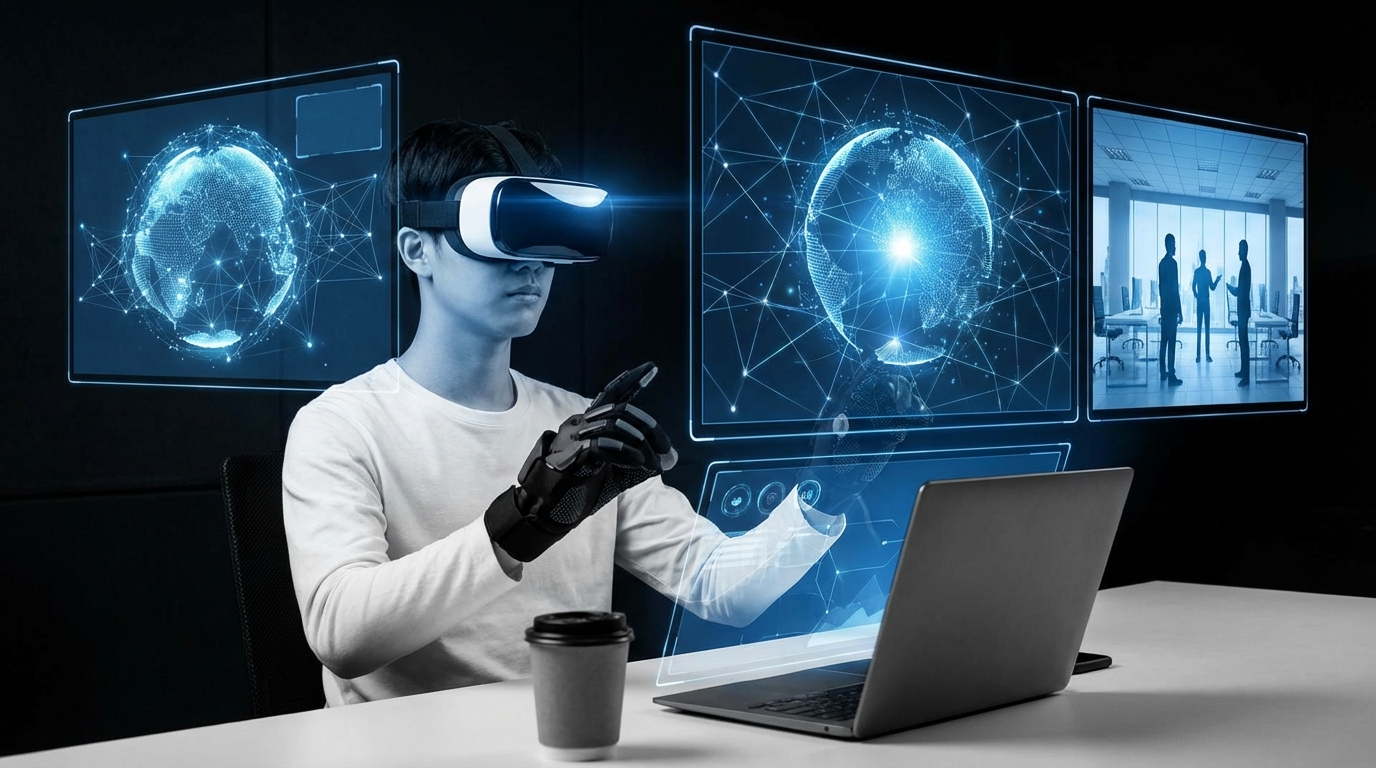
I was on a glitchy Zoom internship standup when it hit me: we are doing “real work” while my teammate’s cat walks across the keyboard. Is this really the future of internships… and if it is, what happens when we throw virtual reality into the mix?
Here is the short answer: internships are shifting from physical offices to blended experiences that combine remote work, VR simulations, and global teams. The students who treat VR and remote tools as core skills (not side gimmicks) will get better training, stronger portfolios, and access to roles that used to be locked behind geography and family income.
Why internships are changing so fast
At some point during a lecture on labor economics, I realized internships are basically experiments in cheap learning. Companies test talent. Students test careers. The old model ran on office space, location, and coffee chats. Now it runs on Wi-Fi, headsets, and screen sharing.
Here are the three big forces that are reshaping internships:
- Remote work is normal in many sectors, not an exception.
- VR headsets are getting cheaper and more common in labs, libraries, and sometimes dorms.
- Companies need faster ways to train students on complex tools without flying them everywhere.
The big shift: internships are moving from “watch someone at a desk” to “practice inside a digital environment that can be replayed, measured, and improved.”
This is good news for students who live far from major cities or cannot afford unpaid roles that require relocating. It is more mixed for students who rely on in-person networking and hallway moments. The tradeoffs are real, and pretending everything remote is perfect would be dishonest.
Physical office vs virtual office vs VR workspace
You can think of internship formats as three overlapping modes:
| Mode | What it feels like | Biggest strength | Biggest weakness |
|---|---|---|---|
| On-site | You sit in a real office with real people. | Serendipity, mentorship, social learning. | Location locked, expensive housing, commute. |
| Remote (2D) | Zoom, Slack, email, shared docs. | Access from anywhere, flexible. | Harder to read social cues, isolation. |
| VR / virtual world | Avatars, virtual rooms, 3D tools. | Hands-on simulations, immersion. | Hardware, motion sickness, learning curve. |
The future will not replace one with another. It will mix them. A three-month internship might have:
- Week 1: VR onboarding and team meet-up in a virtual office.
- Weeks 2-8: Mostly remote work through normal tools.
- Intense days: VR lab sessions to practice rare or risky scenarios.
- Final week: Hybrid showcase, maybe VR demo plus remote presentation.
What VR actually changes for internships
The moment you put on a headset and step into a “work” space, some strange things happen. Your brain treats virtual objects as real tasks. You remember spaces better. Time passes faster. That can turn internships from passive observation into active practice.
VR for training and practice
During a computer science lab, I tried a VR debugging training where code execution was visualized as objects moving through a 3D pipeline. It was weirdly intuitive. If that kind of thing becomes standard, interns can level up faster than watching slides or screen shares.
Here is what VR can train:
- Technical procedures: Lab protocols, machinery operation, factory workflows.
- Soft skills: Sales pitches, customer service conversations, conflict resolution.
- Spatial work: Architecture, UX for AR/VR, robotics coordination, logistics planning.
- Team habits: Standups in virtual rooms, whiteboarding, retrospectives.
VR lets you fail loudly in private, then repeat the same scenario until your response becomes automatic.
For internships, that means:
- Interns can run “simulated weeks” of projects before touching a live client.
- Risky or expensive training (like medical procedures or heavy equipment) can happen without real-world danger.
- Feedback can be instrumented: where you looked, how long you took, what decision you made.
This is very different from “read the onboarding PDF and ask questions later.” It feels more like a flight simulator, but for regular jobs.
VR as a social space for remote interns
One of the worst parts of remote internships is the lack of hallway conversations. You log on, you ship tasks, you log off. It starts to feel like freelancing, not learning.
VR tries to patch that gap by recreating presence:
- You can overhear side chats in a virtual office.
- Body language appears through avatars: where people face, who is “near” whom.
- Whiteboards become shared 3D canvases, not one person sharing a screen.
Is it as rich as a real room? No. But it unlocks new patterns:
Remote interns on different continents can feel like they share a common “space” instead of floating in 50 random Zoom rectangles.
For campus trend watchers, that opens up a huge question: do student communities start meeting in virtual offices to simulate internships before they even land one?
Global access and equity: promise and friction
The optimistic story is clear: a student in a small town with bad local opportunities could intern for a company overseas using VR and remote tools. No rent in a big city. No visa. No relocation.
The friction points are just as real:
- VR hardware cost, even if it is lower than before.
- Headset compatibility across different platforms.
- Internet speed and data caps.
- Accessibility issues for students with certain disabilities.
Here is the hard part: some campuses will provide VR labs, shared headsets, and guided programs. Others will not. That creates a second digital divide on top of the existing laptop and Wi-Fi gap.
The future where VR internships are normal could widen the gap between tech-rich campuses and everyone else, unless universities treat access as basic academic infrastructure.
If you are on a campus that ignores this, your strategy probably has to be different. That might mean pushing your careers office to set up shared gear, or joining external programs that ship headsets to participants.
What remote work adds on top of VR
VR gets a lot of hype, but remote work is the actual baseline. Most of us are not spending eight hours a day in a headset. We are in browsers, IDEs, design tools, and project boards.
The future of internships is more “remote-first, VR-supported” than “VR-only.”
The new basic skill stack for interns
During my last group project, I noticed that the best collaborators were not the smartest in terms of raw IQ. They were the ones who knew how to make remote work feel natural. That same pattern shows up in remote internships.
Here is a realistic skill stack for future interns:
- Async communication: Writing clear updates, documenting progress, asking focused questions.
- Tool navigation: Project boards, shared docs, design files, code repositories.
- Focus management: Designing your own schedule, avoiding context switching.
- Light VR literacy: Joining sessions, orienting in 3D space, using controllers, not breaking the virtual whiteboard.
Remote work skills are becoming as basic as PowerPoint once was. VR is starting to sit alongside them, not above them.
If you treat these skills as “soft” or secondary, you will lose ground to peers who treat them as core.
Remote-first internship formats
Here are common formats that are gaining traction:
- Fully remote, no VR: Standard model with video calls and online tools.
- Remote + optional VR: Main work is standard remote, with VR used for workshops.
- Hybrid cohorts: Some interns on-site, some remote, both joining shared VR sessions.
- Rotational remote: Intern moves each week between teams, sometimes in VR “tours.”
From a student’s point of view, the opportunities are larger, but the competition pool is global. You are no longer only competing with students who can commute to the office. You are competing with everyone with a laptop and a decent connection.
Concrete use cases: what internships might look like by field
I realized during a product design seminar that “VR + remote” is not one future; it is many futures. Different fields will use it in very different ways.
Engineering and computer science
For software students:
- VR-based code review rooms where flows are mapped visually.
- Whiteboarding and architecture planning in shared 3D diagrams.
- Debugging training that visualizes runtime as moving objects.
For hardware, robotics, or mechanical:
- Simulated environments for robots, drones, or vehicles.
- 3D CAD reviews where interns can “walk around” a design.
- Factory or lab walkthroughs without travel.
The real advantage here is not flashy avatars. It is the ability to test and iterate quickly on complex systems without full physical setups.
Business, consulting, marketing
In a strategy class, we role-played a client meeting. Now imagine that, but in VR with real-time analytics.
Possible internship experiences:
- Client meeting simulations where interns practice pitches and negotiations.
- Virtual “war rooms” for market analysis sessions.
- Retail or event simulations where customer behavior is modeled.
Remote work adds:
- Access to international clients and cross-border projects.
- Asynchronous collaboration on decks and financial models.
- Recorded sessions that interns can rewatch to study what went right or wrong.
Design, media, and creative roles
For design students, VR can be both the medium and the studio:
- Storyboarding in virtual spaces where scene scale and pacing feel more real.
- UI/UX testing for AR/VR experiences with live users inside the product.
- Co-creating visual assets on virtual walls or canvases.
Remote collaboration is already normal for creative teams, so internships here will probably be among the first to fully blend VR and remote work.
Healthcare, science, and lab work
Here the gap between student and real practice is often huge, for safety reasons. VR lets interns:
- Practice procedures on virtual patients or lab setups.
- Explore 3D models of organs, molecules, or physical processes.
- Join VR lab tours where experts point and annotate.
Remote components:
- Data analysis projects done from home based on collected lab data.
- Literature reviews and simulations coordinated through remote teams.
- Cross-hospital or cross-lab collaborations that interns can join without travel.
New kinds of metrics and evaluation
When work happens in digital and virtual spaces, almost everything can be logged. That has consequences that students should think about early.
From “hours present” to “interaction data”
In an office internship, your manager mostly sees:
- Whether you arrive roughly on time.
- Whether you look engaged.
- Whether your outputs are acceptable.
With VR and remote tools, managers can also see:
- How often you speak or write in team channels.
- How long you spend in each simulation.
- Which steps you repeat or struggle with.
- How you move and where you look in VR training.
Future interns will be judged less on “body in chair” and more on measurable participation and progress in digital environments.
Some of that is good. It rewards proactive behavior and learning. Some of it is worrying. It can turn into surveillance if not handled with care.
Portfolio upgrades: from slides to session replays
The positive flip side is strong. Instead of saying “I did X,” you can show it:
- Clips of VR simulations where you solved a tricky operation.
- Screen recordings of remote collaborations, with your contributions highlighted.
- Before-and-after versions of projects you improved.
For student startups building tools in this space, one obvious opportunity is “internship portfolios as living timelines,” combining commits, documents, and VR session artifacts.
New problems and risks students should not ignore
It is tempting to paint VR and remote work as a perfect future. That would be lazy thinking. There are some serious issues that students need to think about early.
Burnout and blurred boundaries
In a dorm at midnight, it can feel normal to jump back into work messages. If your “office” is your laptop and your headset, it follows you everywhere.
Risks:
- Longer working hours because there is no clear ending.
- Feeling like you must always be online to prove you are engaged.
- Confusing learning time with “performing” time in VR spaces.
If you do not learn how to set boundaries, remote internships can eat your days in tiny, justifiable chunks.
You need rules for yourself: time blocks, status indicators, and clear communication about availability. That is not “nice to have”; it is a survival skill.
Social learning loss and mentorship gaps
There is something powerful about overhearing how senior people handle a tricky situation. Remote and VR setups can reduce those spontaneous moments.
Problems:
- Mentors have less context on your struggles if they only see finished work.
- You have fewer chances to ask casual questions.
- Office culture becomes a set of messages instead of a feeling.
VR can simulate some parts of this with informal virtual spaces, but it is still intentional, not accidental. You have to book time, join rooms, set up events. That requires interns to be more proactive in seeking mentorship.
Accessibility, motion sickness, and cognitive load
Not every brain or body plays nicely with VR. Some people get migraines, dizziness, or fatigue. Others have disabilities that make standard headsets hard to use.
If internships quietly assume that “everyone can just put on a headset,” they will exclude many capable students.
Students need to:
- Be honest with recruiters and HR about constraints.
- Ask about alternative modes for required VR sessions.
- Push their campuses to build inclusive VR setups, not one-size-fits-all rooms.
How students can prepare right now
During a group chat after class, someone asked: “Do I really need to care about VR to have a good career?” My answer is: you do not need to obsess over it, but ignoring it completely is risky if your field is touched by 3D, simulation, or remote collaboration.
Build real remote work habits on campus
Before worrying about headsets, fix the basics. Employers will care more about whether you can actually function in a remote setup.
Practical steps:
- Run at least one project fully remote with your classmates, even if you live in the same dorm.
- Practice writing clear project updates in shared docs.
- Use project management tools for your student club or side project.
- Experiment with time blocking and “focus hours” away from notifications.
Treat your campus projects as a sandbox to practice the same habits you will need in a remote internship.
Get basic VR exposure without overspending
You do not need the most expensive headset to start learning.
Ways to get exposure:
- Check if your library, makerspace, or lab has shared VR gear.
- Join research projects, game jams, or classes that use VR tools.
- Try free VR collaboration apps, even for simple meetups.
- Watch how experienced users move, point, and collaborate in virtual spaces.
Focus on understanding:
- What is comfortable duration for you in VR.
- How to not get lost in 3D menus and movement.
- Which tasks are better in VR and which are worse.
That last point is important. You should be able to push back politely if a team wants to shove every activity into VR when some tasks are better in normal tools.
Document your learning in a digital-first way
Internships that run on remote and VR tools naturally create digital traces. You can do the same for your campus work.
Ideas:
- Keep a public or semi-public log of projects: what you tried, what failed, what worked.
- Record short clips explaining a project as if you are in a remote standup.
- Collect screenshots of collaborative boards, diagrams, or VR mockups.
This material becomes part of your portfolio and signals that you can operate in digital workspaces.
Opportunities for student builders and startups
From a student startup point of view, this shift is almost unfairly rich with gaps. Every broken part of a remote or VR internship is a chance to build something.
Tools that actually work for interns, not just managers
Most remote tools are built for full-time employees. Interns are a side case at best. That leaves space for:
- Onboarding layers that sit on top of existing tools and guide interns step by step.
- VR tutorials that teach both company processes and basic VR comfort.
- Feedback tools that let interns tag confusing moments and get responses later.
A lot of students experience these pain points firsthand during internships. That lived experience is an advantage in building better tools.
Access and equity solutions
If the future of internships tilts toward VR, there is an obvious question: who makes sure no one is locked out?
Student-led projects could tackle:
- VR lending programs that manage shared headsets across campuses.
- Lightweight VR or pseudo-VR tools that run on phones or basic hardware.
- Accessibility overlays and settings tailored for different needs.
This is not about charity. It is about building practical systems that companies might later adopt or fund.
What campuses might need to change
During a career fair, I noticed a strange mismatch. Recruiters talked about remote work a lot, but campus services were still built for “go to the city, work in an office” logic.
If the future of internships is remote and VR-assisted, campuses will probably need to change several things.
From computer labs to collaboration studios
The old rows of desktops in silent rooms do not match the new internship reality. Campuses may shift toward:
- VR and AR labs with bookable rooms for group sessions.
- Hybrid collaboration spaces where remote teammates can “beam in” on screens or in VR.
- Staff who can help students with both software onboarding and VR comfort.
Students will not just need access to hardware; they will need guidance on remote and VR etiquette, safety, and productivity.
Career services that understand remote + VR roles
Career centers often think in terms of industries and geographies. They may need to add:
- Workshops on remote interviewing and virtual assessment centers.
- Sessions on VR collaboration basics for recruiting events.
- Partnerships with companies running remote-first and VR-assisted internship programs.
Without that shift, students will be left to figure out these rules alone, which favors those with private networks and previous exposure.
How students can evaluate future internship offers
One last practical angle: when you get an offer, how do you know if a VR or remote internship will be a good learning experience and not a chaotic mess?
Questions to ask recruiters and managers
You do not have to accept whatever structure is thrown at you. During interviews or offer discussions, ask pointed questions such as:
- “How is the intern program structured for remote participants?”
- “Which tools do you use for daily collaboration? Is VR part of that?”
- “How do mentors interact with interns in a remote or VR setup?”
- “How do you measure intern progress and give feedback?”
- “If VR is required, how do you support interns who are new to it or have accessibility needs?”
Red flags include:
- Vague answers like “we will figure it out.”
- No dedicated mentor or regular check-ins.
- Heavy VR use with no mention of training or alternatives.
- No clarity on working hours or time zones.
Green flags include:
- Clear schedules with planned sessions and async work.
- Named mentors and backup contacts.
- Documented onboarding and training modules.
- Support for equipment, including VR headsets if needed.
So what does this future feel like, day to day?
Picture a day in a near-future internship:
- Morning: Async check-in on a project board, written update on yesterday’s tasks.
- Late morning: 40-minute VR session where your team walks through a design prototype, rearranges components in 3D, and agrees on changes.
- Afternoon: Deep focus work in regular tools, maybe with background coworking on a silent call.
- Short break: Drop into a virtual “coffee room” with other interns for casual conversation.
- End of day: Record a 2-minute walkthrough of your progress and attach it to the task for your mentor.
None of those parts alone are science fiction. The difference is that they stack: global access, VR training, digital traces, and remote flexibility.
The real future of internships is not about escaping the office into a headset. It is about treating the entire world, physical and virtual, as a connected learning space.
For students, the challenge is simple and hard at the same time: stop thinking of VR and remote work as side features, and start treating them as core parts of your early career toolkit.