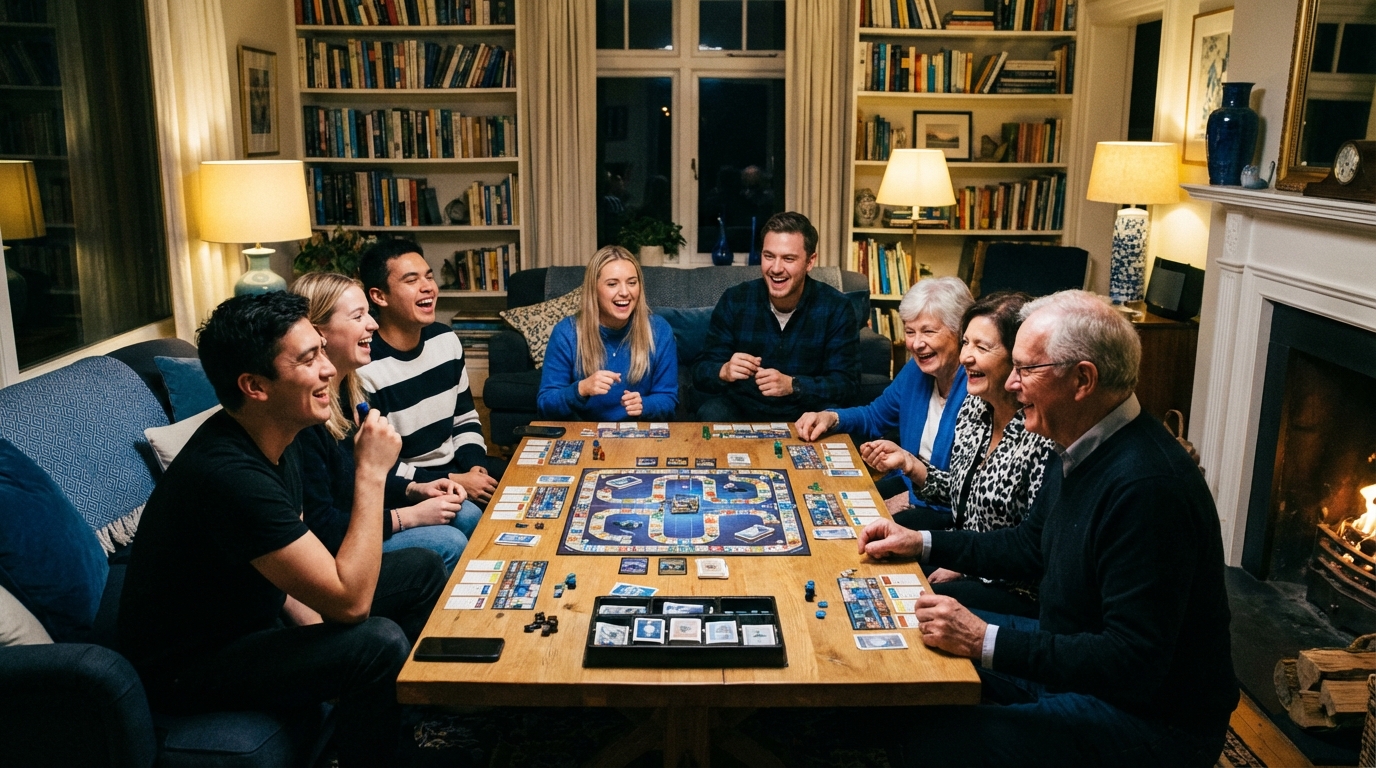
I was halfway through pretending to revise in the library when I realized something weird: every other table was covered in board games, not laptops. Catan, Wingspan, chess clocks ticking, Uno cards flying like exam scripts in week 12.
So why is everyone suddenly playing board games again? Short answer: because our social lives moved online, attention spans cracked, and board games quietly became the perfect excuse to sit together, talk, think, and compete without feeling drained or judged. They hit this sweet spot between low-tech escape and high-level strategy, which feels oddly refreshing when everything else happens through a screen.
Why board games suddenly feel “new” again
The funny part is that board games never really went away. They just stopped being cool for a while. Now they are back in dorms, cafes, libraries, and “study” groups that definitely are not studying.
Here is what changed under the surface:
- We are tired of spending every social interaction on our phones.
- Competition feels safer when it is framed as a game, not a grade or a follower count.
- Game design has improved a lot since Monopoly and Scrabble ruled the shelf.
- Communities form faster around games than around small talk.
- They fit our weird student schedules: one-hour, two-hour, campaign-style, you choose.
Board games are a low-pressure way to be fully present with people, which makes them feel rare and valuable on a campus that never really switches off.
So when someone pulls out a game in the common room, it is not “kids stuff.” It is people quietly saying: can we hang out without checking our phones every thirty seconds?
The screen fatigue problem nobody wants to admit
One of the strangest side effects of lecture recordings, group chats, and digital everything is that hanging out started to feel like another form of screen time.
We have:
| Context | Screen type | Energy cost |
|---|---|---|
| Lectures | Laptop / tablet | Mental focus, passive posture |
| Social life | Phone (DMs, group chats, dating apps) | Emotional monitoring, constant replies |
| Relaxing | Netflix, YouTube, TikTok | Low effort, low interaction |
| Work | Laptop | Task switching, deadlines |
At some point, everything blurred into one giant session of sitting and scrolling. The body is resting, but the brain never stops processing new stimuli. It feels like relaxation but leaves you weirdly tired.
Board games flip the ratio:
- Less visual overload, more deliberate thinking.
- Less “performing” for social media, more genuine interaction.
- Less passive consumption, more active participation.
A board, some cards, and a few tokens force a hard reset: nothing moves until a human touches it.
When a game is on the table, phones usually move aside. Not because someone made a rule, but because there is something more interesting to pay attention to. That simple shift is powerful.
Board games as social technology
In practice, board games are social tools that do a bunch of work for us:
1. Instant structure for awkward groups
Think about the classic uncomfortable scenarios:
- A first-year mixer.
- An entrepreneurship club meetup.
- A course group where people sort of know each other but not really.
Without a shared activity, you need topics, charisma, and social courage. That is a lot of mental load. With a game:
- You already have something to do.
- Silence is normal because people are thinking.
- Talking is partly about the game, not just about personal details.
Board games act like social scaffolding: they hold up the conversation so you do not have to carry it alone.
Nobody needs to be “the interesting one.” The game plays that role.
2. Safe competition in a high-pressure environment
University is already one huge unspoken leaderboard:
- Grades.
- Internships.
- Research positions.
- Startup pitches.
People are constantly comparing themselves. It can get toxic quietly. A board game compresses competition into a smaller, safer space. Losing a game of Azul or Catan hurts less than bombing an exam. Winning is fun, but not life-defining.
There is a weird relief in thinking:
“Here, if I lose, I just lose points. Not my future.”
3. A shared narrative without doomscrolling
Social apps give you a shared feed but not a shared story. You scroll next to each other, but your experiences are parallel, not connected.
In a game, everyone shares the same mini-story in real time. For example:
- The moment someone betrays an alliance in Diplomacy.
- The last dice roll in King of Tokyo where the room holds its breath.
- The one perfect combo in Wingspan that makes everyone groan.
Those tiny stories become references later:
“Remember when you blocked all my roads in Catan?”
That is a different quality of memory from “remember that meme we both liked.”
Modern game design is actually good
A lot of people still think board games equal Monopoly, Risk, Scrabble, and maybe chess if someone is serious. That is an old shelf. Modern board games are very different.
From punishment to agency
Older family games often rely on:
- Elimination (you are out, now wait 40 minutes).
- Pure luck (roll and move, hope the dice likes you).
- Very long sessions without decisions that matter.
Modern games focus more on:
- Continuous decisions.
- Different paths to victory.
- Minimal downtime between turns.
The newer wave of games treats you like a thinker, not just a token that the dice moves around.
You feel like your choices matter, which quietly flatters your brain. It is like a puzzle that respects you.
Variety for every brain type
Ask around a campus game night and you will notice patterns. People gravitate to different categories:
| Type | Example games | Appeal |
|---|---|---|
| Party / social deduction | Werewolf, Secret Hitler, Among Us-style games | Bluffing, reading people, high energy |
| Strategy / “Euro” style | Catan, Wingspan, Terraforming Mars | Planning, resource management, engine building |
| Co-op | Pandemic, Spirit Island, The Crew | Win or lose together, pure teamwork |
| Abstract / tactical | Chess, Azul, Onitama | Clean rules, deep tactics |
| Story-driven | Gloomhaven, Betrayal at House on the Hill | Narrative, characters, episodic play |
Instead of “do you like board games,” the more accurate question is “what kind of thinking feels fun to you?”
Short attention spans, shorter games
There is another design shift: more games finish in 30-60 minutes. That fits our lifestyles:
- You can play between classes.
- You can fit a game between dinner and late-night work.
- You can switch games when the group changes.
Long epic games still exist, but they are now an opt-in experience, like deciding to binge a show instead of a single episode.
Cafes, clubs, and the new “third place”
On many campuses, physical space is a problem. Dorms are crowded, libraries are serious, and bars are expensive. We need places where:
- You can stay for a few hours without constant spending.
- Talking is allowed but not unbearably loud.
- Activities feel social but not draining.
Board game cafes and student-led game nights are filling that gap.
A board game table functions like a portable third place: wherever the game goes, a social space appears around it.
You see this in:
- Common rooms that suddenly feel alive once a game group claims a corner.
- Clubs that run “open game nights” as their easiest recruitment event.
- Libraries that now have game shelves next to the quiet study zones.
The barrier to entry is tiny: someone brings a game, explains it, and that is enough to anchor a whole evening.
Board games as low-stakes networking
This is the part that ambitious students sometimes miss. Board games are not just “for fun.” They are also stealth networking tools, especially in startup and tech circles.
What games reveal about people
Watch someone play a strategy game and you will quietly learn:
- How they handle uncertainty.
- Whether they explain rules patiently.
- If they tilt when things go wrong.
- Whether they cooperate or hoard resources.
- How they negotiate and persuade.
These are not perfect predictors of work behavior, but they expose patterns. A person who constantly blames luck might behave similarly in a project. Someone who helps others understand the game even when competing might be a strong collaborator.
A three-hour game session can reveal more about working with someone than a three-line bio and a LinkedIn connection.
No formal interviews. No stiff coffee chats. Just practical observation.
Game nights as recruiting channels
Some student clubs have noticed this and started using games explicitly:
- Startup clubs that run Catan or cooperative games after pitch nights.
- Consulting clubs that host strategy game evenings to see how people think.
- Tech societies that use board games as a casual way for seniors and juniors to mix.
The trick is to keep it honest. If it turns into a secret “assessment center,” the atmosphere collapses. But as a side effect of genuine play, it is extremely useful.
If you are thinking about building a team for a project, hackathon, or startup, inviting people to a game night is a quietly smart move.
Mental health, burnout, and slow thinking
Some nights, the last thing your brain wants is another input stream. No more videos, no new lectures, no more notifications. Just space.
Board games create that space in a controlled way.
Focused attention as a break
During a game, your attention is pointed at one clear system:
- Cards on the table.
- Resources you control.
- Visible moves other people can make.
You are still thinking, but it is bounded. There is no infinite scroll, no autoplay next episode, no algorithm trying to keep you engaged. When the game ends, it really ends.
People often describe this as mentally refreshing, even if the game is complex. It is like a workout that leaves you tired but stable, rather than wired.
Cooperative games as pressure release
Competitive games are fun, but sometimes you just do not want to fight your friends. Co-op games fix that. You play against the system, not each other.
Examples:
- Pandemic: everyone acts as a team to stop outbreaks.
- The Crew: you communicate under strict limits to complete missions.
- Spirit Island: you work together as island spirits defending against invaders.
What is interesting: these games teach group problem-solving, but if you lose, nobody takes it personally. You share the defeat.
Co-op games let you practice teamwork without grades, salaries, or reputations on the line.
For students who feel constant performance pressure, that kind of play is not childish. It is recovery.
Why board games spread so fast on campus
If one person in a dorm buys a game like Catan or Code Names, the adoption pattern looks almost viral.
Low cost, high reuse
From a student-budget angle, board games are oddly efficient:
- One box can entertain dozens of people across months or years.
- No subscription, no DLC, no battery required.
- You can borrow, lend, or share easily.
Compare that to:
- Buying multiple drinks every time you go out.
- Paying for constant streaming subscriptions.
- Travel costs for off-campus entertainment.
If a group splits the cost of a few games, you suddenly have a social toolkit on standby for the whole semester.
Easy to teach, easy to spectate
Well-designed games have:
- Rules that feel weird for the first 10 minutes, then suddenly click.
- Visuals that let spectators follow what is happening without full context.
So someone walks past, watches two rounds, asks “what is happening,” and by the next game, they are playing. That ease of onboarding accelerates growth.
Social proof in physical form
There is also something powerful about visibility. A shelf full of games in a common room signals “people hang out here.” A cluster of students around a table with cards and dice signals “this is where the fun is.”
Unlike an online group chat, you can literally see the activity. That invites participation.
What this means for student builders and founders
If you care about student startups, community building, or campus culture, the board game resurgence is not just a cute trend. It is a data point.
Signals about what students actually want
Look at what board games provide and you get a checklist for desirable experiences:
| What board games offer | Student desire behind it |
|---|---|
| Face-to-face interaction | Real connection, less mediated by screens |
| Clear rules, low ambiguity | Understandable systems instead of chaotic feeds |
| Shared focus | A break from multitasking and constant switching |
| Re-playability | Reliable, repeatable social rituals |
| Limited time scope | Activities that fit around lectures and deadlines |
If you are building something for students, you can treat board games as a reference manual for what feels good to us right now.
Ask: does your event, product, or club offer a similar sense of structure, replay, and low-stakes challenge?
Opportunities around the board game wave
Some practical directions students are already exploring:
- Campus game libraries: Curated sets of games that students can borrow like books, run by clubs or libraries.
- Board game cafes near campus: Student-founded spaces that mix coffee, light food, and curated game collections.
- Custom games for teaching: Professors collaborating with students to create small games that simulate course concepts.
- Event formats: Hackathons and startup weekends with built-in game breaks to combat burnout.
- Online-offline hybrids: Apps that help organize game nights, match people by interests, and track which games are popular.
If you are only seeing games as “entertainment,” you are missing adjacent spaces where student ventures can grow.
Design lessons from board games for builders
During a product design lecture, I realized that most good board games already follow principles we talk about for digital products, but in a cleaner way.
Clear onboarding
Good games try to:
- Teach by doing, not by dumping the entire rulebook at once.
- Give you a simple first turn so you understand the basics immediately.
- Make the objective obvious, even if strategies are complex.
If your startup idea feels harder to understand than a modern board game, that is a red flag.
Meaningful choices
Games are engaging when:
- Most turns feel like a trade-off, not an autopilot move.
- Bad decisions are recoverable but visible.
- Different strategies are viable, so people can express their style.
Translate that to student products: do users feel that their choices matter? Or are they just following a script?
Fairness and perceived fairness
In many games, randomness exists but must feel fair. People accept:
- Dice in a dice game.
- Shuffle in a card game.
They get angry when:
- Rules favor one player too heavily.
- They lose and feel they never had a chance.
That perception carries over to grading systems, ranking systems, and algorithms. If students feel your system is stacked, they mentally check out. Games remind us how sensitive humans are to fairness signals.
How to start or grow a board game scene on your campus
If your campus does not have an active board game culture yet, or it feels fragmented, you can nudge it without turning it into a forced “initiative.”
Step 1: Start absurdly small
You do not need a full club charter. Start with:
- One or two games you enjoy.
- A consistent time slot (e.g., every Thursday 7 pm).
- One public space that allows lingering (common room, small cafe, corner of the library).
Invite friends, then encourage them to bring one other person. Growth from 4 to 8 regulars changes the vibe dramatically.
Step 2: Choose the right starter games
You want games that are:
- Easy to teach in 5-10 minutes.
- Fun even for people who claim they “do not game.”
- Playable within 30-60 minutes.
Good candidates:
- Codenames (word puzzles, big groups).
- Sushi Go! (simple drafting, cute art).
- Ticket to Ride (light strategy, visible progress).
- King of Tokyo (dice chaos, monster theme).
You can introduce heavier games later for the people who get hooked.
Step 3: Make it socially safe
Some people fear:
- Looking stupid if they forget the rules.
- Being “too competitive” or not competitive enough.
- Not understanding the social norms of the group.
You can counter this by:
- Making it clear that learning is normal and misplays are part of the fun.
- Rotating games so nobody is always the veteran.
- Encouraging table talk and questions at any time.
The main product of a game night is not the game; it is the sense of “this is a place I can return to.”
If people feel that, they will bring others.
Step 4: Mix circles intentionally
If you only invite your close friends, you get a closed bubble. To connect broader parts of campus, consider:
- Co-hosting game nights with other clubs (tech, arts, language societies).
- Advertising “bring a friend from a different major” nights.
- Having one table reserved for new players only.
Games are neutral ground where first-year students, postgrads, and staff can sit at the same table without weird hierarchy.
Why board games are likely to stay, not just trend
Trends come and go quickly on campus: one app, one meme, one social platform, then the next. Board games have a different rhythm.
A few reasons they probably stay relevant:
- Physicality: They are not easily replaced by a notification or a software patch.
- Ritual: Weekly game nights become traditions that outlast individual students.
- Modularity: New games can enter the scene without killing old ones.
- Intergenerational: Alumni, staff, and students can all play together.
At some levels, they feel low-tech, almost retro. But the way students use them now is very current: as intentional breaks from noise, as social scaffolding, as testing grounds for collaboration, and as cheap, repeatable events.
If you want to understand what students are missing from their mostly-online lives, watch what happens around a table when the phones face down and the deck gets shuffled.
That quiet shift is why everyone is playing board games again. Not because they are new, but because they solve a modern problem in a surprisingly human way.