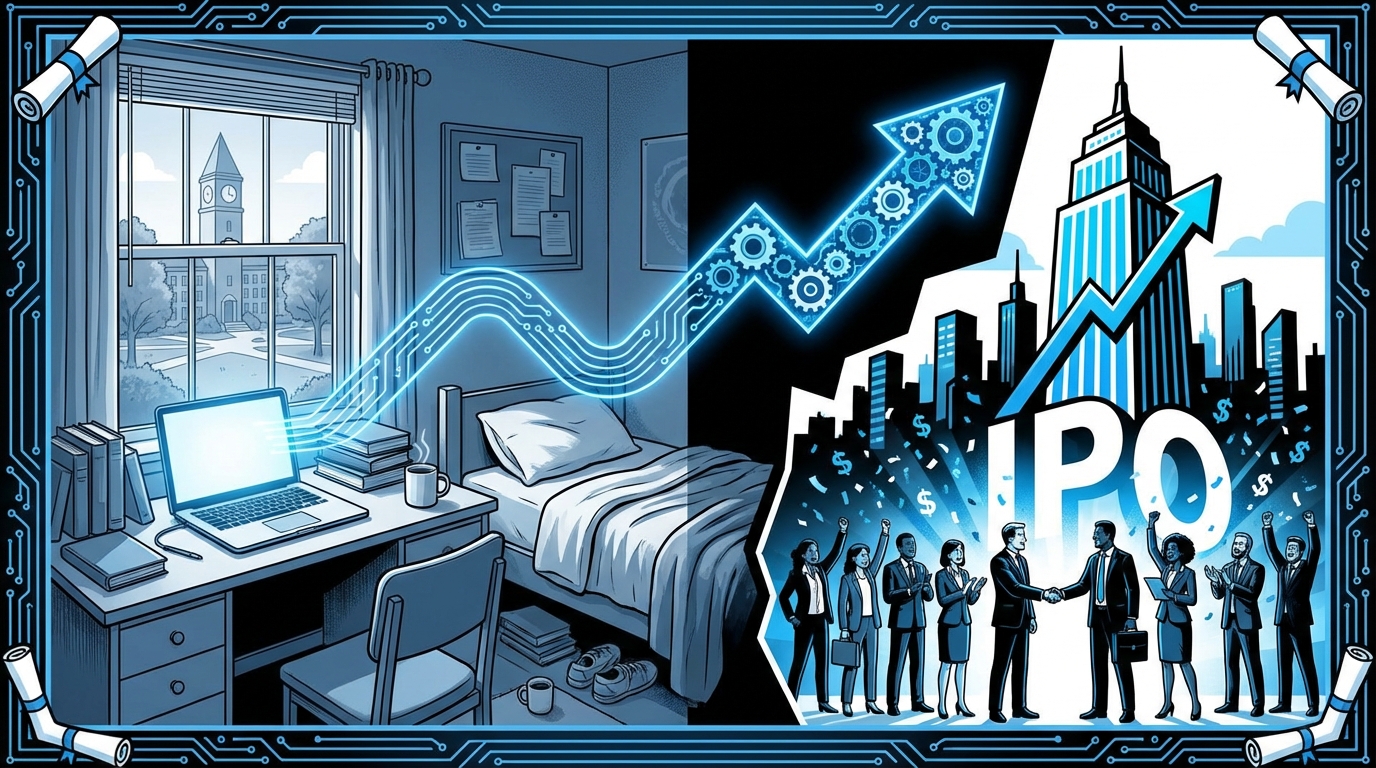
I was halfway through a late-night group project when I caught myself thinking: “What if this slides deck was actually a cap table?” The jump from half-finished coursework to a listed company suddenly did not feel that far-fetched.
TL;DR: University spin-offs go from dorm room to IPO by combining deep technical research, early proof-of-concept wins, the right mentors, brutal focus on a narrow problem, and a long time horizon. The 5 stories below (Google, BioNTech, Shopify, ARM, and Genentech) show different playbooks, but they all share a pattern: small, obsessed student or researcher teams building something so useful that it escapes campus gravity.
Why university spin-offs matter way more than your group chat thinks
At some point during a boring lecture, I realized that a lot of what we call “big tech” actually started as side projects from people trying to pass courses or finish PhDs. None of them sat down and said, “Let me create a trillion-dollar company today.” They said, “Let me fix this one annoying technical problem.”
- Google started as a PhD research project about ranking web pages.
- BioNTech grew from research on mRNA chemistry at a German university.
- Shopify came from a student trying to sell snowboards online.
- ARM was born out of a small UK computer lab.
- Genentech came from university biology research becoming a business.
The common thread: a narrow, technical obsession that turned into a product the outside world actually wanted, not just a nice paper or a good grade.
Before we walk through each story, here is a quick snapshot to keep in your head while you read.
| Company | Origin University | Field | Founding Era | IPO Year |
|---|---|---|---|---|
| Stanford University | Computer Science / Search | Mid 1990s | 2004 | |
| BioNTech | Johannes Gutenberg University Mainz (research base) | Biotech / mRNA | Late 2000s | 2019 |
| Shopify | Carleton University influence, informal | E-commerce / Developer tools | Mid 2000s | 2015 |
| ARM | University of Cambridge (spinoff environment) | Chip design | Early 1990s | 1998 (London), 2023 (New York, relisting) |
| Genentech | University of California, San Francisco | Biotech / Recombinant DNA | Mid 1970s | 1980 |
These cases are not meant to say “you must do this,” but “here is how unusually big outcomes have actually grown out of campuses.” Your project does not need to be a clone of any of these.
Let us go into each one, but with a student builder lens: what did they start with, who helped them, how did the boring parts (IP, funding, structure) work, and what should we copy or ignore.
Story 1: Google – when a PhD problem becomes the front page of the internet
I remember sitting in an information retrieval class thinking, “This ranking formula stuff is elegant, but does anyone outside this room care?” Then you study how Google started and realize: yes, they cared, a lot.
From “BackRub” to a garage to IPO
Google began in 1995 as a research project by Larry Page, joined soon by Sergey Brin, both PhD students at Stanford. The project was called “BackRub.” The core idea was PageRank: using links between web pages as a signal of importance.
Key early steps:
- They used Stanford’s computing resources to crawl and index the web.
- They published academic papers describing the algorithm.
- They hosted the search engine on Stanford servers under a university domain.
- The project grew so popular that it started stressing university infrastructure.
The shift from research to company came when the search engine became too useful. It generated traffic, then user complaints when it went down. At some point, it stopped being “just” a PhD experiment.
University support and IP: the messy part everyone forgets
Stanford helped in a few ways:
- Office space and servers for the early prototype.
- A culture that did not instantly kill side projects.
- Connections to advisors and angel investors (for example, Andy Bechtolsheim wrote them an early check).
On the flip side, there was intellectual property. Stanford owned patents related to PageRank. They licensed this IP to Google in exchange for equity. When Google went public in 2004, Stanford’s stake reportedly became worth hundreds of millions of dollars.
So, what does that mean for you on campus right now?
If your work is based on university-funded research or lab resources, there is a high chance your tech transfer office has automatic rights in the IP. Ignoring them is not brave, it is just naive.
Many students wait too long to talk to tech transfer. That can block funding later, because investors want clear ownership. The lesson from Google is not “do a PhD,” it is “treat IP structure as early infrastructure, like picking a programming language.”
What Google did that most student projects skip
Three habits stand out:
- Obsession with performance: They optimized search results and speed relentlessly. They did not accept “good enough for a demo.” Performance became their unfair advantage.
- Willingness to leave the degree path: Larry Page was ready to leave his PhD to work on the company. He even wrote about the “no-return” point in his dissertation plans.
- Fast move from research paper to real-world usage: They did not just publish PageRank and move on. They wrapped it into a product used by normal people.
Why does this matter to you?
If you are building a campus startup, ask a blunt question: “Would anyone care if my project went offline tomorrow?” If the answer is no, you do not have a Google-like path yet. That is not a failure. It just means you are still in the sandbox phase.
Story 2: BioNTech – deep research that needed a global crisis to show its power
Most of us heard of BioNTech only when vaccines became daily news. It can feel like a sudden success, but the backstory is almost the opposite: decades of grinding research that looked niche for a long time.
From academic cancer research to mRNA startup
BioNTech’s roots sit in the work of Ugur Sahin and Ozlem Tureci, both physician-scientists who held academic roles at the University Medical Center Mainz, linked with Johannes Gutenberg University Mainz in Germany.
Their focus: personalized cancer therapies using mRNA and other immunotherapy methods. That is the type of phrase you hear in a biomedical lecture and instantly feel the weight of complexity.
Here is the rough path:
- Long years of academic research into how mRNA could train the immune system.
- Founding of a company (BioNTech) around 2008 to commercialize this research.
- More than a decade of building platforms, pipelines, and partnerships, mainly in oncology.
- Collaboration with Pfizer on an mRNA vaccine when COVID-19 emerged.
They did not wake up one day and say, “Let us build a company for a hypothetical pandemic.” They were already deep in the science.
The role of the university and research environment
BioNTech used:
- Access to clinical research infrastructure.
- Academic networks for recruiting scientists.
- Grants and research funding tied to the university environment.
The company became independent, but the talent pipeline and early validation came from academic work. Investors could see that the founders had already proved competence in a strict, peer-reviewed world.
Biotech spin-offs show something software students often ignore: some of the biggest startup breakthroughs require extremely long “boring” phases where the world does not care yet.
The IPO in 2019, on the Nasdaq, came before the vaccine spotlight. By the time you saw BioNTech on headlines, the company had been shaping tech and partnerships quietly for years.
Lessons for student builders outside biotech
Even if you are not in life sciences, there are patterns worth stealing:
- Long game thinking: If your field is deep tech, physics, or materials science, expecting a two-year exit is simply not realistic. Design your life for a 10+ year arc.
- Platform mindset: BioNTech did not just build one product. They built an mRNA platform, then adapted it. If your student project can be a platform (for example, developer tools, AI infrastructure), that can open many directions later.
- Mix of academic and business brains: Founders had strong scientific credentials and worked with business leaders who could raise capital and structure deals.
One honest warning here: if your only exposure to biotech is “this sounds cool,” you are underestimating how painful and regulated this space is. There is nothing romantic about long clinical trials, strict regulation, and high failure rates. But if you like that puzzle, campus labs are still one of the best places to start.
Story 3: Shopify – from side project to public platform
During a summer break, I tried to set up an online store for some campus merch and got lost in configuration screens. That frustration is exactly the kind of thing that led to Shopify.
How a snowboarding store became a commerce infrastructure giant
Shopify did not start as a startup pitch. In 2004, Tobias Lutke, a developer who later studied at Carleton University in Canada, wanted to sell snowboards online with friends. The tools available felt clunky and rigid.
So he wrote his own store software using Ruby on Rails. The store was called Snowdevil.
Key turning point:
- Customers started praising the store software more than the snowboards.
- Lutke and co-founders realized the real product was the platform, not the physical items.
- They reoriented around selling the software as “Shopify” in 2006.
This story is less about formal “university spin-off” IP and more about how a student or recent graduate mindset can lead to a new product category.
What Shopify got right that maps well to student builders
Several details feel very “reachable” from a dorm room today:
- Started with their own problem: They tried to run a real business first. The platform emerged from authentic user pain.
- Used modern open-source tools: This saved time and allowed focus on features, not infrastructure.
- Focused on small merchants: They did not chase huge retailers early. They targeted solo founders and micro-brands.
- Built an app ecosystem: Later, Shopify opened a marketplace for third-party apps and themes, turning it into a platform others could extend.
Shopify is a reminder that you do not always need a “deep lab” to create a major company. You need a real problem, technical skill, and the patience to productize what you built for yourself.
The IPO came in 2015 on the Toronto Stock Exchange and New York Stock Exchange. From “we just wanted to sell snowboards” to public company took roughly a decade.
University angle: informal, but powerful
Even though Shopify was not a formal university spin-out, the academic environment still mattered:
- Exposure to programming, communities, and local tech meetups around Carleton and Ottawa.
- A peer group that shared ideas, code, and feedback.
- Time flexibility. Early-stage coding projects are easier to explore when your schedule is not already full of full-time work obligations.
If you are in a similar setup, think like this: your campus is an unfair advantage not just for IP, but also for time, free feedback, and mental bandwidth to experiment.
Story 4: ARM – from university town lab to inside almost every smartphone
In computer architecture class, I remember seeing ARM diagrams in slides and treating them as abstract. Then I looked at my phone, my laptop, and realized that this “abstract” design dominates real hardware.
From Acorn and Cambridge labs to global chip licensing
ARM’s roots trace back to Acorn Computers in Cambridge, UK, and the research and engineering talent surrounding the University of Cambridge.
Timeline snapshot:
- 1980s: Acorn Computers builds machines, often for education.
- Development of a new low-power RISC (Reduced Instruction Set Computer) architecture that became ARM.
- Collaboration with Apple and others on using ARM chips for portable devices.
- 1990: ARM Ltd is formed as a joint venture by Acorn, Apple, and VLSI Technology.
The University of Cambridge was not the direct equity owner of ARM in the same way Stanford was with Google. Instead, the university town operated as an environment where researchers, engineers, and entrepreneurs could move between academia and industry.
What made ARM so powerful as a spin-off style story
ARM used a slightly different business model:
- Licensing, not manufacturing: ARM designs chips but does not run massive fabrication plants. They license the designs to others, which are then used in mobile devices and many other products.
- Focus on low power and simplicity: Instead of chasing raw speed at any cost, they focused on making chips that use less energy. That suited mobile and embedded systems extremely well.
- Deep ties to research and education: ARM architectures were taught in universities, creating a talent pipeline and also normalizing the architecture for new generations of engineers.
ARM went public in London in 1998. Later, it went through acquisitions and in 2023 listed on Nasdaq again, giving it a second act on public markets.
ARM shows how a relatively small team with a focused design can quietly power most devices, while bigger brands get the user-facing attention.
For a student thinking about hardware or deep tech, there is a quiet but powerful lesson: specialized components can win if they fill a clear technical niche, even if your logo never appears on a consumer box.
University spin-out angle: talent loops and local networks
The Cambridge setting provided:
- A constant flow of students trained on relevant theory.
- Professors and researchers who could advise or collaborate.
- Local infrastructure of small tech companies, labs, and investors.
The IP situation with ARM is different from classical lab spin-outs. Still, you can learn something: you do not always need your university to own or license IP directly. Sometimes, the most valuable thing it provides is the talent density and social graph that gives your company its early team and ideas.
Story 5: Genentech – the original biotech spin-off that rewrote medicine
I once sat in a biology lecture about recombinant DNA and struggled to connect it to anything outside exam questions. Then you study Genentech, and suddenly that diagram in the textbook turns into a serious business case.
From UCSF lab to public biotech pioneer
Genentech was founded in 1976 by venture capitalist Robert Swanson and biochemist Herbert Boyer. Boyer was a professor at the University of California, San Francisco (UCSF). He and his colleagues had pioneered techniques for cutting and recombining DNA.
Key steps:
- Swanson approached Boyer with the idea of commercializing recombinant DNA techniques.
- Their early focus was on making therapeutic proteins like insulin via genetically engineered bacteria.
- They worked closely with academic labs, but gradually built in-house research too.
In 1980, Genentech went public, only four years after founding. That IPO is often cited as the signal that biotech could stand on its own as a sector, not just a sub-branch of pharma.
IP, ethics, and the university bargain
Genentech forced universities to confront questions that still matter for spin-offs:
- How do you manage profit when research is publicly funded?
- Who owns what when new techniques involve contributions from multiple labs and researchers?
- What is the right balance between open science and proprietary products?
UCSF and other universities involved in recombinant DNA work navigated licensing deals and sometimes legal disputes. Over time, tech transfer offices became more formalized, partly because they watched large amounts of value emerge in companies that sat near or on top of academic breakthroughs.
Genentech helped normalize the idea that professors and students can be founders without abandoning science. You can publish papers and build businesses, if you design the boundaries clearly.
For campus builders, this is both inspiring and a caution flag: once a field becomes commercially valuable, the rules tighten. Expect more contracts, more lawyers, and more negotiation about ownership.
What Genentech teaches about timing and specialization
Several patterns are worth mapping to your project:
- Right tech, right time: Recombinant DNA had just become proven enough to be practical, but not yet commoditized. Founders placed a big bet that it would reshape drugs.
- Focus on specific therapeutic targets: They did not try to “fix all of medicine.” They chose particular proteins and disease areas.
- Partnerships with larger pharma companies: Rather than trying to do everything internally, they partnered on clinical trials, manufacturing, and distribution.
If your student startup involves frontier tech (AI, quantum, climate, synthetic biology), think about your equivalent of “therapeutic targets”: narrow, clear use cases that force you to build something concrete.
Patterns hidden across all 5 stories
During a strategy seminar, our professor asked us to spot common threads across successful companies. When you apply that exercise to these 5 spin-off stories, certain patterns keep appearing.
1. Start with an obsessed core, not a broad vague vision
None of these teams began with, “We will change the world.” They began with:
- “How do we rank web pages better?” (Google)
- “Can mRNA instruct the immune system more precisely?” (BioNTech)
- “Why is it so painful to launch a small online store?” (Shopify)
- “How do we design a low-power RISC architecture for compact devices?” (ARM)
- “Can we get bacteria to produce human proteins at scale?” (Genentech)
Large outcomes came later. The initial goal was specific and almost narrow.
If your current project pitch sounds like “we are building a platform for everyone,” you probably need to carve it down to one specific burning problem.
2. Universities matter most as launch pads, not cages
Universities played three roles:
| Role | What it looked like | Example |
|---|---|---|
| Technical cradle | Labs, servers, specialist equipment, datasets | Google on Stanford servers, UCSF labs for Genentech |
| Signal of credibility | Degrees, publications, affiliations | BioNTech founders’ academic reputations |
| Network hub | Mentors, alumni angels, talent pipeline | Stanford network early in Google’s life, Cambridge around ARM |
What they did not do is hold the companies inside forever. At some stage, the company needed its own identity, capitalization structure, and governance.
If you feel “capped” by a department, that is a sign to discuss formal spin-out paths with your tech transfer office or to build entirely separate IP that does not conflict with university policies.
3. IP can be a weapon or a landmine
Across these stories, IP showed up in different ways:
- Google: patent licensing from Stanford in exchange for equity.
- BioNTech and Genentech: patents and know-how around biological methods and molecules.
- ARM: architecture designs and instruction sets licensed to many manufacturers.
- Shopify: more about code and brand than fundamental patents.
For student founders, that translates into three practical moves:
- Check your university’s IP policy for student work, especially if you used lab resources or funding.
- Keep a clean record of who wrote code or designed hardware for you and under what conditions.
- Be realistic: aggressive patent strategies cost money and time. Sometimes speed and product quality are stronger early moats.
Ignoring IP because it feels “too legal” is like ignoring version control because it feels “too formal.” It works until it suddenly, and painfully, does not.
4. Time horizons: from lecture semester to decade-long slog
Course timelines are short. Many student projects are built around a 12-week sprint. Spin-offs do not care about your semester schedule.
Look at rough time spans:
| Company | From idea to IPO | Main growth challenges |
|---|---|---|
| About 6 to 8 years | Scaling infra, monetization, competition | |
| BioNTech | About 10+ years | Clinical trials, regulation, partnerships |
| Shopify | About 9 to 11 years | Revenue growth, app ecosystem, global expansion |
| ARM | About a decade to first listing | Standard adoption, licensing deals, competition |
| Genentech | About 4 years | Tech validation, market trust, regulatory clarity |
The quick Genentech timeline is the exception, not the rule, and even there, the underlying science took years of pre-company development.
If you are hoping for an IPO three years after a hackathon, that is not realistic. But if you think you must wait 20 years to do anything meaningful, that is also not accurate. The more honest view: expect a decade-scale journey for anything that needs deep tech or wide adoption.
5. Commercial skills matter as much as technical depth
One pattern across all 5:
- Google had Eric Schmidt and other seasoned leaders join later.
- BioNTech partnered with Pfizer to reach global scale.
- Shopify built a strong product culture and sales channels around dev-centric software.
- ARM handled complex licensing agreements worldwide.
- Genentech navigated complex pharma markets and regulation.
Technical talent alone is not enough. Someone has to:
- Talk to customers or partners.
- Negotiate deals and funding.
- Prepare the company for scrutiny by public investors.
If your team is “four engineers, zero business or communication skills,” that is a risk. You do not need a stereotypical “MBA founder,” but you do need someone who enjoys the commercial and regulatory side.
The most effective student teams I see are half in the lab or code editor, half in annoying meetings with lawyers, grant officers, and early customers.
How to apply these stories to your campus project right now
While reading these giant examples, it is very easy to either get starstruck or dismiss them as outliers. Both reactions are a bit lazy. The better move is to steal specific patterns and test them in your context.
Step 1: Decide if you are a “research spin-off” or a “problem-first startup”
These are not the same thing.
- Research spin-off: Your core tech comes from a lab, thesis, or funded research. You are probably in sciences, engineering, or computer science research groups. BioNTech, Genentech, and ARM are closer to this model.
- Problem-first startup: You spotted a problem (for example, commerce friction, social media pain) and built a solution, without deep formal research. Shopify is closer to this. Google begins as research but quickly behaves like problem-first too.
The path you pick affects:
- Who owns your IP.
- What grants or funding you can get.
- How long your research phase might be.
If you mislabel yourself, you might be talking to the wrong people. Tech transfer offices are great for research-linked IP, less relevant for a pure software side project.
Step 2: Map your current resources like an honest inventory
Take 15 minutes and write down:
- Which labs, professors, or courses link directly to your project.
- What infrastructure you can access for free or cheap (servers, lab gear, datasets).
- Which student programs or grants exist for entrepreneurship on your campus.
- Alumni in your field who have raised money or gone through similar paths.
Then ask:
- “Where would Google / BioNTech / Shopify have started if they were in my exact position today?”
Not in terms of scale, but in terms of first actions: a paper, a prototype, a pilot with real users, or a licensing discussion.
Step 3: Have the annoying IP conversation early
This is where many student teams go wrong, mostly from avoidance.
Practical moves:
- Read your student IP policy. These documents are boring but not that long.
- If any part of your work touches university labs or funded research, talk to tech transfer. Ask clear questions about ownership and spin-out options.
- Agree within your team who owns what. Put it in writing, even if informal for now.
Skipping this feels “fast” until you hit real traction, then it becomes a bottleneck. None of Google, BioNTech, ARM, or Genentech avoided these conversations. They just handled them early enough to keep moving.
Step 4: Choose a narrow use case that forces reality
Every story above pivoted around a concrete use case:
- Search queries people actually typed.
- A virus that had to be blocked.
- Merchants trying to sell products online.
- Devices that needed low-power chips.
- Patients needing specific proteins as drugs.
For your project, pick:
- One type of user with a very specific job to do.
- One metric they care about (time saved, accuracy, cost, convenience).
- One setting where you can run a quick but honest test (campus clinic, small local shop, student housing, lab environment).
If you cannot find a specific test like that, your idea is still in the theory stage. That is fine, just do not lie to yourself about the stage you are at.
Step 5: Think past graduation day
A subtle trap in student entrepreneurship is planning only until the end of your degree. Spin-offs that reach IPO do not care when you finish your modules.
Ask yourself:
- “If this shows signs of working, am I ready to delay or reshape my career path for several years?”
- “Who else would stay full-time on this after graduation?”
- “Do we have mentors or early team members who are not dependent on student cycles?”
Your degree is a finite timeline, but your company is not. Make decisions as if the project could exist long after your student ID expires.
If the honest answer is that no one on the team wants that long haul, that is not a moral failure. It just means your project is probably better framed as a learning experience than a spin-off candidate.
Step 6: Study local examples, not just global legends
Google and BioNTech are helpful, but they are extreme outliers. On your own campus or region, there are probably smaller but more relatable spin-offs:
- A hardware company that raised a small seed round.
- A software tool used by a few research groups worldwide.
- A medtech firm that cleared a specific regulatory milestone.
Find them. Ask the founders blunt questions:
- “What did you mess up with the university in the early days?”
- “How did your IP agreement actually work in practice?”
- “What do you wish you had started 12 months earlier?”
You will likely hear less glamorous stories about paperwork, grant deadlines, and first sales. Those are the parts that often decide whether a spin-off survives long enough to ever think about going public.
Why “dorm room to IPO” is the wrong mental model, and what to use instead
There is a romantic script: build in a cramped dorm, drop out, get a big check, list on Nasdaq. It is catchy, but also very misleading.
A more accurate mental model, looking at these 5 companies, might be:
“Lab, lecture hall, garage, small office, many years of unglamorous work, then maybe IPO.”
Each phase has a different flavor:
| Phase | What you are actually doing | Student-equivalent |
|---|---|---|
| Research / exploration | Figuring out if the tech even works | Senior project, thesis, build phase |
| Prototype / early users | Real people use it, even if clunky | Campus pilots, lab partners, first merchants |
| Company formation | Legal structure, IP agreements, seed funding | Tech transfer negotiations, startup accelerators |
| Scale-up | Teams, systems, product lines, serious capital | Way beyond campus, but seeded from it |
| Public markets / exit | Liquidity, scrutiny, investor relations | Rare, but visible and heavily analyzed |
If you are currently in phase 1 or 2, judging yourself by phase 5 metrics (IPO valuation, global reach) is not just unfair, it is analytically wrong.
The more helpful question is: “Given where I am now, what is the next small step that Google, BioNTech, Shopify, ARM, or Genentech also had to take at some point?”
Sometimes that step is as non-glamorous as:
- Cleaning up your documentation so someone outside your team can understand your code or method.
- Booking a meeting with your university’s technology transfer office.
- Running a small, honest user test where you accept bad news.
- Writing a clear explanation of your tech that a smart non-expert can follow.
The companies that went from dorm or lab to IPO did not skip these steps. They just did them early and kept doing them for longer than feels comfortable.
If you are reading this between classes or in a noisy common room, that is exactly the environment where some of history’s biggest spin-offs started. The difference is not the furniture or the Wi-Fi. It is what you choose to build, how brutally you test it, and whether you are ready to treat your “student project” as something that can outgrow campus gravity.