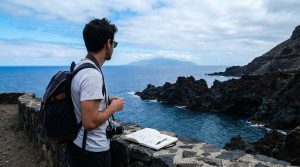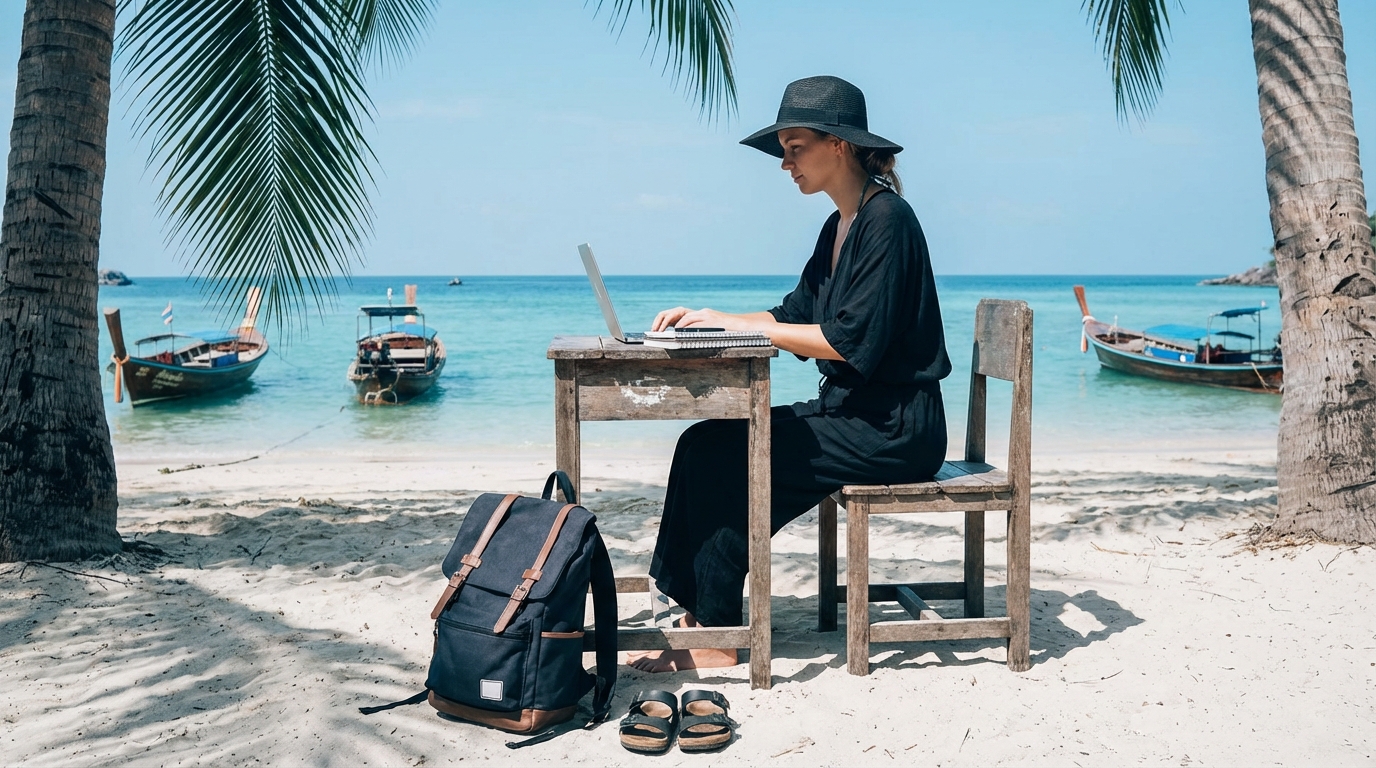
I caught myself the other night staring at a Zoom lecture while my friend sent photos from a coworking space in Chiang Mai. Same degree, same lecture, completely different life setting. It felt like someone had hacked university and turned it into “study mode + adventure DLC.”
So, can you actually be a digital nomad student, studying from a beach in Thailand, without wrecking your grades or your sanity? Short answer: yes, it is possible, but only if you treat it like a serious project, not a holiday with Canvas notifications turned on in the background. You need systems for time zones, Wi‑Fi, money, focus, and mental health, or the beach will quietly win against your degree every single time.
What “Digital Nomad Student” Really Means
I used to think “digital nomad” meant sitting with a laptop in a hammock, doing a few emails, then snorkeling all afternoon. Then I tried watching a 2‑hour recorded lecture over weak hostel Wi‑Fi and learned humility.
When you add “student” to “digital nomad,” the rules shift. You are not just working; you are also:
- Sticking to a semester calendar that does not care where you are
- Dealing with exams at fixed times
- Submitting assignments through learning platforms that may crash
- Needing quiet, deep focus blocks for reading, writing, and projects
Being a digital nomad student is less “vacation with a laptop” and more “portable campus you carry in your backpack.”
Thailand fits this surprisingly well. The country has:
| Factor | Why it helps students |
|---|---|
| Cost of living | Cheaper rent, food, and transport than most Western cities, so student budgets stretch further. |
| Internet | Good mobile data and solid Wi‑Fi in cities and tourist hubs, if you choose the right places. |
| Time zone | Works for many European and Asian universities, trickier but possible for US schedules. |
| Community | Many remote workers and travelers, so you are not the only one opening a laptop at 8 a.m. |
But it is not automatic. You cannot just land in Phuket, open Notion, and expect your GPA to float. You need a plan.
Step 1: Check If Your Degree Can Survive Thailand
Before you start checking flight prices, you need a reality check: does your program actually support studying from abroad?
Courses That Work Well From a Thai Beach
Some study paths are far more portable than others. If most of your work happens on a laptop, you are in a far better position than lab‑based majors. Courses that tend to work:
- Computer science, software engineering, data science
- Design, media, communications
- Business, marketing, management
- Social sciences with online readings and essays
- Online degrees that were built for remote delivery from day one
Courses that struggle:
- Medicine, nursing, dentistry
- Engineering with mandatory labs or equipment
- Fine arts that need studio time
- Any program with strict attendance rules or participation marks tied to physical presence
The more your degree needs your physical body in a room, the less realistic it is to move that body to a Thai island for months.
Ask yourself bluntly:
- Can all my lectures be watched online, live or recorded?
- Are exams online, or do I need to sit them on campus?
- Are there group projects that assume face‑to‑face work?
- Is attendance graded, or is the focus on assignments and exams?
If you cannot answer these clearly, ask your course coordinators. Say you are considering studying from another country for part of the semester and you want to understand practical constraints. If their answers are vague, that is already a signal.
Time Zone Reality Check
Thailand is GMT+7. That interacts very differently with various universities:
| Your uni region | Typical effect in Thailand |
|---|---|
| Europe (e.g., Germany, UK) | Lectures in the late afternoon or evening Thailand time. Quite workable. |
| Australia / New Zealand | Classes might land in early afternoon or evening. Also quite comfortable. |
| North America (US, Canada) | Lectures can be late night or very early morning. Exams might be at 1-4 a.m. |
Ask your lecturers:
- Will sessions be recorded?
- Is live attendance mandatory?
- If exams are fixed time, do they allow alternate sittings for time zones?
If your final exam is at 9 a.m. New York time, that is 9 p.m. in Thailand. That is manageable. If it is at 6 p.m. on the West Coast of the US, that is 8 a.m. the next day in Thailand, which may be even better.
The point: you need to map your academic timetable onto Thailand time before you book anything.
Step 2: Visas, Rules, and Staying Legal
This is the unglamorous part that can ruin everything if you ignore it. You are not just a tourist. You are also a student, and possibly doing freelance work on the side. That has legal implications.
Visa Options Many Students Consider
I am not an immigration lawyer, and you should double‑check current rules, but broad patterns look like this:
- Tourist visas / visa exemption: Good for short stays (often 30-60 days, sometimes extendable). You are “on holiday” while quietly studying online.
- Education visa (ED visa): Tied to studying at a Thai language school or other local course. Some students combine this with their online degree from home.
- Long‑term visas (e.g., long‑stay, special programs): Targeted at remote workers or retirees, often with income or savings requirements that students may not meet.
Questions to research carefully:
- How long can you legally stay without leaving and re‑entering?
- Are visa runs realistic for your budget and timetable?
- Are you allowed to “work” for foreign clients from Thailand on that visa?
If your entire plan depends on “I will just do visa runs every couple of months,” pause and cost that out, both in money and in lost study time.
This is also where it helps to admit that some Instagram digital nomad content quietly skips the legal parts. Do not build your life strategy on a reel.
Step 3: Building the Portable Campus Setup
Once you are legally allowed to be there, the next problem is boring but crucial: your gear and your setup. This is what will decide whether the beach is a nice reward after studying, or an everyday distraction that slowly wrecks your schedule.
Your Hardware: Minimal but Serious
You do not need a fancy setup, but you do need a stable one. Think like someone setting up a field lab.
- Laptop: With at least 8-16 GB RAM, solid battery, and a charger that matches Thai voltage (it usually does). Install all uni tools before you leave.
- External storage: A small SSD or large USB stick for offline backups of readings and assignments.
- Noise‑canceling headphones: Hostels and cafes are loud. You will thank yourself during exams.
- Lightweight laptop stand and external keyboard: Optional, but your back and neck will appreciate it during long essay sessions.
- Portable hotspot: You might rely on your phone with a Thai SIM, but a separate device can add redundancy.
Internet Strategy: Do Not Wing It
Your classes and deadlines will not wait for the hostel Wi‑Fi to stop glitching. In practice, students who manage this well follow a layered approach:
- Primary: Stay in accommodations that advertise stable Wi‑Fi and have reviews mentioning “good for work” or “fast Internet.”
- Backup: Local SIM with a high‑data plan on a reliable provider (people often mention AIS, DTAC, TrueMove). Use tethering when Wi‑Fi fails.
- Emergency: Know two nearby cafes or coworking spaces with solid Wi‑Fi where you can run if your connection dies before an exam.
Before high‑stakes events (live exams, graded presentations):
- Run a speed test the day before and an hour before
- Charge all devices fully
- Download any necessary files locally
If your plan for exam day is “I hope the hostel Wi‑Fi is OK,” you do not have a plan.
Software and Files: Redundancy Over Confidence
Think of your digital life in three layers:
| Layer | Purpose | Tools |
|---|---|---|
| Cloud | Access from anywhere, easy sharing | Google Drive, OneDrive, Dropbox, university storage |
| Local | Offline work during outages | Downloads of lectures, PDFs, offline docs |
| Backup | Disaster recovery | External SSD, periodic backups |
Set a weekly ritual: plug in your external drive and dump your “Current Semester” folder onto it. You only need one accidental laptop drop in a cafe to understand why this matters.
Step 4: Designing Your Day Around Time Zones
The romantic version is “study for a bit, swim, eat mango sticky rice, repeat.” In reality, you need a clear structure, or days will blur into a mix of procrastination and slight guilt.
Picking a Base, Not Constantly Moving
This is where many digital nomad students go wrong: they travel like tourists. New city every 4 days, constantly packing, new Wi‑Fi networks, new beds. That lifestyle collides hard with a reading list and recurring lectures.
For a serious semester, pick:
- 1 main base city (e.g., Chiang Mai, Bangkok, Phuket, Koh Lanta)
- Longer stays (3-8 weeks) in each spot, instead of rapid hopping
- Short weekend trips out of that base, rather than full location moves every few days
Think “I live here for a while” rather than “I am passing through.” Your grades need that stability.
Building a Sample Daily Schedule
Let us say your university is in Germany. You are in Chiang Mai. Your 2 p.m. lecture in Germany is at 8 p.m. in Thailand.
A reasonable weekday might look like:
- 07:30-08:00: Wake up, quick breakfast
- 08:00-11:00: Deep work (readings, essays, coding) at a quiet cafe or coworking space
- 11:00-13:00: Lunch, short walk, errands
- 13:00-16:00: Second study block (problem sets, group work calls)
- 16:00-18:30: Free time (gym, exploring, social stuff)
- 18:30-20:00: Lectures streamed live in Thai evening
- 20:00-22:00: Light work (review notes, plan tomorrow)
If your university is on the US East Coast, you might flip the logic:
- Morning: Free time, errands, beach
- Afternoon: Individual work
- Late evening / night: Live classes
This is where you need to be honest with yourself: can you really focus on a 10 p.m. lecture after a long day in the heat and sun? Some people can, many cannot. Try simulating that schedule for a week at home before you commit.
Step 5: Money, Budget, and Side Gigs
The good news: your money often stretches further in Thailand. The bad news: it is very easy to underestimate how quickly “cheap” adds up once you start island hopping and cafe‑hopping.
Rough Cost Ranges
Actual costs depend on lifestyle choices. You can live like a very frugal student or like a mid‑range tourist. Here is a simplified view:
| Category | Frugal (per month) | Comfortable (per month) |
|---|---|---|
| Rent (room/apartment) | $200-$350 | $400-$700 |
| Food | $150-$250 (mostly street food) | $250-$400 (mix of cafes, restaurants) |
| Transport | $40-$80 | $80-$150 |
| Coworking / cafes | $0-$80 | $80-$200 |
| Fun / travel / extras | $100-$200 | $200-$400+ |
Add travel insurance and an emergency fund on top.
Doing Remote Work While Studying
This is where it gets intellectually interesting but also risky. You might be tempted to fund your stay by freelancing or working remotely. That can work, but it splits your attention three ways:
- Your degree
- Your job or freelance clients
- Your new environment, which wants your time and energy
Ask yourself: if work ramps up for a week and midterms hit at the same time, what gives? The beach will not negotiate with your deadlines. Your clients might not either.
If you still decide to work:
- Keep work hours small and consistent (e.g., 10-15 hours per week)
- Prefer project‑based work with clear deadlines rather than constant live availability
- Be open with clients about time zones from the start
- Do not rely on this income for survival in month one; things often start slowly
If your degree is your long‑term asset, treat everything else as secondary. It is very easy to sacrifice the long term for a few extra short‑term dollars.
Step 6: Avoiding the Classic Study‑Abroad‑But‑Remote Traps
The digital nomad student life has its own set of common failure modes. Seeing them early helps you dodge them.
Trap 1: Constant Travel Mode
New places every week feel fun, but your brain quietly pays a tax:
- Packing and unpacking all the time
- Finding new grocery spots
- Testing new Wi‑Fi and SIM coverage
- Adjusting to new noises, beds, roommates
Each of these steals focus from your reading list. If your weekly life looks like an endless travel vlog, your semester might start to sag.
Trap 2: Social FOMO
Hostels and nomad hubs are full of people who are, frankly, less tied to a semester schedule than you are. You will hear:
- “We are going diving tomorrow, just skip your class, it is recorded, right?”
- “We are doing a trip to another island, come on, you can study in the van.”
You can say “yes” sometimes. If you never say “no,” your exam prep will silently evaporate. The hardest part is not discipline in the abstract; it is saying, “I have class,” when everyone else has beer.
Trap 3: Underestimating Admin Overhead
Remote life adds admin tasks that campus life hides from you:
- Visa renewals and immigration visits
- Finding doctors or pharmacies if you get sick
- Unexpected accommodation moves if a place turns out bad
- Fixing banking issues, cards that get blocked, or lost devices
All of those take time. Build slack into your schedule so one “small problem” does not wipe out revision week.
Step 7: Finding Study‑Friendly Spots in Thailand
Not every pretty beach equals a good study base. Some are better as short breaks between study blocks.
Popular Hubs For Study + Work
Students and remote workers often gather in a few key places:
- Chiang Mai: Many cafes and coworking spaces, cheaper rent, calm vibe, strong student presence from local universities.
- Bangkok: Fast Internet, every service you can think of, but more intense and distracting.
- Phuket (certain areas): Combination of beach and service infrastructure, with some coworking options.
- Koh Lanta / Koh Phangan (certain parts): More relaxed islands where longer‑term remote workers settle.
Remote beaches on tiny islands look amazing on Instagram, but can have weak Internet, power cuts, and noise that ruins your exam day. Better to treat them as short post‑exam rewards.
How To Audit a Place For Study Before Booking Long Term
When I research a new base, I look at:
- Reviews for Wi‑Fi: Specific phrases like “worked remotely here,” not just “Wi‑Fi available.”
- Desk and chair: A bed and a tiny coffee table are not study‑friendly for weeks.
- Noise levels: Bars next door, construction sites, and constant motorbikes will slowly drain your focus.
- Distance to cafes / coworking spaces: You want at least 2-3 realistic options within walking or short scooter distance.
Treat your accommodation like an off‑campus library that you also sleep in. If you would not want to revise there for finals, think twice.
Step 8: Mental Health, Loneliness, and Identity
There is a weird psychological layer to being a digital nomad student. You are not exactly a tourist, not exactly a local, and not exactly a standard campus student. That in‑between identity can feel confusing.
The Hidden Loneliness Problem
From the outside, it might look like constant social activity. In reality:
- Hostel friendships tend to be short‑lived
- People leave every few days
- You are often studying while others are out exploring
That can create a quiet disconnect. You might start asking: “Why am I here if I am just staring at a laptop anyway?”
To counter that:
- Keep 1-2 strong connections with people back home through weekly calls
- Join recurring things in your base city (language classes, climbing gym, meetup groups)
- Connect with other remote students or workers, not just pure tourists
Setting Boundaries With Yourself
A digital nomad student life amplifies your habits. If you are already prone to procrastination, the new environment will not fix it; it might make it worse. Instead of pretending you will turn into a new person on arrival, design external supports:
- Fixed study hours each weekday, blocked in your calendar
- Accountability with a friend on the same path (send each other daily goals)
- Physical cues, like a specific cafe that is “study only,” not Netflix time
The beach is not your enemy. The lack of boundaries is.
Step 9: Talking To Your University About It
This part is very unromantic, but it can save you from bureaucratic pain later. You do not have to share every detail, but for key elements, transparency helps.
What To Clarify With Your Program
These are boring questions, but they matter:
- Are there any classes with mandatory in‑person attendance this semester?
- How are exams conducted? Online, on campus, or via proctoring centers?
- Are there any labs, placements, or workshops that require physical presence?
- Can group project meetings happen online without penalty?
If a lecturer says, “We strongly prefer in‑person attendance,” ask: “Is it graded, or just recommended?” This is where you should not just nod and disappear to Thailand. Get clear answers in writing if you can.
Staying in the Loop While Far Away
One risk of remote studying: you miss all the corridor conversations where people hear about small changes. To reduce that risk:
- Check your student email daily
- Stay active in class group chats
- Attend at least some office hours, even if just to keep a human connection with lecturers
You want your lecturers to remember you as “that student who always shows up to online sessions,” not “the ghost who vanished to somewhere warm.”
Step 10: Who Is This Actually Good For?
The digital nomad student setup is not a universal upgrade. There are personalities and situations where it fits well, and others where it becomes a complicated way to avoid problems at home.
Signs It Might Fit You
It tends to work better if:
- You already manage your own time reasonably well
- You enjoy solo work and do not rely on physical library presence
- Your program is flexible and mostly online already
- You are comfortable with uncertainty and small daily changes
- You have at least a basic financial cushion
Signs You Might Want To Wait
You might be forcing it if:
- You are struggling academically already and hoping a new place “resets” you
- You need strong in‑person academic support, like tutoring centers or labs
- You get very stressed by logistics and ambiguity
- Your budget is extremely tight, with no buffer for surprises
In that case, a shorter trip during a break or a summer term abroad at a partner university might be a smarter first step than a full nomad semester.
Turning The Beach Into a Feature, Not a Distraction
The picture that finally made sense for me was this: the beach, the temples, the food, the new people, all of that is not the core of the plan. The core is your study system. The environment is the reward and the background.
If you flip that, and make your degree the background to your travel life, the cracks will appear. The deadlines do not care about sunsets.
The digital nomad student life works when you treat studying like the non‑negotiable anchor, and let Thailand fill the space around it.
So yes, you can absolutely watch a lecture from a balcony in Chiang Mai, submit an assignment from a cafe in Bangkok, and review flashcards on a ferry to an island. The question is not “Is it possible?” The real question is: “Are you willing to build the structure that makes the beach feel earned, not stolen, from your future self?”